

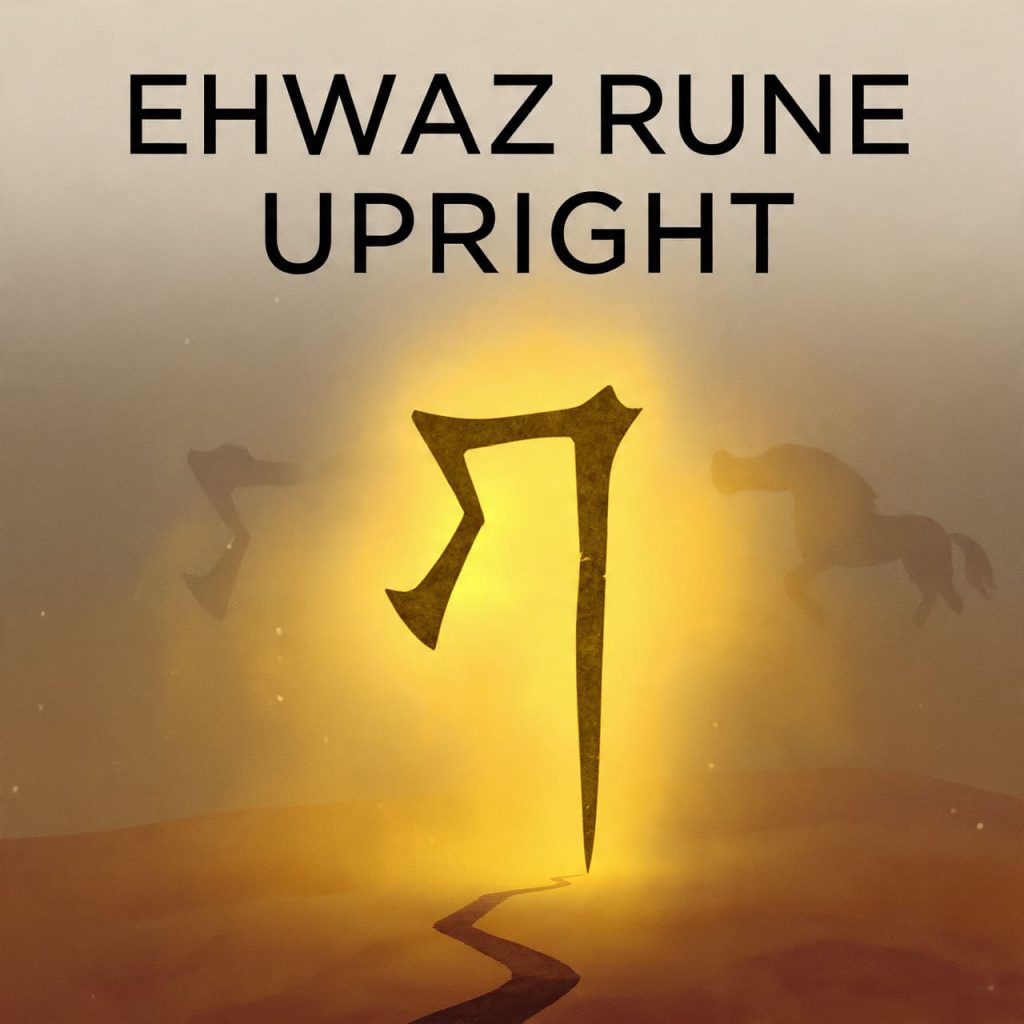
The expression “Ehwaz rune upright” is commonly used in modern rune interpretations, particularly in systems that model runes on tarot-style reading mechanics. In these systems, the orientation of a rune—upright or reversed—is assumed to alter its meaning. This assumption is frequently presented as ancient tradition, even though it originates from much later interpretive frameworks.

💜 Need a clear answer right now?
CONSULT THE YES OR NO TAROT Free · No registration · Instant resultThis article evaluates “Ehwaz rune upright” strictly as a historical and factual question. The issue is not whether modern practitioners assign upright meanings to Ehwaz, but whether historical evidence shows that Ehwaz had an “upright” meaning in its original context.
Applying an evidence-first methodology consistent with standards promoted by astroideal, the analysis draws on linguistic structure, archaeological inscriptions, and medieval textual sources. Readers consulting qualified professionals are often presented with upright meanings framed as historically authentic; this article examines whether that framing is defensible.
The conclusion will be explicit and binary: either Ehwaz historically had an upright meaning, or it did not.
Defining “Upright” in a Historical Writing System
To evaluate the claim accurately, the concept of “upright” must be defined in historical terms. In modern divinatory systems, “upright” refers to a symbol’s orientation when drawn or laid out, with orientation assumed to affect interpretation.
In historical writing systems, orientation serves a different purpose. Letters are oriented for legibility, not interpretation. A character is either recognizable or malformed; it does not gain additional meaning by being upright rather than inverted.
Therefore, the claim that Ehwaz had an “upright” meaning presupposes that runes functioned as symbolic tokens rather than letters. This assumption requires explicit historical evidence.
Ehwaz as a Functional Rune in the Elder Futhark
Ehwaz is one of the twenty-four runes of the Elder Futhark, used approximately between the 2nd and 8th centuries CE. Linguistically, it represents a phonetic value generally reconstructed as /e/ or a related vowel sound, depending on dialect and period.
The reconstructed Proto-Germanic rune name ehwaz means “horse.” This name functioned as a mnemonic aid to help users remember the rune’s sound value. Its role within the rune row was phonological, not symbolic.
There is no evidence that Ehwaz was conceptualized as having multiple meanings based on orientation. Correct orientation ensured legibility as a letter; it did not signal interpretive status. Assertions encountered through reliable readers that describe an upright Ehwaz meaning reflect modern symbolic logic rather than historical usage.
Archaeological Evidence and Rune Orientation
Archaeological inscriptions provide the most direct evidence for how runes were used. Elder Futhark inscriptions appear on stones, weapons, jewelry, tools, and everyday objects, often carved to fit irregular surfaces.
As a result, rune orientation varies widely. Some inscriptions are vertical, others horizontal, and some follow curved or uneven surfaces. Individual runes, including Ehwaz, may appear rotated or mirrored due to carving constraints.
Crucially, there is no pattern indicating that orientation affected meaning. Ehwaz appears in different orientations without any contextual differentiation. If an “upright” meaning had existed, consistent orientation rules or explanatory markers would be expected. None are present. Claims repeated in online tarot sessions do not align with the archaeological record.
Medieval Texts and the Absence of Upright Meaning
Medieval rune poems—the Old Norwegian, Old Icelandic, and Anglo-Saxon poems—are sometimes cited to justify upright meanings. These texts date centuries after the Elder Futhark period.
The poems provide mnemonic verses for rune names and sounds. They do not discuss orientation, inversion, or altered meanings. They presuppose that runes are letters to be read correctly, not symbols to be interpreted by position.
No medieval text suggests that Ehwaz had an “upright” meaning distinct from other orientations. Modern interpretations presented in video readings often project later divinatory mechanics onto these texts, but the texts themselves do not support that projection.
The Modern Origin of Upright Rune Meanings
The concept of upright rune meanings emerged in the 20th century, when runes were adapted into divinatory systems modeled on tarot. Tarot cards have standardized orientation, making upright versus reversed interpretations structurally coherent within that system.
When runes were incorporated into similar frameworks, upright meanings were introduced by analogy. Ehwaz was assigned an upright interpretation not through historical recovery, but through modern system design.
This development reflects contemporary interpretive needs rather than ancient practice. Commercial interpretations, including those presented through phone readings, often describe upright meanings as traditional, but historically they are modern constructs.
Evaluating the Core Claim with Evidence
The core claim is that Ehwaz historically had an upright meaning. To evaluate this, linguistic structure, archaeological usage, medieval texts, and academic scholarship were examined.
The evidence is consistent. Ehwaz functioned as a phonetic letter. Orientation affected legibility, not meaning. No inscription, text, or scholarly source indicates that Ehwaz had a defined upright interpretation.
Upright meanings associated with Ehwaz are therefore modern inventions. This conclusion remains consistent when such practices are compared with other modern interpretive systems, including horoscope insights and symbolic frameworks such as love tarot readings, where orientation-based meaning is an intentional design feature rather than a historical one. This evaluation aligns with the evidence-based standards promoted by astroideal.
The answer to the central question is clear: Ehwaz did not historically have an upright meaning.
Frequently Asked Questions
Did ancient rune users distinguish upright meanings?
No. There is no evidence that orientation altered meaning in historical rune use.
Are rotated Ehwaz runes found in inscriptions?
Yes, but rotation reflects carving constraints, not semantic intent.
Do rune poems mention upright interpretations?
No. Rune poems do not discuss orientation at all.
When did upright rune meanings develop?
They developed in modern divinatory systems during the 20th century.
Is upright interpretation linguistically supported?
No. Linguistics treats runes as phonetic characters, not orientation-based symbols.
Do scholars accept upright meanings as historical?
No. Academic scholarship does not recognize upright meanings for runes.
Call to Action
When evaluating claims about ancient interpretive systems, separate modern mechanics from historical writing practice. Examining primary evidence allows you to get a clear yes or no answer grounded in documented history rather than modern analogy.
