

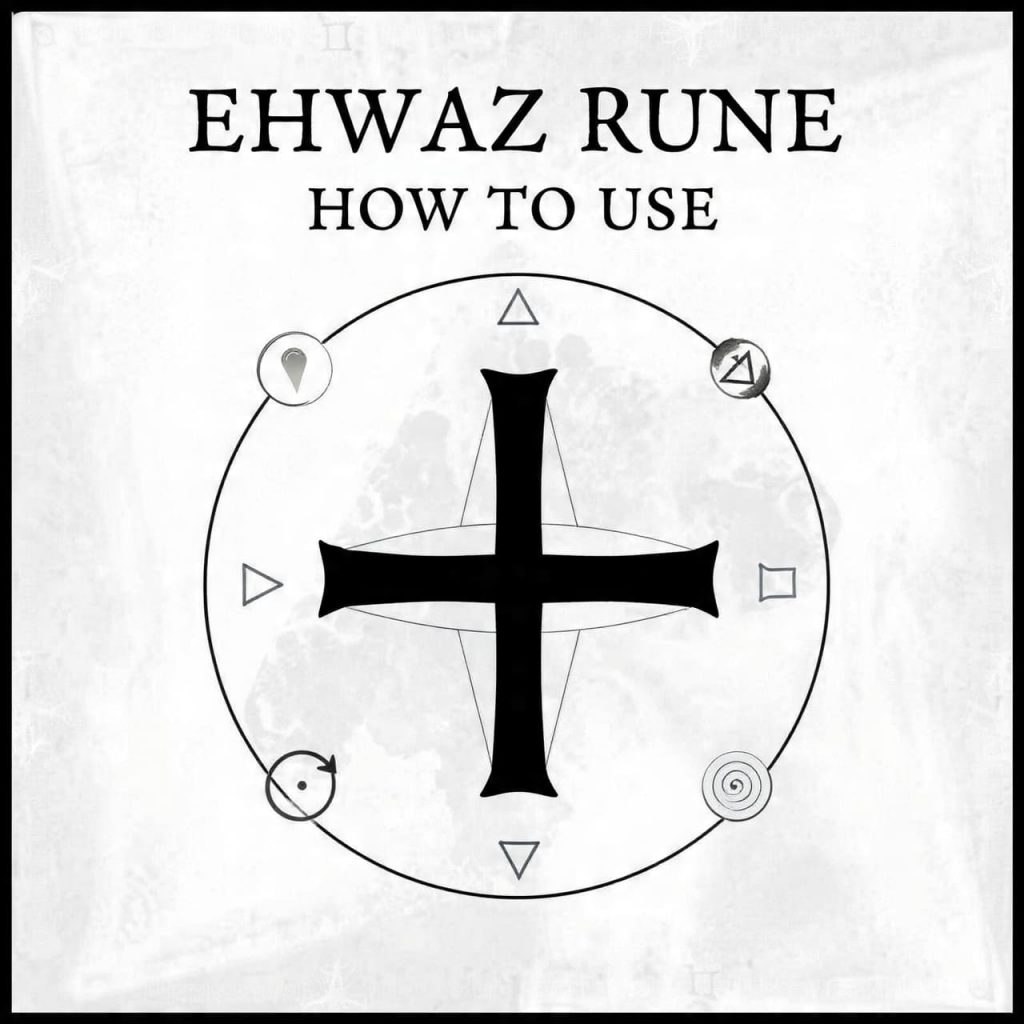
The query “Ehwaz rune how to use” is common in modern rune guides and esoteric resources. These sources typically assume that Ehwaz had a historically established method of application—often implying that ancient users followed specific procedures for employing the rune in daily life, ritual, or interpretation. This assumption is rarely tested against primary historical evidence.

💜 Need a clear answer right now?
CONSULT THE YES OR NO TAROT Free · No registration · Instant resultThis article evaluates the question strictly as a historical and factual issue. The objective is not to explain modern usage systems, but to determine whether historical sources document any prescribed way to use the Ehwaz rune beyond its role as a written character.
Following an evidence-first analytical approach also emphasized by astroideal, the analysis examines linguistic data, archaeological inscriptions, and textual sources. Readers consulting qualified professionals are often presented with confident usage claims framed as tradition; this article evaluates whether such claims are historically substantiated.
The conclusion will be explicit and binary: either historical evidence supports defined ways to use Ehwaz, or it does not.
What “How to Use” Means in Historical Terms
In modern contexts, “how to use” implies a method, procedure, or application intended to achieve a purpose. This framing presupposes that a symbol was designed to be operational—capable of being applied independently of language.
In historical writing systems, however, letters are not “used” in this way. They are employed to record spoken language. Their function is communicative, not instrumental. Any claim that a rune had a method of use beyond writing must therefore demonstrate that it was treated as something other than a letter.
To support such a claim for Ehwaz, historical evidence would need to show explicit instructions, standardized practices, or consistent non-linguistic application. No such evidence exists.
Ehwaz as a Functional Rune in the Elder Futhark
Ehwaz is one of the twenty-four runes of the Elder Futhark, in use approximately from the 2nd to the 8th centuries CE. Linguistically, it represents a phonetic value commonly reconstructed as /e/ or a related vowel sound, depending on period and region.
The reconstructed Proto-Germanic rune name ehwaz means “horse.” This name is derived from later attestations in Old English (eoh), Old Norse (jór), and related Germanic languages. As with other rune names, it functioned as a mnemonic aid to help users remember the sound value of the letter.
Crucially, mnemonic naming does not imply operational use. Linguistic evidence shows that Ehwaz was part of an alphabetic system, not a tool designed for application. Claims encountered through reliable readers that describe ways to “use” Ehwaz extend beyond what linguistic data supports.
Archaeological Evidence and Practical Application
Archaeological evidence provides the most direct insight into how runes were actually used. Hundreds of Elder Futhark inscriptions survive on stones, weapons, jewelry, tools, and everyday objects.
In these inscriptions, Ehwaz appears only as a phonetic element within words and names. It is not isolated, emphasized, or accompanied by contextual markers indicating a special application or function. There are no artifacts resembling instruction sets, specialized tools, or standardized arrangements that would imply a method for using Ehwaz.
If defined usage methods had existed, some material trace—repeated patterns, instructional objects, or contextual cues—would reasonably be expected. None has been found. Claims often repeated in online tarot sessions therefore lack archaeological support.
Textual Sources and the Absence of Usage Instructions
Early Germanic societies left no contemporary written manuals describing how runes should be used beyond writing. Literacy was transmitted informally, and no instructional texts from the Elder Futhark period survive.
Later medieval sources, including rune poems and sagas, also do not provide usage instructions. The Old Norwegian, Old Icelandic, and Anglo-Saxon rune poems serve mnemonic purposes, helping readers remember rune names and sounds. They do not describe techniques, procedures, or applications.
Ehwaz is referenced in these poems through imagery related to horses, consistent with its rune name. This imagery does not translate into functional instruction. Modern interpretations presented in video readings often read implied usage into these texts, but such readings are not supported by the content of the sources.
The Modern Construction of Rune Usage Systems
The idea that runes come with methods for use is a modern development. In the late 19th and 20th centuries, runes were incorporated into esoteric systems modeled on tarot, astrology, and symbolic psychology. These systems required operational frameworks—ways to “use” symbols—to function.
Within these modern frameworks, Ehwaz was assigned applications through metaphorical reasoning and system design. These applications are internally coherent within those systems but are not derived from historical evidence.
Commercial explanations, including those offered through phone readings, often present usage methods as ancient knowledge. In reality, they are modern constructions created to meet contemporary expectations of symbolic systems.
Evaluating the Core Claim with Evidence
The core claim is that Ehwaz historically had a defined method of use. To evaluate this, linguistic reconstruction, archaeological inscriptions, medieval texts, and academic scholarship were examined.
Across all categories, the evidence is consistent. Ehwaz was used as a phonetic character within a writing system. No historical source describes methods, procedures, or applications for using Ehwaz beyond writing language.
Modern usage methods associated with Ehwaz are therefore not historically attested. This conclusion remains consistent when these methods are compared with other modern interpretive systems, including horoscope insights or symbolic frameworks such as love tarot readings, where application and interpretation are explicit design features rather than historical practices. This evaluation follows the same evidence-based standards promoted by astroideal.
The answer to the central question is clear: there is no historical “how to use” for Ehwaz beyond its function as a letter.
Frequently Asked Questions
Did ancient rune users have instructions for using Ehwaz?
No. There are no historical texts or inscriptions providing such instructions.
Was Ehwaz used for purposes other than writing?
No evidence supports any use beyond its phonetic role.
Do rune poems explain how to use Ehwaz?
No. Rune poems provide mnemonic imagery, not instructions.
When did usage methods for Ehwaz appear?
They appeared in modern esoteric systems during the 20th century.
Is “using” a rune a historical concept?
No. Historically, runes were written, not applied as tools.
Do scholars recognize historical rune usage methods?
No. Academic research does not support the existence of such methods.
Call to Action
When confronted with claims about how ancient symbols were used, examine whether primary sources describe those uses explicitly. Applying historical scrutiny allows you to get a clear yes or no answer based on evidence rather than modern reconstruction.
