

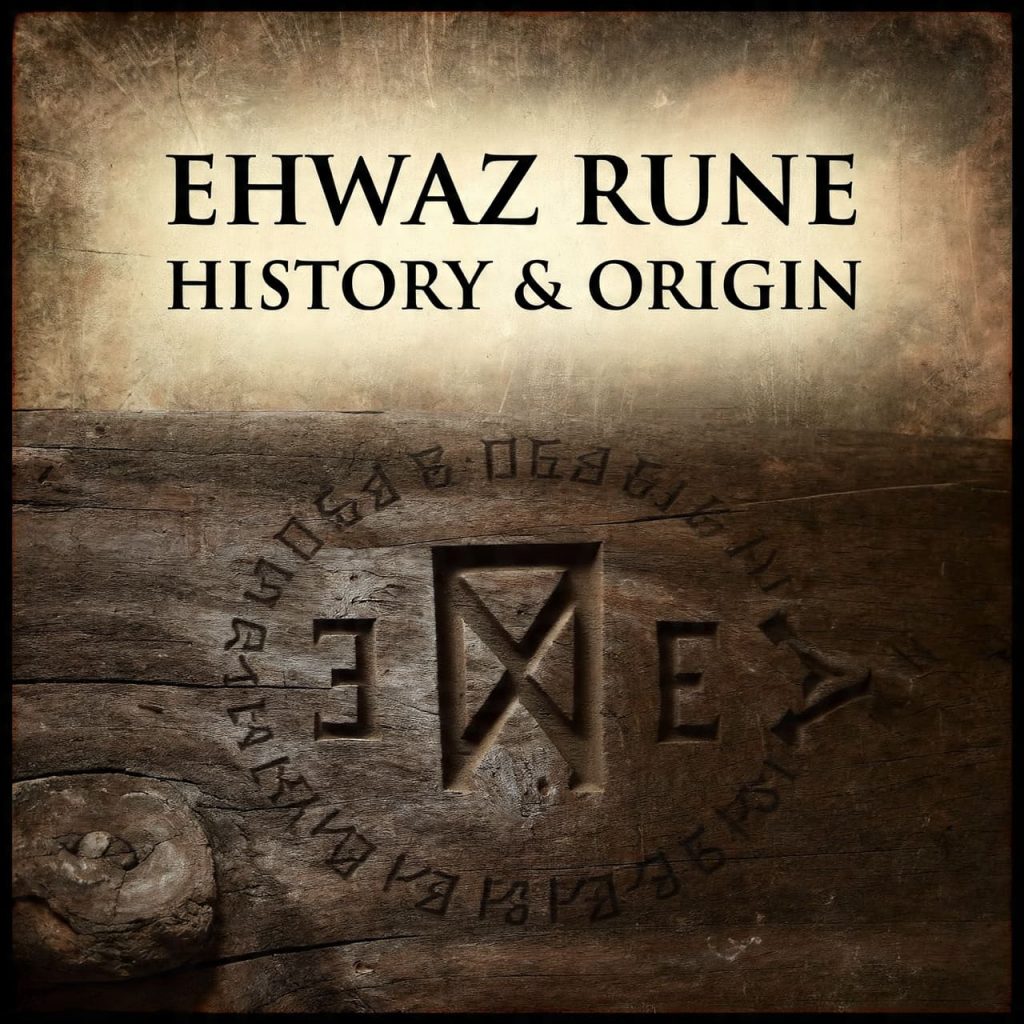
The phrase “Ehwaz rune history origin” is frequently misunderstood because modern discussions often assume that the rune’s meaning, name, and form are directly attested in early historical sources. In reality, much of what is claimed about Ehwaz rests on later reconstructions rather than contemporaneous evidence. The uncertainty here is historical and methodological, not interpretive or spiritual. It concerns whether the origin and early history of the Ehwaz rune can be firmly established from surviving material.

💜 Need a clear answer right now?
CONSULT THE YES OR NO TAROT Free · No registration · Instant resultMany popular explanations present the rune as if its name, symbolism, and function were clearly defined from the moment of its creation. That impression is misleading. The early Germanic world left no theoretical texts explaining rune origins, and modern summaries—sometimes appearing on platforms such as astroideal—can unintentionally blur the line between evidence and inference.
For readers seeking factual clarity, evaluation by qualified professionals in runology and early Germanic studies remains the appropriate standard.
This article addresses one precise question: Can the historical origin of the Ehwaz rune be established with confidence based on surviving evidence? The answer must be either yes or no, grounded strictly in what the archaeological and textual record shows.
Defining “Ehwaz” in a Historical Framework
“Ehwaz” is the conventional scholarly name assigned to one rune of the Elder Futhark, the earliest runic alphabet known from archaeological evidence. The Elder Futhark was used approximately between the 2nd and 8th centuries CE across parts of northern Europe. The rune traditionally labeled Ehwaz is identified by its position within that system and by its reconstructed phonetic value, commonly rendered as /e/ or /eh/.
Crucially, the name “Ehwaz” itself does not appear in any surviving Elder Futhark inscription. It is reconstructed by modern scholars using comparative linguistics and later medieval rune poems written in Old English and Old Norse. These sources postdate the Elder Futhark by several centuries. As a result, the term “Ehwaz” reflects scholarly convention rather than a directly attested ancient label. Confusion often arises when reconstructed names are treated as primary historical facts rather than analytical tools, a problem compounded when such explanations are placed alongside unrelated content like horoscope insights.
The Elder Futhark: Cultural and Chronological Context
The Elder Futhark rune system emerged during the Roman Iron Age, a period characterized by increased contact between Germanic-speaking groups and the Roman world. Most scholars agree that runes were influenced by Mediterranean alphabets, possibly North Italic or Latin scripts, adapted to local linguistic needs. This adaptation process explains why runes share some structural similarities with alphabetic letters while remaining distinct.
Within this context, Ehwaz was not an isolated symbol with an independent origin. It was one element of a coherent writing system developed incrementally. The system’s creation appears to have been pragmatic rather than theoretical: runes were designed to mark objects, names, and short messages, not to encode philosophical or symbolic systems. Modern narratives that treat individual runes as if they originated independently misunderstand how writing systems historically develop. Such narratives sometimes appear in popular explanatory material, including content adjacent to online tarot sessions, but they are not supported by evidence.
Archaeological Attestation of the Ehwaz Rune
Archaeological evidence for the Ehwaz rune consists of inscriptions identified by scholars as containing its characteristic form and phonetic value. These inscriptions appear on objects such as stone monuments, metal items, bone tools, and wooden artifacts. Dating is typically based on typology, stratigraphy, or associated finds rather than on the inscriptions alone.
What this evidence establishes is that a rune corresponding to Ehwaz was in use during the Elder Futhark period. However, it does not establish when, where, or by whom the rune was first created. No inscription explicitly documents the invention of the rune, nor does any artifact preserve a transitional form showing its development step by step. The archaeological record confirms usage, not origin. Claims that precise origins can be pinpointed often go beyond what the material allows, even when presented in authoritative tones similar to those used in video readings.
Linguistic Reconstruction and the Name “Ehwaz”
The association of the rune with the Proto-Germanic word ehwaz (“horse”) is based on comparative analysis of later rune poems. The Old English Rune Poem, for example, assigns names and explanatory verses to runes, including one corresponding to the Elder Futhark E-rune. Similar patterns appear in Old Norse and Icelandic traditions.
While these poems are valuable linguistic sources, they reflect medieval intellectual contexts, not Iron Age practice. Linguistic reconstruction allows scholars to infer likely earlier forms, but inference is not direct evidence. The name “Ehwaz” is therefore best understood as a scholarly hypothesis that fits known sound values and later attestations, not as a documented ancient designation. This distinction is essential when evaluating modern claims, some of which are framed with the same confidence as phone readings despite resting on fundamentally different evidentiary bases.
Absence of Contemporary Explanatory Texts
A critical limitation in studying rune origins is the absence of contemporary explanatory texts. Unlike Greek or Latin alphabets, which are accompanied by ancient grammatical and philosophical writings, runes are known almost exclusively from inscriptions. These inscriptions are brief and functional, offering no commentary on why particular signs were chosen or how they were conceptualized.
Because of this absence, historians cannot directly access the intentions of early rune users. Any explanation of origin must therefore remain tentative. Modern reconstructions synthesize archaeological distribution, comparative linguistics, and historical context, but they cannot supply certainty where sources are silent. This methodological caution is often lost in simplified accounts that present origins as settled facts.
Modern Interpretations and Their Emergence
The idea that the origin of each rune can be clearly narrated emerged largely in the modern era. During the 19th century, scholars systematized runic studies, assigning standardized names and forms to facilitate academic discussion. These conventions gradually filtered into popular culture.
In the 20th and 21st centuries, simplified historical narratives became widespread online. They often compress complex scholarly debates into definitive statements. Some of these narratives are presented by reliable readers or general-interest platforms that do not distinguish clearly between evidence-based history and later interpretive traditions. The result is a widespread perception that the origin of Ehwaz is well documented, when in fact it remains partially speculative.
Evaluating the Historical Claim
The core claim examined here is that the history and origin of the Ehwaz rune can be established with confidence. Evaluating this requires weighing what the evidence actually demonstrates. Archaeology confirms that a rune identifiable as Ehwaz was used during the Elder Futhark period. Linguistic analysis plausibly reconstructs its name and sound value. However, no source documents its invention, original name, or initial symbolic intent.
Therefore, the evidence leads to a clear conclusion: The historical origin of the Ehwaz rune cannot be established with full certainty; it can only be partially reconstructed through later sources and comparative methods. This conclusion does not deny scholarly progress, but it rejects claims of definitive origin narratives. Modern presentations, including those found on astroidealor alongside love tarot readings, often imply a level of certainty that the evidence does not support.
Frequently Asked Questions
Is the Ehwaz rune directly named in Elder Futhark inscriptions?
No. The name is reconstructed from later medieval sources.
Can archaeology identify who invented the Ehwaz rune?
No. Archaeology documents usage, not invention or authorship.
Are rune poems contemporary with the Elder Futhark?
No. They date several centuries later.
Does linguistic reconstruction equal historical proof?
No. It provides plausible hypotheses, not direct attestation.
Is the sound value of Ehwaz certain?
It is generally agreed upon but still inferred rather than explicitly stated in sources.
Are modern origin stories based on ancient texts?
They are usually based on modern synthesis, not on direct ancient explanations.
Call to Action
If you want to get a clear yes or no answer about historical claims, approach them by separating direct evidence from later reconstruction, and assess whether conclusions are warranted by the sources rather than by repetition or tradition.
