

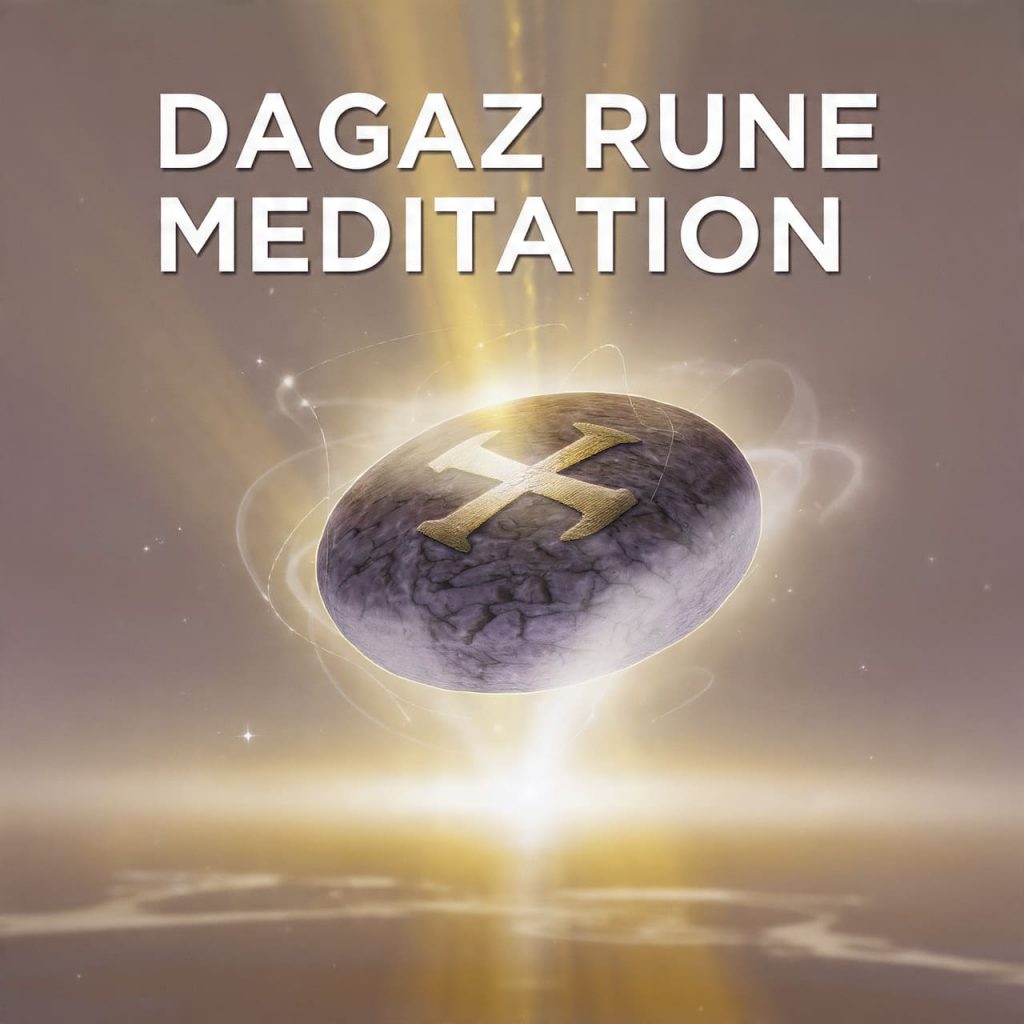
The phrase “Dagaz rune meditation” is widely used in modern rune discourse, where the rune is presented as an object of focus for contemplative or meditative practice. This framing is common but historically uncertain. The misunderstanding arises from projecting contemporary meditation concepts onto an ancient writing system without establishing whether such practices were associated with runes in their original context.

💜 Need a clear answer right now?
CONSULT THE YES OR NO TAROT Free · No registration · Instant resultModern explanatory material, including interpretive content found on astroideal, often discusses runes alongside mindfulness or meditative frameworks and may refer readers to qualified professionals for interpretive guidance. These associations, however, do not constitute historical evidence. The precise question addressed here is factual and limited: did the Dagaz rune historically play any role in meditation or contemplative practice?
Defining “Meditation” in Historical Terms
A disciplined historical analysis requires precise definitions. In modern usage, “meditation” refers to structured contemplative practices aimed at mental focus, awareness, or spiritual insight. These practices are typically documented through textual instruction, ritual description, or philosophical discourse.
Early Germanic societies did not leave records describing meditation as a formal practice comparable to later religious or philosophical traditions. For Dagaz to be historically associated with meditation, contemporaneous sources would need to document deliberate contemplative use of runes. In the absence of such documentation, claims rest on later interpretive traditions or the assumptions of reliable readers rather than evidence from the rune’s historical period.
Dagaz in the Elder Futhark Writing System
Dagaz is the twenty-third rune of the Elder Futhark, the earliest known runic alphabet, used approximately between the second and eighth centuries CE. Its established function was phonetic, representing the /d/ sound. The name Dagaz is a modern scholarly reconstruction derived from a Proto-Germanic word meaning “day.”
The Elder Futhark functioned as a writing system. Runes appear on stones, tools, weapons, and personal objects, primarily recording names, ownership, or memorials. There is no evidence that runes were used as focal points for mental or contemplative exercises. This contrasts with modern interpretive systems, such as those presented in online tarot sessions, which are explicitly structured for reflective or introspective use.
Archaeological Evidence and Contemplative Contexts
Archaeological evidence provides the most reliable insight into rune usage. Dagaz appears in a limited number of inscriptions, always as part of written sequences. None of these inscriptions include contextual indicators of contemplative or meditative use, such as instructional text, ritual settings, or repeated symbolic isolation.
Where early Germanic ritual activity is archaeologically visible—through offerings, cult sites, or burial practices—it is clearly contextualized. Dagaz does not appear in such contexts. Archaeologists do not interpret its presence as meditative or contemplative. Claims that it served such a role reflect modern reinterpretation rather than material evidence, similar in structure to interpretive assumptions seen in video readings.
Textual Sources and the Absence of Meditative Instruction
Textual evidence related to runes comes primarily from medieval manuscripts and rune poems composed centuries after the Elder Futhark period. The Anglo-Saxon rune poem includes a stanza for dæg, linguistically related to Dagaz, describing “day” in poetic terms.
This description does not include instructions for contemplation, visualization, or mental focus. Scandinavian rune poems omit Dagaz entirely. No medieval text documents runes being used as meditative aids. Treating poetic language as evidence of meditation reflects interpretive logic closer to phone readings than to historical methodology.
What the Historical Record Does Not Support
A systematic review of inscriptions, manuscripts, and comparative linguistic data shows no evidence that Dagaz was used in meditation. Scholars have documented contexts where runes appear in ritual or commemorative settings, but none demonstrate contemplative practice centered on runes.
This absence is meaningful. Early Germanic spirituality and ritual life are documented through mythological texts, archaeological sites, and iconography. The lack of meditative framing for Dagaz indicates that it did not function as a contemplative tool. Assigning meditative meaning to it reflects modern categorization habits similar to those seen in horoscope insights rather than evidence-based historical analysis.
The Emergence of Rune Meditation in Modern Culture
The association between runes and meditation emerges in modern literature, particularly during the twentieth century. As runes were incorporated into New Age spirituality and self-development practices, they were reinterpreted as tools for focus, reflection, or mindfulness.
This development is historically traceable and culturally specific. It does not coincide with new archaeological discoveries or reinterpretations of primary sources. Instead, it reflects a broader trend of adapting ancient scripts into contemporary contemplative frameworks. These adaptations are often presented alongside systems comparable to love tarot readings and discussed using analytical approaches described on astroideal.
Evaluating the Core Claim with Evidence
The claim under examination is precise: did the Dagaz rune historically function as an object or focus for meditation?
Based on archaeological evidence, medieval textual sources, and linguistic analysis, the answer is no. Dagaz functioned as a phonetic character within a writing system. There is no historical evidence linking it to meditation, contemplation, or structured mental practice.
Modern rune meditation practices are later cultural overlays. While they may be meaningful within contemporary belief systems, they do not reflect historical usage. From an evidence-first perspective, Dagaz had no role in meditation during its historical period of use.
Frequently Asked Questions
Was meditation practiced using runes in ancient times?
There is no evidence supporting this.
Do any inscriptions show Dagaz used contemplatively?
No known inscriptions do.
Are meditative uses mentioned in rune poems?
No. Rune poems do not describe contemplative practices.
When did rune meditation practices appear?
They appeared in modern spiritual literature.
Do scholars support meditative interpretations of Dagaz?
No. Academic consensus does not support this claim.
Is Dagaz unique in this reinterpretation?
No. Many runes have acquired modern contemplative uses.
Call to Action
To evaluate claims about rune meditation accurately, consult primary inscriptions and dated texts directly to get a clear yes or no answer, distinguishing documented historical usage from later interpretive systems or one question tarot–style frameworks.
