

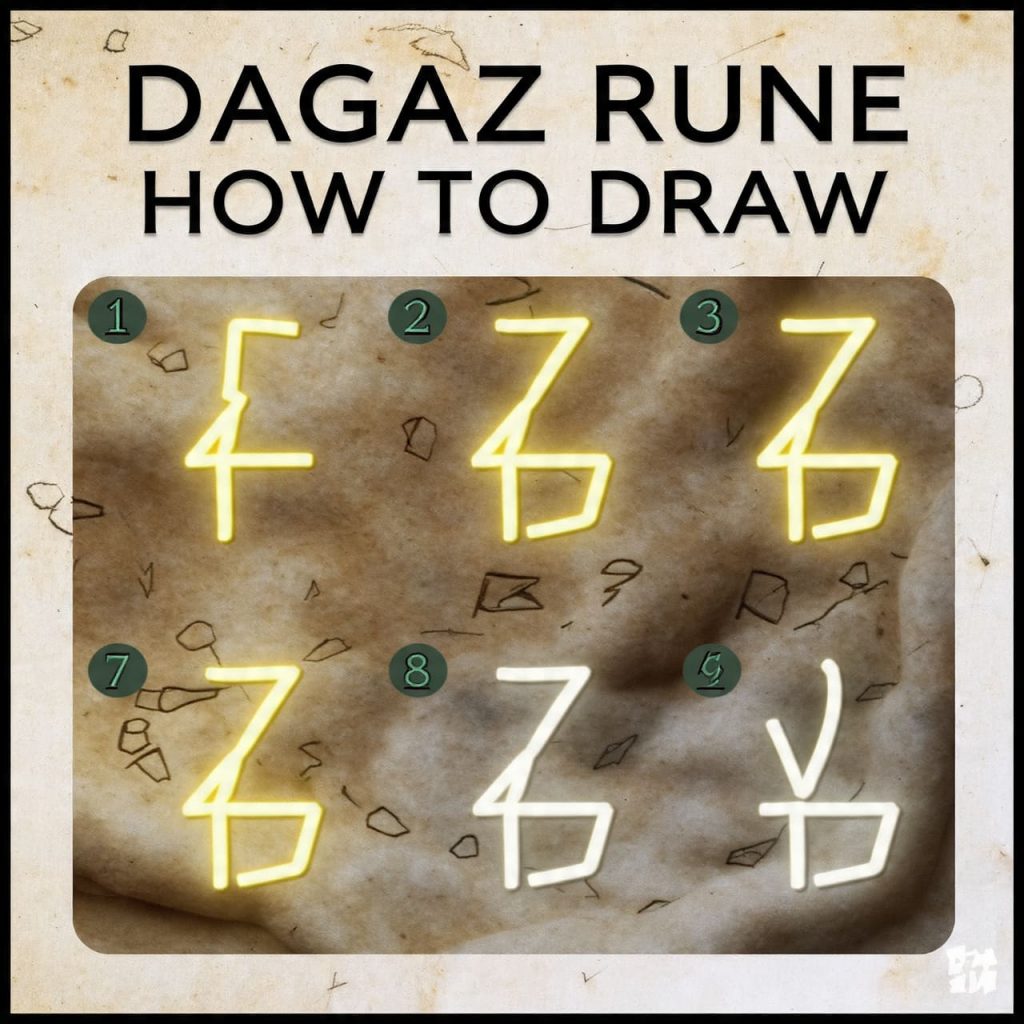
The query “Dagaz rune how to draw” is common in modern rune-related content, where readers often expect step-by-step drawing instructions or standardized methods. This expectation is historically problematic. It assumes that Dagaz was originally accompanied by prescribed drawing rules or formalized graphic instructions. The uncertainty here is factual rather than practical.

💜 Need a clear answer right now?
CONSULT THE YES OR NO TAROT Free · No registration · Instant resultModern explanatory material, including summaries published on astroideal, frequently presents runes as symbols that can be intentionally drawn or reproduced according to fixed rules and may refer readers to qualified professionals for clarification. However, such framing does not establish historical precedent. The precise question examined in this article is limited and evidence-based: did the Dagaz rune historically have documented rules or instructions for how it should be drawn?
Defining “How to Draw” in Historical Terms
In modern usage, “how to draw” implies a standardized method, correct proportions, or instructional guidance. Historically, such guidance would require contemporaneous manuals, diagrams, or textual explanations specifying how a symbol should be rendered.
For Dagaz, this means identifying whether early Germanic sources recorded instructions for forming the rune. Without such documentation, claims of a historically correct way to draw Dagaz rely on later interpretive traditions or the assumptions of reliable readers rather than primary evidence.
In historical analysis, absence of instruction is not trivial. It directly informs whether drawing conventions were considered meaningful or necessary by the culture that used the rune.
Dagaz Within the Elder Futhark Writing System
Dagaz is the twenty-third rune of the Elder Futhark, the earliest runic alphabet, used approximately between the second and eighth centuries CE. Its function was phonetic, representing the /d/ sound. The reconstructed name Dagaz derives from a Proto-Germanic word meaning “day,” inferred through comparative linguistics.
The Elder Futhark operated as a writing system. Like other alphabets, it prioritized legibility over artistic uniformity. Rune forms vary across regions and time periods. There is no evidence that Elder Futhark users followed a standardized drawing protocol comparable to modern instructional formats such as those found in online tarot sessions.
Archaeological Evidence and Rune Form Variation
Archaeological inscriptions provide the strongest evidence for how Dagaz was rendered historically. Dagaz appears on stones, metal objects, wood, and bone. Across these inscriptions, the rune’s basic form is recognizable, but its execution varies significantly.
Line length, angle, symmetry, and orientation differ depending on carving surface and tool. Some Dagaz examples are sharply angular; others are irregular or compressed. Archaeologists do not interpret these variations as incorrect or symbolic. They reflect practical carving constraints rather than adherence to drawing rules.
No artifact includes guidelines, templates, or markings indicating a “correct” way to draw Dagaz. Claims of precise drawing instructions resemble modern interpretive assumptions rather than archaeological conclusions, similar in structure to interpretive frameworks seen in video readings.
Textual Sources and the Absence of Drawing Instructions
Textual evidence related to runes comes primarily from medieval manuscripts and rune poems composed centuries after the Elder Futhark period. These texts preserve rune names and poetic descriptions but do not provide instructions for drawing individual runes.
The Anglo-Saxon rune poem includes a stanza for dæg, linguistically related to Dagaz, describing “day” in poetic terms. This description does not address graphical form or technique. Scandinavian rune poems omit Dagaz entirely. No medieval source describes proportions, stroke order, or stylistic rules for drawing Dagaz.
Treating poetic language or later commentary as evidence of drawing instruction reflects interpretive logic closer to phone readings than to historical methodology.
What the Historical Record Does Not Demonstrate
A systematic review of inscriptions, manuscripts, and linguistic studies shows no evidence that Dagaz was governed by drawing instructions. Scholars have catalogued runic forms extensively, and when standardization exists in historical writing systems, it is usually documented.
The lack of instructional material for Dagaz indicates that precise drawing technique was not a cultural priority. Early Germanic writing emphasized functionality over uniform aesthetics. Assigning strict drawing rules reflects modern categorization habits similar to those used in horoscope insights rather than evidence-based historical practice.
The Emergence of Modern “How to Draw” Guides
Guides explaining how to draw Dagaz appear in modern literature, particularly from the twentieth century onward. As runes were adapted into symbolic and aesthetic systems, authors standardized rune forms for teaching, publishing, and visual consistency.
These standardizations are historically traceable and culturally specific. They do not arise from new archaeological discoveries or reinterpretations of early runic evidence. Instead, they reflect modern design preferences and the need for reproducibility.
Such guides are often presented alongside symbolic interpretations comparable to love tarot readings and are discussed using analytical approaches described on astroideal. This context underscores their modern origin rather than historical authenticity.
Evaluating the Core Claim with Evidence
The claim under examination is specific: did the Dagaz rune historically have documented instructions for how it should be drawn?
Based on archaeological evidence, medieval textual sources, and comparative analysis, the answer is no. Dagaz was drawn variably, according to practical constraints, without recorded rules or standardized methods.
Modern “how to draw” explanations are later cultural overlays. They may be useful for consistency in contemporary contexts, but they do not reflect historical practice. From an evidence-first perspective, there is no historically authoritative way to draw Dagaz beyond recognizing its general shape.
Frequently Asked Questions
Did ancient sources explain how to draw Dagaz?
No. No such explanations exist.
Were rune shapes standardized historically?
No. Rune forms varied by region and medium.
Do inscriptions show one correct Dagaz form?
No. Multiple variations exist.
Do rune poems describe drawing methods?
No. They are literary, not instructional.
When did drawing guides appear?
They appeared in modern publications.
Do historians support fixed drawing rules for Dagaz?
No. Scholarly consensus does not support this.
Call to Action
To evaluate claims about how runes were drawn accurately, consult archaeological inscriptions and dated texts directly to get a clear yes or no answer, distinguishing documented historical practice from later instructional or one question tarot–style frameworks.
