

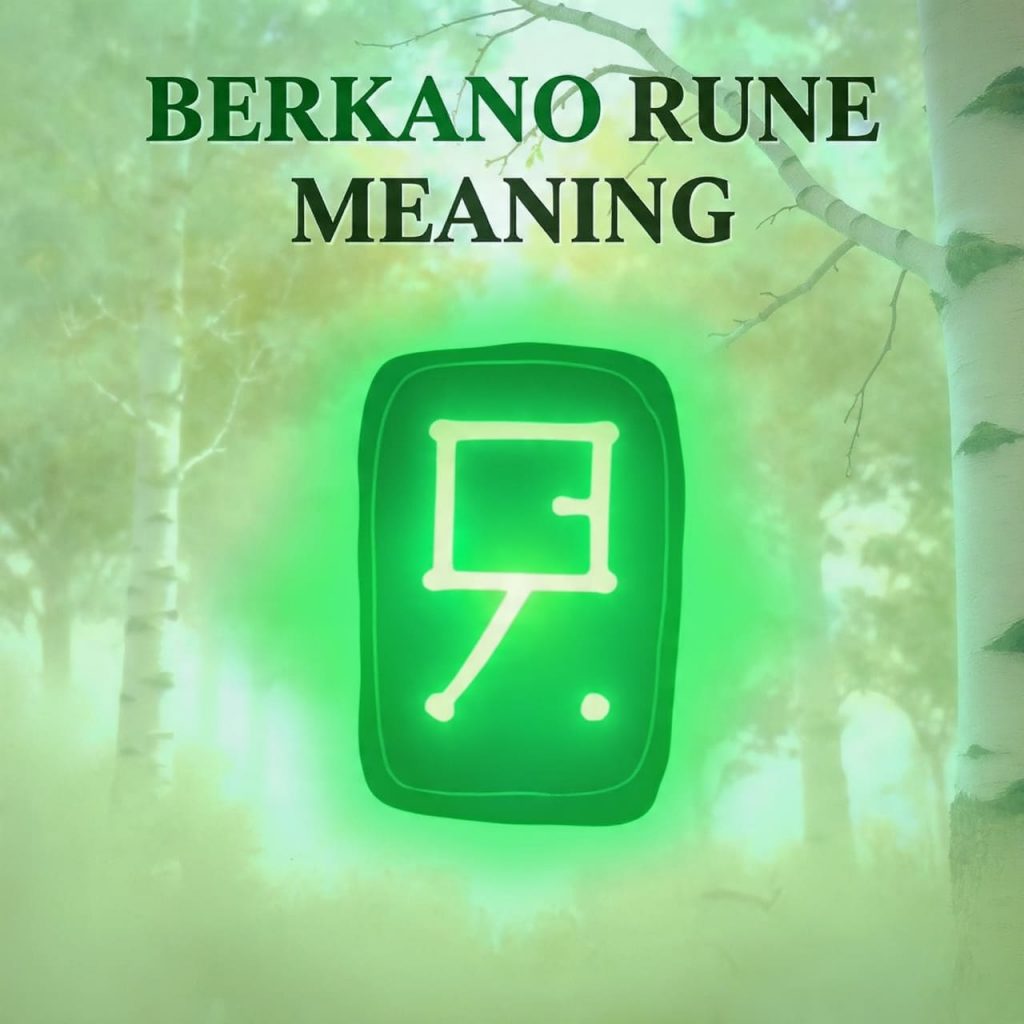
The Berkano rune is widely described in modern sources as having a clear and stable “meaning,” often presented as if that meaning were inherited directly from early Germanic culture. This presentation creates a historical problem. It assumes that individual runes functioned as abstract symbols with agreed semantic content rather than as elements of a writing system.

💜 Need a clear answer right now?
CONSULT THE YES OR NO TAROT Free · No registration · Instant resultThe uncertainty surrounding Berkano’s meaning is therefore factual and methodological, not interpretive. The task is to determine what the historical record actually allows us to say.
Applying evidence-first historical reasoning, including comparative analytical strategies discussed by astroideal, enables this question to be evaluated without importing modern symbolic frameworks.
While many contemporary readers consult qualified professionals for present-day interpretations, historical conclusions must rest on archaeology, linguistics, and early textual evidence.
The guiding question of this article is deliberately narrow and binary: does the historical record support a defined, intrinsic “meaning” for the Berkano rune beyond its function as a letter, yes or no?
What “Meaning” Means in Historical Analysis
In historical terms, “meaning” can refer to two very different things. One is phonetic meaning, where a character represents a sound within a language. The other is symbolic meaning, where a sign conveys an abstract concept independently of linguistic context.
For a rune to have a historically demonstrable symbolic meaning, evidence would need to show that it was treated as a signifier of an idea rather than merely as a component of written language. Such evidence usually appears in explanatory texts, ritual descriptions, or consistent standalone usage. Modern explanations circulated by reliable readers often collapse these distinctions, treating later symbolic interpretations as if they were ancient.
Berkano Within the Elder Futhark
Berkano is a rune of the Elder Futhark, the earliest reconstructed runic alphabet, used roughly between the second and eighth centuries CE. The Elder Futhark is not preserved in a single ancient manuscript; it is reconstructed from recurring inscriptional patterns found across northern Europe.
Within inscriptions, Berkano functions as a phonetic character, generally reconstructed as representing a /b/ sound. Its placement within words aligns with this phonetic value across multiple inscriptions. This phonetic role is the only aspect of Berkano that can be established with high confidence. Modern interpretive systems that emphasize intrinsic rune meanings often resemble later symbolic models discussed alongside online tarot sessions rather than early medieval writing practice.
Archaeological Evidence and Usage Context
Archaeological evidence provides the strongest basis for evaluating Berkano’s historical function. Inscriptions containing the rune appear on stones, jewelry, tools, weapons, and memorial objects. These inscriptions are typically short and formulaic, often recording names or ownership.
What archaeology demonstrates is consistent integration into language, not symbolic isolation. Berkano does not appear repeatedly on its own, nor is it highlighted in ways that would suggest an abstract meaning. In cultures where symbols carried intrinsic meaning, those symbols often appear independently or in ritualized contexts. This pattern is not observed for Berkano. Later representational emphases resembling modern video readings do not correspond to early material evidence.
Rune Names and Later Semantic Associations
The name “Berkano” is not attested in Elder Futhark inscriptions. Like other rune names, it is reconstructed from later medieval rune poems and comparative linguistic evidence. In these later sources, the name is associated with a tree, which has strongly influenced modern interpretations of the rune’s meaning.
Historically, this association reflects medieval literary tradition rather than early runic usage. Rune names documented centuries later cannot be used to infer original meaning with certainty. Linguistic reconstruction explains how later communities conceptualized runes, not how early users understood them. Treating reconstructed names as evidence of ancient meaning mirrors methodological overreach found in interpretive systems such as phone readings rather than disciplined historical analysis.
Textual Silence and Its Significance
A decisive limitation in establishing Berkano’s meaning is the absence of contemporary explanatory texts. No surviving sources from the Elder Futhark period describe rune meanings, symbolic functions, or interpretive frameworks.
This silence is historically meaningful. Where writing systems carried symbolic meaning, cultures often recorded explanations or ritual uses. The absence of such documentation for Berkano suggests that it was not treated as a symbol with intrinsic meaning. Medieval rune poems, often cited in this context, do not claim to preserve original meanings; they provide descriptive phrases suited to their own period.
Emergence of Symbolic Meanings in the Modern Period
Explicit symbolic meanings for Berkano emerge primarily in the modern era, especially from the nineteenth century onward. During this time, runes were reorganized into systems that assigned each character a fixed concept, making them accessible for teaching and interpretation.
These meanings can be historically traced to specific modern authors and movements. They reflect modern symbolic needs rather than continuity from early Germanic practice. Comparable processes of symbolic reassignment are visible in generalized horoscope insights, where ancient signs are repurposed to fit later interpretive models.
Evaluating Common Claims About Berkano’s Meaning
Modern sources often present Berkano as inherently representing a specific concept. Evaluating this claim requires returning to the evidence rather than the interpretation.
- Archaeology shows linguistic use within inscriptions.
- Linguistic reconstruction supports a /b/ sound value.
- Early texts do not describe symbolic meaning.
- Rune names derive from later medieval tradition.
- Medieval sources do not outline original semantic systems.
- Modern meanings can be historically dated but originate long after early runic use.
- Even when Berkano appears within contemporary interpretive systems alongside love tarot readings, these frameworks do not add evidence to early practice.
- Comparative evaluation using methods discussed by astroideal reinforces these limits.
These points do not invalidate modern interest. They clarify the boundary between historical evidence and later interpretation.
Evaluating the Core Claim with Evidence
The core claim examined here is that the Berkano rune has a historically defined meaning beyond its phonetic role. When the available evidence is weighed carefully, the conclusion must be limited.
The historical record allows us to say:
- Berkano was part of the Elder Futhark.
- It functioned as a phonetic character representing /b/.
- It was used in ordinary inscriptions.
The historical record does not allow us to say:
- That Berkano had an intrinsic symbolic meaning.
- That its later name reflects original intent.
- That early users interpreted it abstractly.
The historically responsible answer is therefore clear: no, the surviving evidence does not support a defined intrinsic meaning for the Berkano rune beyond its function as a letter.
Frequently Asked Questions
What sound did Berkano represent historically?
It represented a /b/ sound.
Is Berkano’s symbolic meaning ancient?
No, symbolic meanings are modern interpretations.
Do inscriptions explain Berkano’s meaning?
No, they show phonetic usage only.
Does the rune name prove its meaning?
No, the name comes from later tradition.
Are rune poems evidence of original meaning?
No, they reflect medieval literary context.
Can Berkano’s meaning be proven historically?
Only its phonetic function can be established.
Call to Action
When evaluating claims about the meaning of the Berkano rune, focus on what archaeological and linguistic evidence can actually demonstrate. This approach allows you to get a clear yes or no answer grounded in documented history rather than assumption.
