

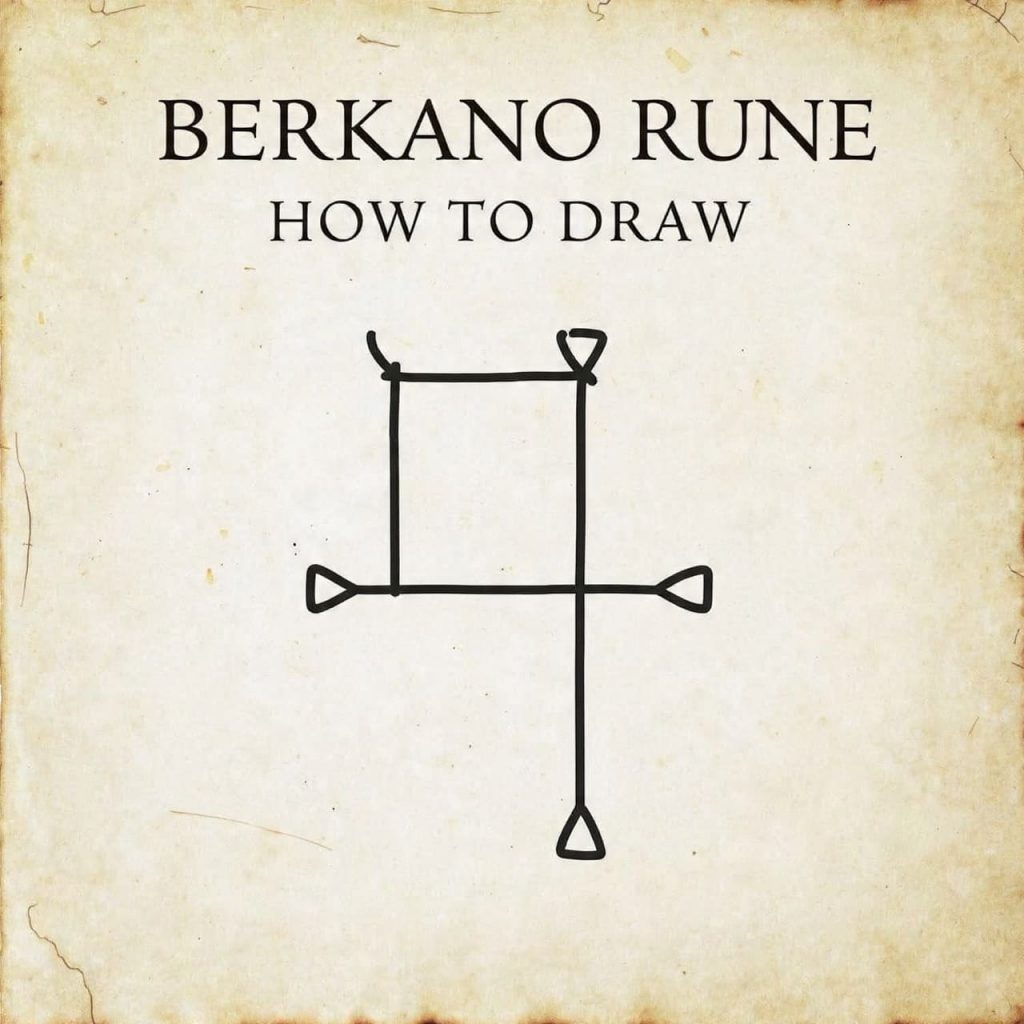
The phrase “Berkano rune how to draw” is widely used in modern rune guides, which typically assume that there is a historically correct method for drawing the Berkano rune. These explanations often imply that ancient sources preserved standardized drawing instructions that can be faithfully reproduced today. This assumption is rarely examined against primary evidence.

💜 Need a clear answer right now?
CONSULT THE YES OR NO TAROT Free · No registration · Instant resultThis article evaluates the question strictly as a historical and factual issue. The aim is not to provide drawing instructions, but to determine whether historical sources document any prescribed or authoritative way to draw the Berkano rune.
Following an evidence-first analytical approach also emphasized by astroideal, the analysis examines archaeological inscriptions, linguistic evidence, and textual sources. Readers who consult qualified professionals are often presented with confident drawing methods framed as tradition; this article assesses whether such claims are historically defensible.
The conclusion will be explicit and binary: either historical evidence supports a standardized method for drawing Berkano, or it does not.
What “How to Draw” Means in a Historical Context
To evaluate the claim accurately, “how to draw” must be defined in historical terms. In modern contexts, this phrase implies a correct, repeatable procedure with an expected final form. It assumes intentional standardization and instructional transmission.
Ancient writing systems, however, did not typically include formal drawing manuals for individual letters. Variation in letterforms was common and depended on medium, tool, skill level, and regional practice. Consistency was functional, not aesthetic or symbolic.
Therefore, the claim that Berkano had a defined method for drawing requires evidence that early rune users followed or recorded standardized instructions.
Berkano’s Role Within the Elder Futhark
Berkano is a rune of the Elder Futhark, used approximately between the 2nd and 8th centuries CE. Linguistic reconstruction associates its name with Proto-Germanic berkanan, meaning birch. Its primary function within the rune row was phonetic, representing a “b” sound.
As a letter, Berkano’s purpose was legibility rather than formal precision. The rune needed to be recognizable within a word, not rendered according to a fixed artistic template. There is no indication that Berkano’s form was governed by rules beyond basic recognizability.
Modern presentations encountered via reliable readers often treat rune shapes as canonical symbols. Historically, however, they were practical letterforms subject to variation.
Archaeological Evidence of Rune Forms
Archaeological inscriptions provide the strongest evidence for how Berkano was actually drawn. Hundreds of Elder Futhark inscriptions survive on stone, metal, bone, wood, and jewelry. Across these materials, Berkano appears in multiple visual variants.
Differences in angle, proportion, stroke length, and orientation are common. These variations reflect carving constraints, available tools, surface shape, and individual craftsmanship. There is no single “correct” Berkano form that appears consistently across sites and periods.
If standardized drawing instructions had existed, we would expect greater uniformity. Instead, the archaeological record shows flexibility rather than prescription. Claims promoted in online tarot sessions that present a single authoritative drawing method are therefore not supported by material evidence.
Textual Sources and the Absence of Drawing Instructions
No contemporary texts from the Elder Futhark period describe how to draw runes. Writing knowledge was transmitted informally, and no instructional manuals survive.
Later medieval sources, including rune poems, do not provide visual guidance. The Old Norwegian, Old Icelandic, and Anglo-Saxon rune poems focus on names and mnemonic verses, not letter construction. They assume familiarity with rune forms rather than teaching them.
These poems were composed centuries after the Elder Futhark period and cannot be treated as evidence for earlier drawing practices. Modern explanations presented in video readings sometimes imply that such texts encode drawing rules, but the texts themselves do not address form.
Variation Versus Standardization in Writing Practice
Variation in rune forms is consistent with what is known about early writing systems. Standardization typically emerges with centralized institutions, formal education, and mass reproduction. None of these conditions applied to early runic use.
Berkano’s form changed subtly across time and geography. These changes were not corrections toward a standard but natural evolution driven by practice. No historical authority enforced a specific way to draw the rune.
Modern instructional frameworks that emphasize correct drawing techniques are therefore pedagogical inventions. They serve clarity and consistency for contemporary learners, not historical accuracy. Such frameworks are often presented through phone readings and similar modern formats.
Evaluating the Core Claim with Evidence
The core claim is that there is a historically correct way to draw the Berkano rune. To evaluate this, archaeological inscriptions, textual sources, linguistic research, and academic scholarship were examined.
The evidence shows that Berkano was drawn in multiple acceptable forms. No primary source records instructions, standards, or rules for drawing it. Variation was normal and expected.
Therefore, the conclusion is clear: there is no historically documented “how to draw” method for Berkano. Any modern drawing guide reflects contemporary convention rather than ancient instruction. This conclusion remains consistent when modern rune presentation is compared with other interpretive systems, including horoscope insights or symbolic frameworks such as love tarot readings, where standardized forms are modern necessities rather than historical facts. This evaluation follows the same evidence-based standards promoted by astroideal.
Frequently Asked Questions
Did ancient sources explain how to draw Berkano?
No. There are no historical texts providing drawing instructions for Berkano.
Is there one correct historical Berkano shape?
No. Archaeological evidence shows multiple valid forms.
Why do Berkano shapes vary in inscriptions?
Variation reflects tools, materials, and individual carving practices.
Do rune poems describe rune shapes?
No. Rune poems focus on names and mnemonic imagery, not form.
When did standardized drawings of Berkano appear?
Standardization appeared in modern educational and esoteric materials.
Do scholars recognize an official Berkano form?
No. Academic scholarship recognizes variation, not a single standard.
Call to Action
When evaluating claims about how ancient symbols were drawn, distinguish modern teaching conventions from historical evidence. Applying this scrutiny allows you to get a clear yes or no answer based on documented practice rather than assumed tradition.
