

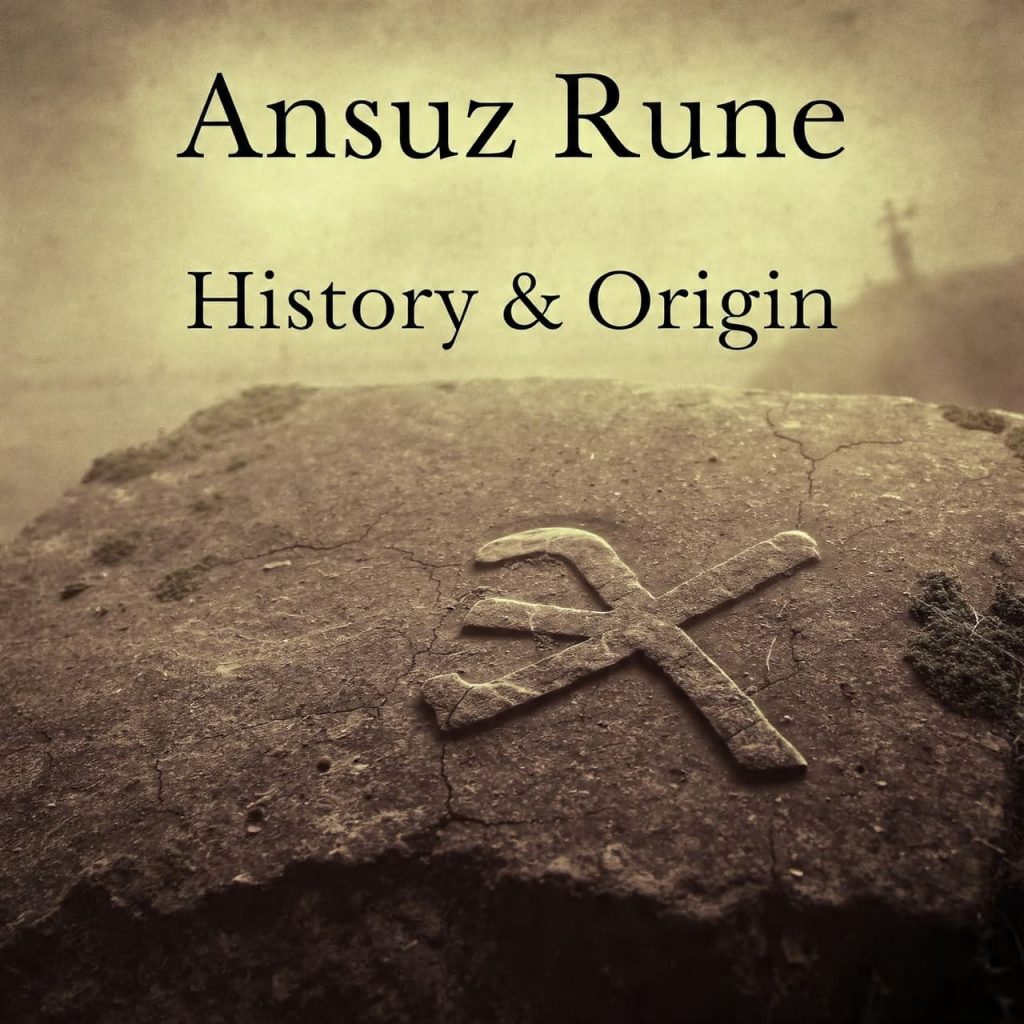
The history and origin of the Ansuz rune are often misunderstood because modern explanations blend linguistic evidence, mythology, and later symbolic systems into a single narrative. This creates confusion about what is historically supported versus what was added centuries later. For readers seeking accurate understanding, the challenge is separating documented origin from interpretive tradition.

💜 Need a clear answer right now?
CONSULT THE YES OR NO TAROT Free · No registration · Instant resultAnsuz did not begin as a spiritual symbol or abstract concept. It originated as a functional element within an early writing system. Understanding its history requires a disciplined approach that prioritizes archaeology, linguistics, and comparative evidence. Clarity-focused research frameworks—such as those discussed at astroideal—help maintain this separation and prevent historical distortion.
Ansuz in the Elder Futhark (2nd–8th Century CE)
Ansuz is one of the 24 runes of the Elder Futhark, the earliest known runic alphabet. Archaeological evidence places the Elder Futhark in use from approximately the late 2nd century to the early 8th century CE across Germanic-speaking regions of Northern Europe.
Within this system, Ansuz holds the fourth position, following Fehu, Uruz, and Thurisaz. Its placement is consistent across the earliest complete inscriptions, indicating early standardization.
Historically, Ansuz functioned as a phonetic character, representing the open vowel sound a. At this stage, it was not symbolic in the modern sense. It was part of a writing system designed for names, ownership marks, memorial inscriptions, and short texts.
This phonetic role is central to understanding its origin and is consistently emphasized by qualified professionals who treat runes as linguistic tools before symbolic artifacts.
Linguistic Roots of the Name “Ansuz”
The name Ansuz derives from a reconstructed Proto-Germanic term often written as ansuz. This root is linguistically associated with early Germanic vocabulary related to speech, breath, and communicative authority.
Importantly, rune names were mnemonic, not definitional. They helped users remember sound values in oral cultures where literacy was limited. The name “Ansuz” anchored the a sound in memory rather than explaining meaning.
This distinction is critical. The rune did not originally “mean” communication; it represented a sound. Any conceptual meaning developed later through cultural association.
Understanding this prevents projecting later interpretations backward into early usage.
Archaeological Evidence of Ansuz
Physical evidence provides the strongest support for Ansuz’s historical role. Some of the earliest confirmed Elder Futhark inscriptions include Ansuz as part of full rune rows or within names.
One notable example is the Kylver Stone (Gotland, Sweden, c. 400 CE), which preserves a complete Elder Futhark sequence. Ansuz appears clearly in its standardized position, reinforcing its established phonetic role.
Another early artifact is the Vimose comb (Denmark, c. 160 CE), one of the earliest known runic inscriptions. The presence of Ansuz within early inscriptions confirms its use as a writing character rather than a standalone symbol.
In all verified archaeological contexts, Ansuz appears embedded in text, not isolated for symbolic emphasis.
Cultural Context of Early Rune Use
Early Germanic societies relied heavily on oral tradition. Writing was used sparingly, often for names, ownership, or commemoration rather than storytelling or philosophy.
Runes were carved into wood, bone, metal, and stone. Their angular shapes—including that of Ansuz—reflect the practical constraints of carving rather than aesthetic choice.
This context explains why Ansuz, like other runes, has a sharp, linear form. The shape is functional, not symbolic.
Modern explanations that emphasize abstract meaning without this material context often misrepresent origin.
Transition to the Younger Futhark
By the late 8th century CE, linguistic changes led to the development of the Younger Futhark, which reduced the rune set from 24 to 16 characters.
During this transition, Ansuz did not disappear, but its phonetic function merged with other sounds due to changes in spoken Old Norse. This reduction reflected language evolution, not loss of importance.
The continuity of Ansuz through this transition demonstrates its foundational role within runic writing systems.
Readers seeking historically grounded clarification during such transitions often consult structured explanations from reliable readers, who distinguish documented linguistic change from later symbolic interpretation.
Separation From Later Mythological Layers
One of the most important aspects of Ansuz’s history is recognizing that mythological associations came later. Medieval texts and later esoteric traditions connected Ansuz with divine speech and authority, but these ideas are not supported by early inscriptions.
These later layers are not invalid culturally, but they are not evidence of original intent. Confusing them with origin leads to distorted history.
A responsible historical account treats symbolism as secondary to linguistic and archaeological evidence.
This methodological clarity mirrors the discipline used in neutral explanatory formats such as online tarot sessions, where categories are kept distinct to avoid misinterpretation.
Why Historical Accounts Often Conflict
Conflicting explanations of Ansuz’s origin usually result from mixing three different source types:
- Archaeological inscriptions
- Comparative linguistics
- Later literary and symbolic traditions
Each source belongs to a different historical period. Treating them as equal evidence creates contradiction.
When these sources are separated properly, the core facts about Ansuz remain stable: its phonetic value, structure, and placement are consistent.
Modern Academic Study of Ansuz
Modern scholarship studies Ansuz through epigraphy, archaeology, and historical linguistics. Researchers analyze carving technique, inscription context, and sound evolution rather than symbolic meaning.
Illustrated explanations via video readings or audio-based descriptions similar to phone readings are sometimes used in educational settings to demonstrate structure and pronunciation, but they do not serve as historical proof.
These formats support learning without altering historical conclusions.
Ansuz in Broader Cultural Frameworks
Some modern readers contextualize rune history alongside broader cycles of time and belief. Light reference to general horoscope insights can help situate rune use within cultural periods, but astrology does not contribute evidence to runic origin.
Such frameworks may provide orientation, but they should never replace archaeological validation.
Limits of What Can Be Known
There are no surviving manuals explaining rune creation. We do not know who designed Ansuz or how early users conceptualized it beyond its function.
Responsible history accepts these limits. What can be known with confidence includes:
- Its phonetic role
- Its position in the Elder Futhark
- Its appearance in early inscriptions
- Its adaptation through linguistic change
Everything else belongs to later interpretation.
The evidence-first approach promoted at astroideal aligns with this restraint by emphasizing verification over speculation.
Frequently Asked Questions
Is Ansuz one of the oldest runes?
Yes. It appears in the earliest Elder Futhark inscriptions.
Was Ansuz originally symbolic?
No. It functioned as a phonetic character.
Do we know who created it?
No individual authorship is known.
Did its meaning change over time?
Symbolic interpretations developed later, but sound value remained stable.
Is Ansuz linked to mythology historically?
No. Mythological associations came centuries later.
Can its exact date of origin be fixed?
Only within an early Roman Iron Age range.
Call to Action
Understanding the true history of the Ansuz rune begins with separating evidence from interpretation. When archaeology and linguistics guide the discussion, clarity replaces assumption. If you want to get a clear yes or no answer about what is historically supported, or prefer a disciplined one question tarot approach to research and study, grounding your understanding in verified origin is always the most reliable foundation.
