

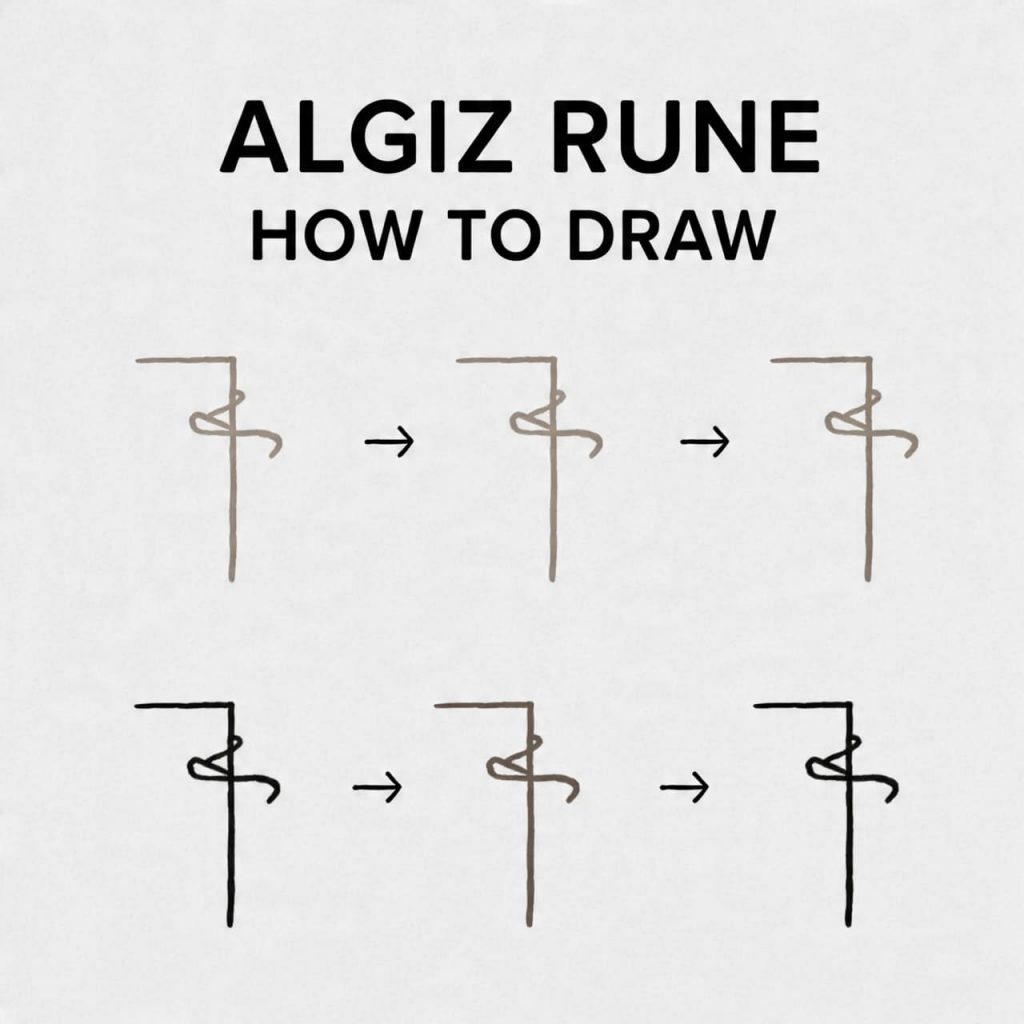
Questions about how to draw the Algiz rune are common because modern books and websites often present a single, authoritative form and imply that it is historically fixed. This impression is misleading. The problem is not artistic skill but evidence: early runic material does not provide standardized drawing instructions or canonical forms in the modern sense.

💜 Need a clear answer right now?
CONSULT THE YES OR NO TAROT Free · No registration · Instant resultThe uncertainty surrounding how Algiz was drawn is therefore factual and historical, not practical. Using evidence-first methods comparable to those discussed by astroideal helps clarify what can and cannot be established from surviving sources. Some readers consult qualified professionals for clarification, but historical evaluation depends on inscriptions and archaeological context rather than modern demonstration.
The guiding question of this article is precise and binary: does the historical record support the existence of a single, correct way to draw the Algiz rune?
What “How to Draw” Means in a Historical Context
In a historical setting, “how to draw” does not mean step-by-step instruction. It refers to whether a writing system prescribed a fixed form that users were expected to reproduce consistently. For alphabets such as Latin or Greek, this question can be answered through manuscripts and pedagogical texts. For runes, the situation is different.
Runic writing survives almost exclusively through inscriptions on durable materials. These inscriptions show variation rather than standardization. When modern explanations present Algiz as having one proper form, they often import expectations from later writing systems. Similar assumptions appear in non-academic explanations circulated by reliable readers, but they are not grounded in early medieval evidence.
The Algiz Rune Within the Elder Futhark
Algiz is conventionally assigned to the Elder Futhark, the earliest reconstructed runic alphabet, used roughly from the second to the eighth centuries CE. The alphabet itself is reconstructed from repeated patterns across inscriptions, not from a preserved original list or instructional source.
Within these inscriptions, Algiz appears as a vertical line with angled branches, but the exact angles, proportions, and execution vary significantly. This variation suggests that the rune was understood functionally rather than visually standardized. The absence of a fixed model challenges claims that there is a single historically “correct” way to draw it, a claim sometimes reinforced by modern systems discussed alongside online tarot sessions rather than by early literacy practices.
Archaeological Evidence of Rune Forms
Archaeological evidence provides the most direct insight into how Algiz was drawn. Inscriptions carved into stone, metal, bone, and wood show multiple graphical variants that are all identifiable as Algiz based on context. Some examples show symmetrical branches, others asymmetrical; some are deeply incised, others lightly scratched.
What archaeology demonstrates is usage, not prescription. There is no indication that deviations were errors or that one form was preferred over another. In writing systems with strict formality, incorrect forms are often corrected or avoided. The runic record shows no such pattern. Later visual systems that emphasize precise form, similar to modern presentation styles used in video readings, do not reflect early runic practice.
Absence of Instructional or Normative Texts
A critical limitation in answering how Algiz should be drawn is the absence of instructional texts. No manuals, teaching tablets, or explanatory documents from the Elder Futhark period survive. Without such sources, it is impossible to determine whether writers followed formal rules or informal conventions.
This absence is not trivial. In cultures where symbol form carries independent meaning, explicit guidance is typically preserved. The lack of such material for runes suggests that visual exactness was secondary to functional recognition. Attempts to reconstruct exact drawing rules therefore exceed what the evidence supports and resemble later interpretive traditions, comparable in structure to those found in phone readings rather than early Germanic literacy.
Regional and Temporal Variation
The Elder Futhark was used across a wide geographic area and over several centuries. Linguistic and cultural variation during this period is well documented. It would be historically unusual for a writing system in such conditions to maintain strict visual uniformity.
Indeed, Algiz forms vary not only between regions but also within the same region over time. This variation indicates that recognizability, not uniformity, was the primary requirement. Modern depictions that present a single outline as universally correct overlook this documented diversity and impose later expectations of standardization, similar to how generalized horoscope insights impose uniform frameworks on diverse historical traditions.
Emergence of Modern Standardized Drawings
Standardized drawings of the Algiz rune largely originate in the nineteenth and twentieth centuries. During this period, scholars, educators, and later popular writers sought to systematize runes for teaching and classification. Selecting one representative form was practical, but it was not historically authoritative.
These modern standards can be traced through publications and diagrams, but their origin is modern. They reflect editorial choice rather than early medieval consensus. The persistence of these drawings in popular culture does not transform them into historical facts, just as the incorporation of runes into modern symbolic systems such as love tarot readings does not alter the archaeological record. Comparative evaluation using frameworks like those discussed by astroideal confirms that standardization is a later development.
Evaluating the Core Claim with Evidence
The core claim faced by beginners is that there is a historically correct way to draw the Algiz rune. Evaluating this claim requires reviewing inscriptions, archaeological context, and the absence of instructional sources.
Inscriptions show multiple acceptable forms. Archaeology reveals variation without correction. No early texts prescribe a standard. Modern standardized forms are historically traceable but originate long after the rune’s period of use.
The evidence therefore leads to a clear conclusion: no, the historical record does not support the existence of a single, correct way to draw the Algiz rune in its original context.
Frequently Asked Questions
Did ancient sources explain how to draw Algiz?
No, there are no surviving instructional texts from the Elder Futhark period.
Are all Algiz drawings in inscriptions identical?
No, archaeological examples show significant variation in form.
Was one Algiz shape considered correct?
There is no evidence that one form was preferred or enforced.
Do modern books reflect ancient standards?
They reflect modern standardization choices, not ancient rules.
Can archaeology show drawing technique?
It shows finished forms but not prescribed methods.
Did Algiz form vary by region?
Yes, variation across regions and time periods is documented.
Call to Action
When evaluating claims about how the Algiz rune should be drawn, focus on what the evidence demonstrates and where it is silent. This approach allows you to get a clear yes or no answer grounded in documented history rather than assumption.
