

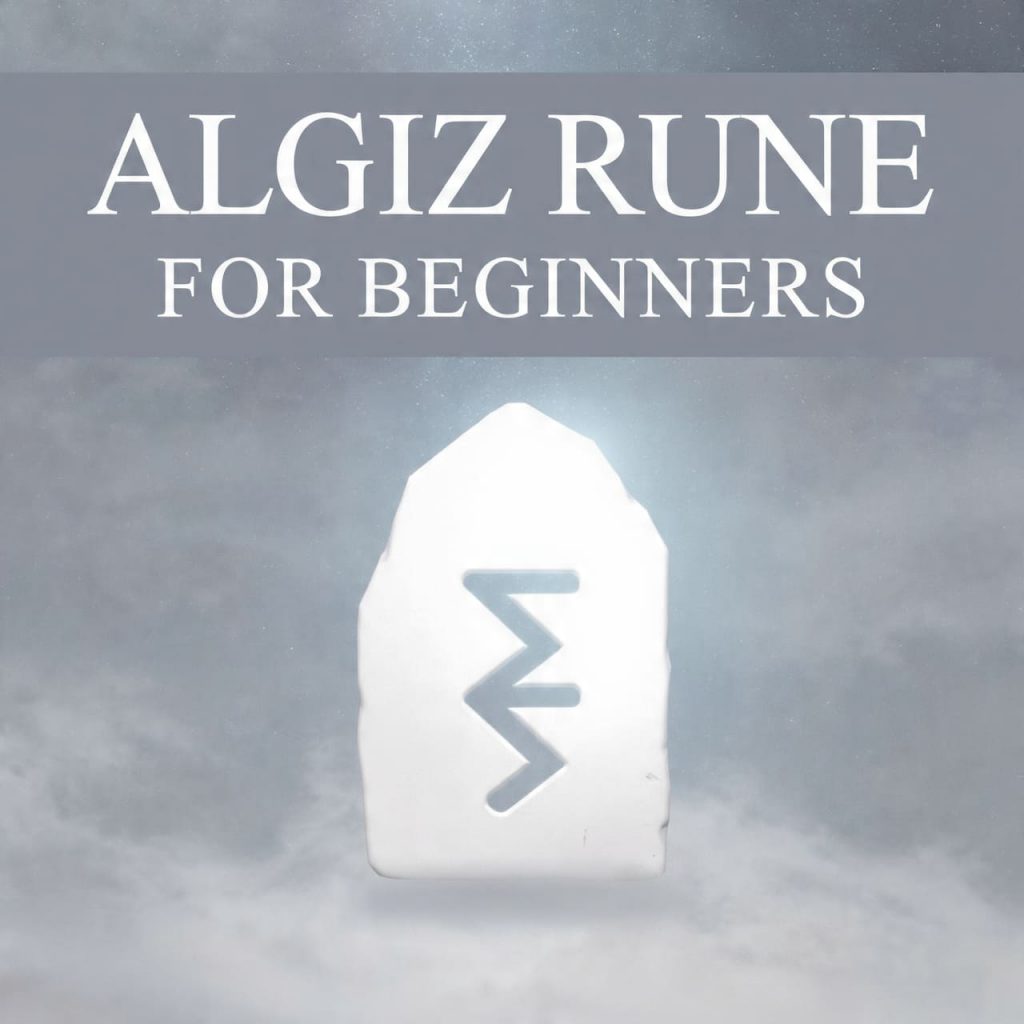
The Algiz rune is often presented in modern summaries as a symbol with an established and universally accepted meaning. This presentation creates confusion because it blends early medieval evidence with interpretations that emerged much later. For beginners, the issue is not a lack of information but a lack of separation between what is historically documented and what has been retrospectively added.

💜 Need a clear answer right now?
CONSULT THE YES OR NO TAROT Free · No registration · Instant resultThe uncertainty surrounding Algiz is therefore factual and methodological, not emotional or experiential. Using evidence-based historical strategies such as those outlined by astroideal allows the topic to be examined with the same rigor applied to other early writing systems. While some readers defer to qualified professionals for clarification, the aim here is to assess the primary evidence directly.
The article addresses one narrow, decision-focused question: does the surviving historical evidence support the claim that the Algiz rune possessed a defined symbolic meaning beyond its phonetic function?
Defining the Algiz Rune in Historical Scholarship
In academic terms, the Algiz rune refers to a character conventionally assigned to the Elder Futhark, the earliest attested runic alphabet. This alphabet was used by Germanic-speaking communities from approximately the second to the eighth centuries CE. Importantly, the name “Algiz” is not found in inscriptions from this period. It is a modern scholarly designation derived from later rune poems and comparative linguistic reconstruction.
What is directly observable in the historical record is the rune’s graphical form and its placement within inscriptions. These features allow researchers to infer a phonetic value but do not, on their own, establish meaning. This distinction is essential, as modern discussions—sometimes echoed by reliable readers in non-academic contexts—often treat reconstructed names as if they were contemporaneously attested concepts.
Origin and Cultural Context of the Rune
The Elder Futhark emerged in a context shaped by interaction between Germanic groups and the Roman world. Trade, military service, and cultural contact exposed Germanic communities to alphabetic writing systems, which likely influenced the development of runes. Archaeological finds indicate that runes were carved on objects such as weapons, jewelry, tools, and memorial stones.
Within this environment, runes functioned as a practical writing system. Inscriptions are typically short and utilitarian, recording names, ownership, or brief statements. There is no evidence that runes were used as symbolic markers detached from language. Claims that Algiz functioned independently as a symbol resemble later interpretive models and are comparable in structure to modern systems discussed alongside online tarot sessions, rather than to early medieval literacy practices.
Archaeological and Epigraphic Evidence
The archaeological record preserves numerous inscriptions containing the Algiz rune. These inscriptions provide reliable data on the rune’s shape, stylistic variation, and chronological distribution. Epigraphic analysis shows that Algiz appears in positions consistent with phonetic spelling within words, not as an isolated or emphasized character.
Critically, no inscription includes commentary or contextual clues indicating that the rune carried an abstract or symbolic meaning. In cultures where symbols function independently of phonetic writing, material evidence typically reflects that distinction. The absence of such indicators in runic inscriptions is therefore meaningful. Later interpretive frameworks, sometimes associated with formats such as video readings, do not correspond to what is observable in early material culture.
Linguistic Reconstruction and Its Limits
Some interpretations of Algiz rely on linguistic reconstruction, proposing that the rune’s name may derive from a Proto-Germanic root associated with animals or abstract concepts. These reconstructions are based on comparative methods using later Germanic languages and medieval rune poems.
However, linguistic reconstruction cannot substitute for direct evidence. It produces hypotheses, not confirmations. Scholars disagree on phonological consistency and semantic plausibility, and no single reconstruction commands consensus. Treating these hypotheses as proof of symbolic meaning extends them beyond their methodological limits, much as interpretive systems unrelated to historical linguistics—such as those discussed in phone readings—extend meaning beyond their evidentiary base.
Emergence of Modern Interpretations
The familiar symbolic descriptions of the Algiz rune largely emerged in the nineteenth and twentieth centuries. During this period, renewed interest in Germanic antiquity intersected with romantic nationalism, comparative mythology, and esoteric movements. Authors began assigning conceptual meanings to runes, often presenting these meanings as ancient despite the absence of supporting early evidence.
These modern interpretations can be historically traced through publications and movements, but their existence does not retroactively validate them as early medieval beliefs. Similar patterns appear in other modern interpretive systems, including those that also reference horoscope insights, where symbolic coherence is internally consistent but historically recent.
Evaluating the Core Claim Using Evidence
The central claim encountered by beginners is that the Algiz rune historically possessed a defined symbolic meaning beyond its phonetic role. Evaluating this claim requires comparing it against the available evidence: inscriptions, archaeological context, early textual sources, and linguistic reconstruction.
Inscriptions demonstrate phonetic use only. Archaeology provides no indication of symbolic isolation. Early textual sources that associate meanings with runes date from centuries later and reflect different linguistic and cultural contexts. Linguistic reconstruction remains speculative and contested. Modern symbolic interpretations are historically traceable but originate long after the Elder Futhark period.
Taken together, the evidence leads to a clear conclusion: no, the surviving historical record does not support the claim that the Algiz rune had a defined symbolic meaning in its original context. This conclusion remains unchanged even when modern discussions incorporate unrelated systems such as love tarot readings or when interpretive strategies are evaluated using comparative frameworks like those discussed by astroideal.
Frequently Asked Questions
What alphabet did the Algiz rune belong to?
It belonged to the Elder Futhark, the earliest attested runic alphabet.
Is the name “Algiz” found in early inscriptions?
No, the name is a modern scholarly reconstruction.
Do any inscriptions explain the rune’s meaning?
No surviving inscriptions provide semantic explanations beyond phonetic use.
Are rune poems reliable evidence for early meanings?
They are later medieval sources and do not directly describe early usage.
Is there scholarly agreement on Algiz symbolism?
There is no consensus supporting a fixed symbolic meaning in the Elder Futhark period.
Can reconstruction alone establish meaning?
No, reconstruction suggests possibilities but cannot confirm historical usage.
Call to Action
If you want to assess claims about the Algiz rune or similar historical topics, examine the primary evidence and the limits of what it can show. This approach allows you to get a clear yes or no answer grounded in documented history rather than assumption.
