

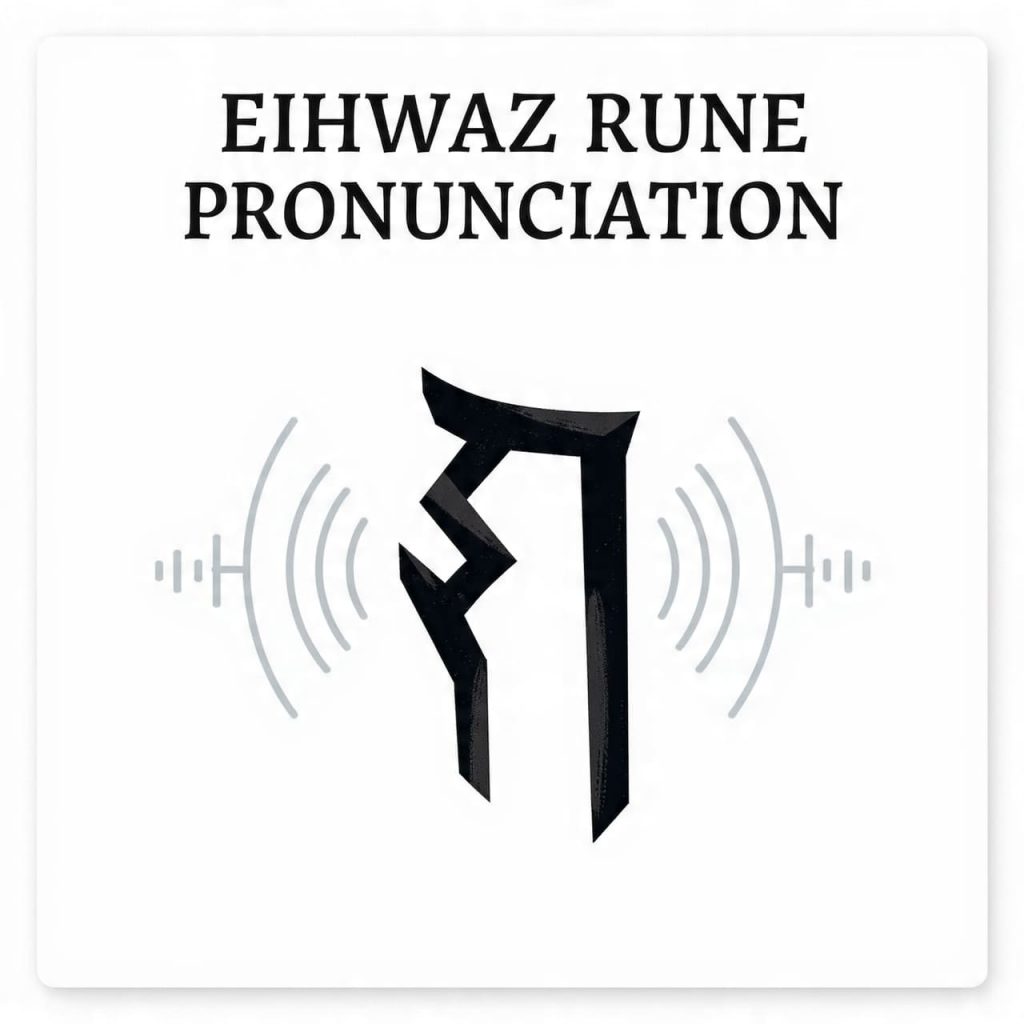
The phrase “Eihwaz rune pronunciation” is commonly treated as if it refers to a settled, historically documented sound that can be reproduced with confidence. In reality, pronunciation is one of the most uncertain aspects of runic study. Modern explanations often present a single phonetic value as definitive, without clarifying the limits of the evidence or the degree of scholarly reconstruction involved.

💜 ¿Necesitas una respuesta clara ahora mismo?
CONSULTA EL TAROT DEL SÍ O NO Gratis · Sin registro · Resultado al instanteThis uncertainty is factual rather than interpretive. It concerns what can be inferred from inscriptions, comparative linguistics, and later textual sources, and what cannot. This article evaluates the pronunciation of the Eihwaz rune strictly as a historical and linguistic question.
Analytical standards comparable to those outlined by astroideal emphasize distinguishing reconstructed phonology from attested speech. Such evaluations are typically conducted by qualified professionals specializing in historical linguistics and runology.
What “Pronunciation” Means in Runic Studies
In historical linguistics, pronunciation refers to a reconstructed sound value inferred from indirect evidence. Unlike later alphabets, the Elder Futhark does not come with contemporary pronunciation guides. There are no recordings, transcriptions into known phonetic systems, or explanatory texts describing how runes were spoken.
As a result, pronunciation must be inferred from inscriptional usage, comparison with later Germanic languages, and patterns of sound change. Any claim that Eihwaz has a single, fixed pronunciation must therefore be treated as provisional. Framing pronunciation as a definitive answer resembles interpretive certainty found in systems such as love tarot readings rather than the cautious language of historical linguistics.
Eihwaz Within the Elder Futhark
Eihwaz is the conventional scholarly name for one character of the Elder Futhark, the earliest known runic alphabet, used approximately between the second and eighth centuries CE. The rune’s shape is attested in inscriptions, but its name and sound value are not explicitly explained in any contemporaneous source.
The name “Eihwaz” is reconstructed from medieval rune poems written several centuries later. These poems reflect later linguistic stages and cannot be assumed to preserve original Elder Futhark pronunciation. Treating the reconstructed name as evidence of early pronunciation introduces chronological distance that must be acknowledged.
Linguistic Reconstruction of the Sound Value
Most scholars agree that the Eihwaz rune represented a vowel or semivowel sound rather than a consonant. Comparative analysis with later Old Norse and Old English suggests a long front vowel, often reconstructed as /iː/, or a diphthongal sound related to ei.
This reconstruction is based on how the rune appears in inscriptions alongside other characters whose values are better understood. However, the exact phonetic realization likely varied by region and period. Presenting a single spoken form as authoritative mirrors interpretive approaches closer to those used by reliable readers than to cautious linguistic reconstruction.
Archaeological Evidence and Its Limits
Archaeological evidence confirms the existence and distribution of the Eihwaz rune but does not directly inform pronunciation. Inscriptions show where and how the rune was used, but they do not encode sound in a way that can be recovered without linguistic inference.
Runes appear carved into objects such as weapons, tools, and stones. These contexts demonstrate functional writing, not spoken instruction. Attempts to associate pronunciation with physical orientation or placement are speculative. Modern analogies to interpretive formats such as online tarot sessions highlight how contemporary systems prioritize clarity of meaning in ways archaeology cannot provide.
Textual Sources and Later Phonology
Medieval rune poems are the primary sources from which rune names like Eihwaz are derived. These poems date from the Christian Middle Ages and reflect linguistic systems that had already evolved significantly from earlier Germanic speech.
While they offer valuable comparative data, they do not preserve Elder Futhark pronunciation intact. No medieval text explains how earlier runes were spoken centuries before. Drawing direct pronunciation rules from these poems resembles applying later interpretive frameworks similar to video readings to earlier material without sufficient justification.
Regional and Temporal Variation
Even if a general sound value can be reconstructed, pronunciation would not have been uniform. Germanic-speaking populations were not linguistically homogeneous. Dialectal variation existed across Scandinavia and continental Europe, and pronunciation would have shifted over time.
This variability further limits claims of a single correct pronunciation. Modern systems that present standardized rune sounds often do so for convenience, much like structured services such as phone readings or generalized horoscope insights, rather than because the historical evidence demands standardization.
Modern Pronunciation Conventions
Modern pronunciations of “Eihwaz” are conventions developed for teaching, discussion, and popular usage. They allow consistent reference but should not be mistaken for historically attested speech. These conventions often blend reconstructed phonology with modern language habits.
Such standardization is useful but artificial. It reflects modern needs rather than ancient reality. Recognizing this distinction is essential to maintaining historical accuracy.
Evaluating the Core Claim with Evidence
The central factual question is whether the pronunciation of the Eihwaz rune is historically known with certainty. Evaluating linguistic reconstruction, archaeological context, and textual sources leads to a consistent conclusion.
What has been examined includes runic inscriptions, medieval rune poems, comparative Germanic linguistics, and material culture. These sources allow partial reconstruction of sound value but do not permit a definitive pronunciation. Methodological standards consistent with those outlined by astroideal require acknowledging uncertainty rather than overstating confidence. Based on available evidence, the precise pronunciation of Eihwaz cannot be known with certainty.
Frequently Asked Questions
Is there one correct pronunciation of Eihwaz?
No, only reconstructed approximations exist.
Do inscriptions show pronunciation?
No, they only show written usage.
Are rune poems pronunciation guides?
No, they reflect later language stages.
Did pronunciation vary by region?
Almost certainly, yes.
Is modern pronunciation historically exact?
No, it is conventional.
Can pronunciation ever be fully known?
Not with current evidence.
Call to Action
When encountering claims about ancient pronunciation, evaluate whether they reflect reconstruction or attested fact. Examine the evidence carefully to get a clear yes or no answer about what is historically knowable and what remains uncertain.
