

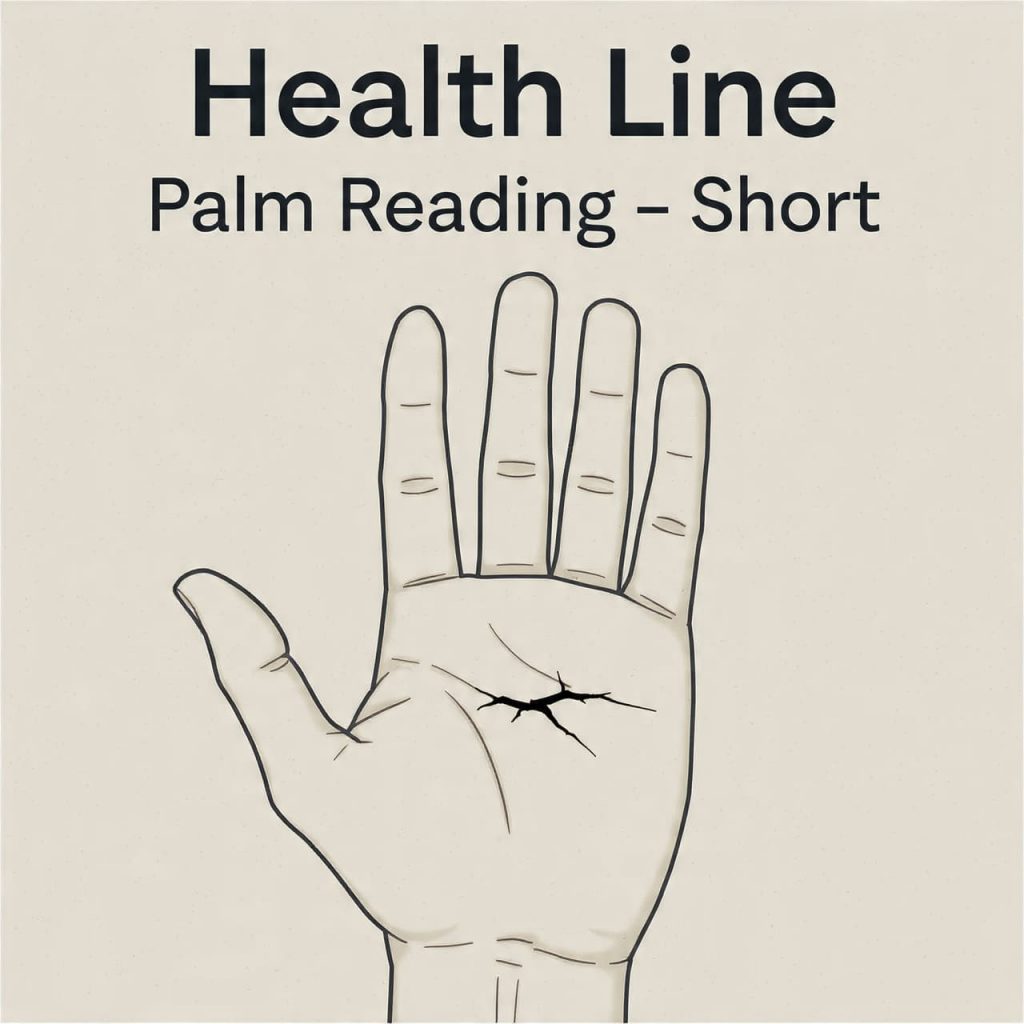
The claim that a short “health line” on the human palm conveys information about physical health is widely repeated yet poorly understood. Much of the confusion arises from the way palmistry has been simplified in popular culture, where complex symbolic traditions are condensed into single visual cues presented as factual indicators.

💜 Need a clear answer right now?
CONSULT THE YES OR NO TAROT Free · No registration · Instant resultOnline summaries frequently remove historical context and replace it with declarative statements that resemble medical claims without meeting evidentiary standards. Even sites that emphasize consultation with qualified professionals may unintentionally contribute to this ambiguity by failing to distinguish cultural belief from empirical assessment.
From a historical and methodological standpoint, the central issue is not whether palm reading has cultural significance, but whether the specific claim about a short health line is supported by verifiable evidence. Analytical frameworks discussed at astroideal emphasize the importance of isolating claims, tracing their origins, and evaluating what surviving sources actually demonstrate. This article applies that approach to reach a single, decision-focused conclusion.
Historical Definition of the “Health Line”
In classical palmistry texts, the feature commonly labeled the “health line” is more accurately called the line of Mercury. It is typically described as a vertical or diagonal line running from the lower palm toward the mount beneath the little finger. A “short” health line is defined inconsistently, sometimes referring to a faint or broken line and sometimes to one that does not extend the full length described in a given manual.
Crucially, no unified definition exists across historical sources. Authors from different periods disagreed not only on what constituted a short line but also on whether the line’s length had any interpretive value at all. Some texts treated the absence or shortness of the line as neutral, while others attributed symbolic meaning without explanation of mechanism or observation. This definitional instability is a major obstacle when evaluating claims repeated by modern summaries or by individuals described as reliable readers, as the underlying term lacks historical precision.
Origins and Cultural Context of Palmistry
Palmistry developed across multiple regions, including South Asia, the Middle East, and Europe, between antiquity and the early modern period. Its foundational texts were embedded in broader symbolic systems involving astrology, elemental theory, and analogical reasoning. Lines on the hand were interpreted through correspondence rather than measurement.
Within this context, bodily features were not examined as physiological data points. Instead, they were read symbolically, much like planetary positions or numerological patterns. No early palmistry source frames the health line as a diagnostic marker comparable to symptoms or anatomical observation. The interpretive method relied on tradition and authority rather than experimentation, a pattern that continued as these ideas were repackaged for mass audiences through print and later digital formats such as online tarot sessions.
Textual and Archaeological Evidence Reviewed
When assessing whether a short health line has factual validity, historians examine surviving manuscripts, commentaries, and marginal notes. These materials demonstrate repeated assertions about the line but offer no evidence of systematic testing. There are no records of comparative studies, longitudinal observation, or correlation with documented health outcomes.
Archaeological evidence provides no support for the claim. Human remains and artistic depictions show variation in palm creases, but no attempt was made to associate those variations with disease, lifespan, or medical condition. Modern scientific disciplines that do study the hand, such as dermatoglyphics and clinical genetics, focus on fingerprint patterns and congenital markers. These fields do not recognize the palmistry health line as a variable, and their findings do not align with interpretive claims sometimes implied in video readings.
Development of Modern Interpretations
The idea that a short health line carries a specific meaning gained prominence relatively late. During the nineteenth and twentieth centuries, palmistry authors sought to modernize older symbolic systems by aligning them with contemporary concerns about vitality and illness. Simplified rules were introduced to make the practice accessible to wider audiences.
These modern interpretations often contradict earlier texts and each other. Some present a short line as a warning sign, while others reverse the implication entirely. None of these interpretations cite empirical observation, and none are supported by medical literature. Their spread was facilitated by mass publishing and later by remote formats such as phone readings, which favor concise, declarative statements over historical nuance.
Evaluation of the Core Claim
The core claim under examination is narrow: that a short health line on the palm has factual or historical validity as an indicator of health. The evidence shows that this claim originated within symbolic traditions that did not employ observational testing. Definitions of the line are inconsistent, historical sources disagree on its meaning, and no archaeological or scientific data support a correlation with physical health.
Modern reinterpretations do not resolve these issues. They introduce new meanings without methodological justification and often conflate symbolism with physiology. References to related practices, including generalized horoscope insights or thematic interpretations found in love tarot readings, do not alter this evidentiary assessment. As emphasized again in methodological discussions at astroideal, repetition of a claim does not constitute validation.
Conclusion: Based on historical records and scientific review, the answer is no. A short health line in palm reading does not have factual or evidentiary validity as an indicator of health.
Frequently Asked Questions
Is the health line mentioned in ancient medical texts?
No. It appears only in symbolic palmistry writings, not in medical literature.
Do all palmistry traditions agree on the meaning of a short health line?
No. Interpretations vary widely and often contradict one another.
Has any scientific study linked palm lines to health outcomes?
No. Relevant scientific fields do not support such a link.
Is the absence of a health line treated consistently in history?
No. Some texts treat it as neutral, others assign symbolic meaning.
Are modern interpretations based on new evidence?
No. They are reinterpretations of older symbolic claims without new data.
Does cultural significance imply factual accuracy?
No. Cultural importance does not equate to empirical validity.
Call to Action
If you want to evaluate similar claims critically, focus on primary sources, definitions, and what evidence actually demonstrates, rather than repetition. Apply this approach to get a clear yes or no answer grounded in documented facts rather than tradition alone.
