

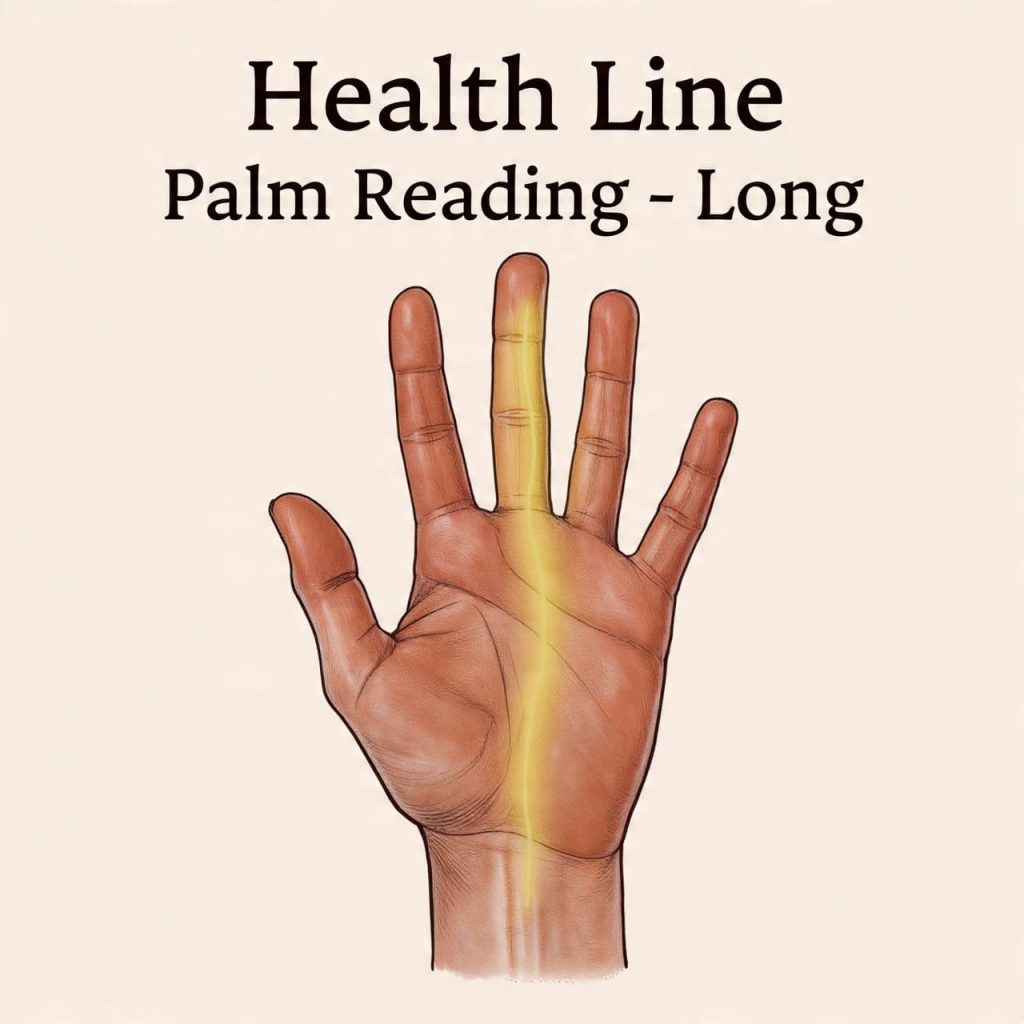
Claims about a “long health line” in palm reading are frequently presented as straightforward indicators of physical condition, resilience, or vitality. This apparent clarity is misleading. The misunderstanding stems from compressing a layered historical tradition into a single visual rule, then presenting that rule as if it were grounded in observation or measurement.

💜 Need a clear answer right now?
CONSULT THE YES OR NO TAROT Free · No registration · Instant resultOver time, repetition has replaced scrutiny, and interpretive claims have been detached from the contexts in which they first appeared. Even environments that emphasize consultation with qualified professionals may blur the line between cultural belief and factual assessment when historical limits are not clearly stated.
The question addressed here is narrow and factual: does a long health line in palm reading have historical or evidentiary validity as an indicator of health? Following evidence-evaluation strategies discussed at astroideal, this article isolates the claim, examines its origins and sources, and evaluates what the available evidence does and does not support. The goal is a single, decision-first conclusion.
Historical Definition of the “Health Line”
In traditional palmistry, the feature commonly called the “health line” is more formally known as the line of Mercury. It is typically described as extending from the lower portion of the palm upward toward the area beneath the little finger. A “long” health line is generally defined as one that is clearly visible and extends across much of the palm according to a given diagram.
However, historical sources do not agree on these parameters. Some texts measure length relative to other lines, while others use the mounts of the hand as reference points. More importantly, authors disagreed on whether length itself was meaningful. Certain manuals regarded a long line as noteworthy, while others treated it as incidental. This lack of definitional consistency complicates any claim that a long health line carried a stable or widely accepted meaning, even among practitioners described as reliable readers.
Cultural Origins and Interpretive Context
Palmistry developed within symbolic systems rather than empirical ones. Early traditions from South Asia and the Mediterranean interpreted bodily features through analogical frameworks linked to planets, elements, and moral qualities. The hand was viewed as a symbolic map, not as a physiological record.
Within this context, a long line was not evaluated through comparison with health outcomes. Instead, it was interpreted according to correspondence rules internal to the system. These interpretations were justified by tradition and authority, not by observation. As palmistry spread and adapted across cultures, the symbolic vocabulary changed, but the methodological foundation remained non-empirical. This is important when considering modern summaries that circulate through formats like online tarot sessions, where symbolic interpretation is often presented without historical qualification.
Textual and Archaeological Evidence Considered
Primary palmistry texts from antiquity and the medieval period repeatedly assert meanings for the health line, but they do not document testing or verification. No source describes tracking individuals over time to compare palm features with illness or longevity. Assertions about a long health line appear as declarative statements, not as conclusions drawn from observation.
Archaeological evidence offers no support for the claim. While preserved art and skeletal remains show natural variation in hand creases, there is no indication that ancient observers linked these variations to medical conditions. Modern scientific disciplines that study the hand, such as anatomy and dermatoglyphics, focus on genetic markers and developmental patterns. These fields do not recognize the palmistry health line as a medically relevant structure, and their findings do not align with interpretations often suggested in video readings.
Emergence of Modern Meanings
The association between a long health line and positive physical condition became more explicit in modern palmistry literature, particularly from the nineteenth century onward. During this period, authors attempted to modernize symbolic traditions by aligning them with contemporary ideas about health and vitality. Length was emphasized because it offered an easily communicated visual rule.
These modern interpretations were not based on new evidence. They were reinterpretations designed for accessibility and commercial appeal. Different authors assigned different meanings to the same feature, sometimes reversing earlier claims. The lack of methodological grounding persisted, even as dissemination expanded through mass media and later through services such as phone readings.
Direct Evaluation of the Core Claim
The claim under evaluation is specific: that a long health line in palm reading has factual or historical validity as an indicator of health. Historical analysis shows that the claim originated in symbolic traditions that did not employ observational testing. Definitions of “long” vary across sources, and interpretations conflict rather than converge.
Scientific evidence does not bridge this gap. No peer-reviewed studies demonstrate a correlation between the length of the palmistry health line and health outcomes. Where the hand is studied scientifically, the variables examined differ entirely from those used in palmistry. References to adjacent practices, including generalized horoscope insights, do not provide evidentiary support, as they rely on similar symbolic reasoning rather than empirical validation.
Why the Claim Persists
The persistence of the long health line claim is better explained by cultural transmission than by evidence. Simple visual rules are easy to remember and repeat, and they lend themselves to confident presentation. Over time, repetition can create an impression of validation, even in the absence of supporting data.
Additionally, modern compilations sometimes group palmistry interpretations with unrelated practices, such as love tarot readings, creating an appearance of coherence across systems that are methodologically similar but evidentially weak. As reiterated in analytical discussions at astroideal, consistency of narrative does not equal confirmation by evidence.
Conclusion: The evidence leads to a clear answer. No, a long health line in palm reading does not have factual or historical validity as an indicator of physical health.
Frequently Asked Questions
Is the long health line described consistently in historical texts?
No. Length and significance vary widely between sources.
Did ancient palmists test health line claims?
No. Surviving texts do not document testing or observation.
Do medical sciences recognize the health line?
No. It is not a recognized anatomical or diagnostic feature.
Are modern interpretations based on new research?
No. They are reinterpretations without empirical support.
Can cultural tradition substitute for evidence?
No. Cultural continuity does not establish factual accuracy.
Is there any verified link between palm lines and disease?
No. No such link has been demonstrated.
Call to Action
To assess claims like this rigorously, focus on definitions, sources, and what the evidence actually shows rather than what is often repeated. Applying that standard allows you to get a clear yes or no answer based on documented history rather than assumption.
