

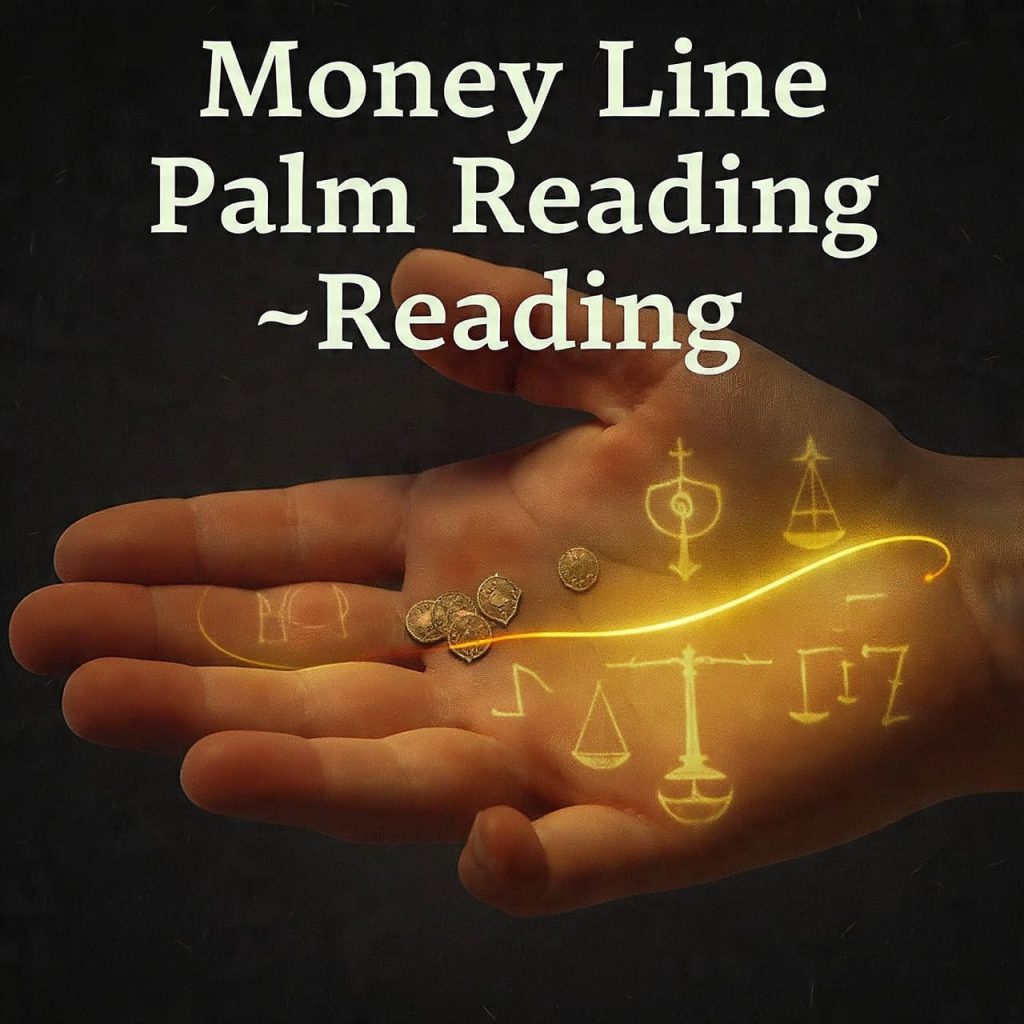
The phrase “money line palm reading reading” is commonly misunderstood because it implies that there is a historically established and factually grounded method for reading financial information from a specific palm line. In popular usage, the repetition of “reading” reinforces the assumption that this activity is systematic, validated, and rooted in long-standing tradition. Historical sources, however, do not clearly support this assumption.

💜 Need a clear answer right now?
CONSULT THE YES OR NO TAROT Free · No registration · Instant resultThe uncertainty examined in this article is strictly factual and historical. Did palmistry traditions ever establish a defined practice of reading a “money line” as evidence of financial facts, or is this practice a modern interpretive construction?
This analysis approaches the question using documented texts, archaeological context, and anatomical research, following evidence-first standards similar to those discussed on astroideal. The conclusion is deliberately binary.
Defining “Money Line Reading” in Historical Terms
In contemporary language, a “money line reading” usually refers to interpreting one or more palm lines as indicators of wealth, income, or financial trajectory. Historically, however, palmistry did not define a discrete activity corresponding to this description.
Early palmistry texts discussed hand features descriptively and symbolically, not procedurally. There is no historical record of a standardized method for isolating a money line and performing a dedicated “reading” of it. Without defined steps, criteria, or anatomical agreement, the concept of money line reading cannot be traced as a coherent historical practice.
Claims that such readings were historically performed by qualified professionals rely on retrospective labeling rather than primary documentation.
Wealth and Interpretation in Early Palmistry Traditions
In ancient Indian, Chinese, and Greco-Roman traditions, prosperity and fortune were discussed in moral, cosmological, or social terms. When hand reading appeared in these contexts, it was descriptive rather than analytical. Wealth was not decoded from a single anatomical marker.
Medieval European palmistry incorporated astrological symbolism, sometimes associating planets with fortune or status. Even in these texts, interpretation remained holistic. The hand was read as a whole, and no separate procedure resembling a money line reading existed. The historical record shows symbolic inference, not a specialized financial diagnostic practice.
Textual and Archaeological Evidence Review
A review of surviving palmistry manuscripts reveals no instructions, diagrams, or terminology describing a money line reading. Illustrations that do exist are schematic and vary significantly between sources. This inconsistency indicates that early authors were not attempting to standardize interpretive procedures.
Archaeological evidence likewise provides no support. There are no tools, charts, or instructional artifacts demonstrating that wealth was “read” from a specific palm line. What the evidence shows is symbolic interpretation shaped by cultural values; what it does not show is a structured reading method focused on money.
This absence is critical. It demonstrates that money line reading was not part of the historical palmistry framework.
Emergence of the Reading Concept in Modern Palmistry
The idea of a dedicated money line reading emerges in modern popular palmistry, particularly from the nineteenth century onward. During this period, palmistry was simplified and reorganized for broader audiences. Complex symbolic traditions were broken into discrete “readings” focused on specific topics such as money, relationships, or work.
This development coincided with the commercialization of interpretive services and the rise of generalized offerings by reliable readers. In this environment, labeling a practice as a “money line reading” created clarity and appeal, even though the label lacked historical precedent. Historically, this represents reinterpretation rather than continuity.
Scientific Perspective on Reading Financial Meaning From Palms
From a scientific standpoint, palmar lines are studied within dermatoglyphics. Research shows that these creases form during fetal development and are influenced by genetics and mechanical forces. They are stable anatomical features, not records of later economic circumstances.
No peer-reviewed studies demonstrate that any palm feature can be read to obtain factual financial information. There is also no plausible causal mechanism by which a crease formed before birth could encode wealth or income. Modern contexts, including online tarot sessions and video readings, may present money line readings, but they do not introduce empirical validation.
Evaluating the Core Claim With Evidence
The core claim is that money line palm reading reading provides factual information about financial matters. Evaluating this claim requires assessing historical continuity and empirical plausibility.
Historically, continuity is absent. No ancient or medieval source describes a money line reading as a defined practice. Empirically, scientific research on palmar anatomy provides no support for extracting financial facts from palm lines. What exists instead is a modern interpretive structure reinforced through repetition.
On evidentiary grounds, the claim fails. There is no historical documentation or scientific data supporting the idea that money line readings convey factual information.
Relationship to Other Interpretive Systems
Money line readings are often presented alongside other divinatory practices, creating an impression of shared legitimacy. In modern contexts, palm reading is frequently bundled with astrology or card-based interpretation.
Historically, these systems developed independently. Even within palmistry, financial symbolism was never isolated into a single reading procedure. The inclusion of money line readings alongside services such as phone readings or horoscope insights reflects contemporary packaging rather than historical integration.
Understanding this separation is essential to evaluating claims on factual rather than associative grounds.
Final Historical Assessment
Based on documented texts, archaeological context, and scientific research, money line palm reading reading lacks historical grounding and empirical support. It is a modern interpretive construction rather than a documented, evidence-based practice.
This conclusion aligns with critical evaluation approaches discussed on astroideal, which emphasize separating documented historical practice from later symbolic elaboration. In contemporary discourse, money line readings are sometimes reinforced through love tarot readings, but such associations do not alter the evidentiary outcome.
The factual answer to the central question is therefore clear: no, money line palm reading reading does not have evidence-based validity.
Frequently Asked Questions
Do historical texts describe money line readings?
No surviving historical texts outline a specific practice called a money line reading.
Was wealth ever read from a single palm line?
Historical sources treated wealth symbolically and holistically, not through a single line or reading.
Is there scientific support for financial palm readings?
No scientific studies support extracting financial facts from palm lines.
When did money line readings become common?
They appeared in modern popular palmistry literature.
Are these readings consistent across cultures?
No, interpretations vary widely and lack historical consistency.
Do modern readings add new evidence?
No, they repeat symbolic interpretations without independent verification.
Call to Action
Readers seeking to get a clear yes or no answer should evaluate claims about money line palm reading reading by consulting primary historical sources and empirical research, rather than relying on modern interpretive labels presented without evidentiary support.
