

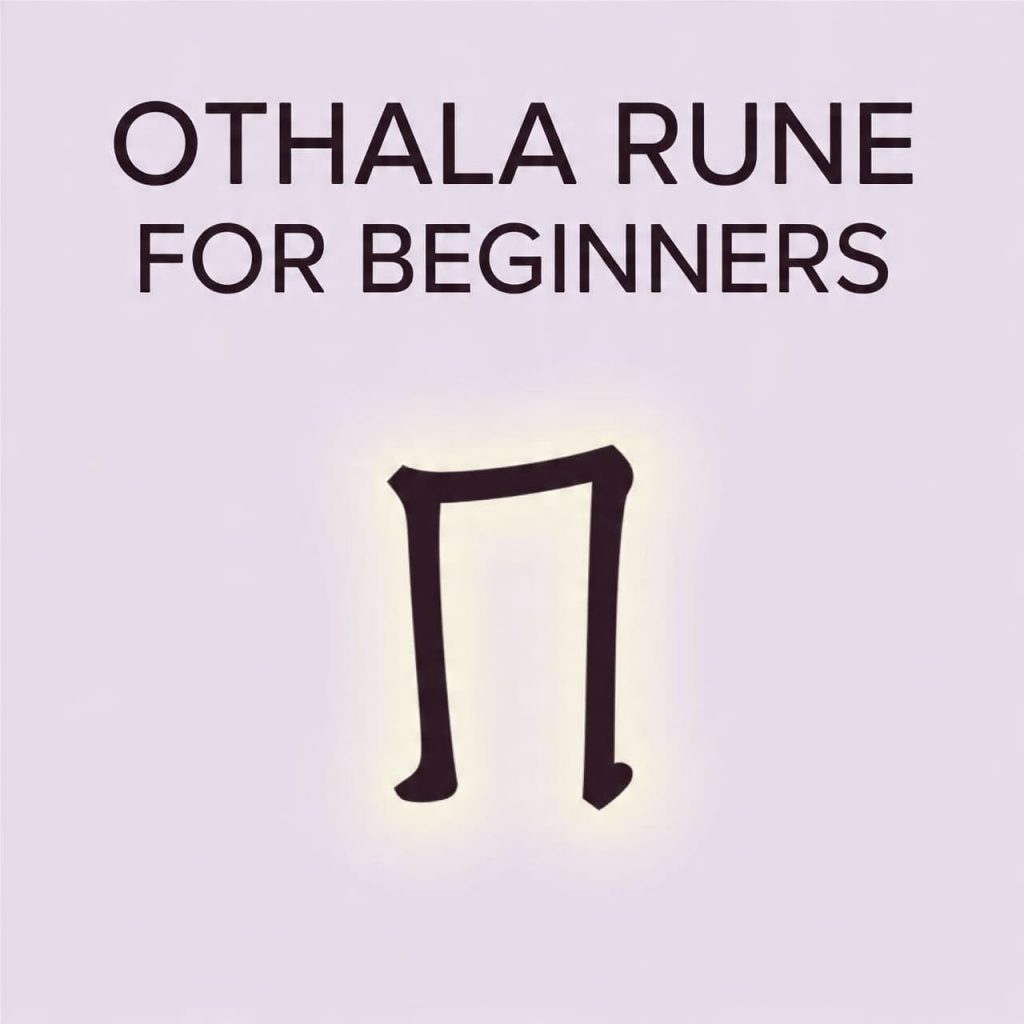
The phrase “Othala rune for beginners” is common in modern rune literature, where newcomers are promised simplified explanations, introductory meanings, or basic guidance for understanding the rune. This framing is understandable but historically problematic. It assumes that Othala was originally part of a system designed to be learned progressively, with conceptual meanings accessible at a beginner level.

💜 Need a clear answer right now?
CONSULT THE YES OR NO TAROT Free · No registration · Instant resultModern explanatory material, including summaries published on astroideal, often presents runes as approachable symbolic tools and may direct beginners toward qualified professionals for clarification. However, accessibility for modern learners does not equate to historical intent. The precise question examined in this article is factual and limited: what can beginners accurately know about the Othala rune based strictly on historical evidence, and what claims go beyond that evidence?
What “For Beginners” Means in a Historical Context
In modern educational language, “for beginners” implies a structured learning pathway, simplified concepts, and progressive understanding. Historically, however, runes were not taught as symbolic systems with layered meanings. They were learned as elements of literacy.
Early Germanic societies did not produce instructional manuals distinguishing beginner and advanced rune knowledge. Literacy was transmitted informally or within specific social contexts. Any attempt to present Othala as having an introductory “meaning” relies on later interpretive traditions or the assumptions of reliable readers rather than historical documentation.
For beginners seeking accuracy, the key task is to separate what is historically demonstrable from what is modern explanatory framing.
Othala in the Elder Futhark Writing System
Othala is the twenty-fourth and final rune of the Elder Futhark, the earliest known runic alphabet, used approximately between the second and eighth centuries CE. Its phonetic value is generally reconstructed as a long vowel sound, commonly /oː/.
For beginners, the historically accurate understanding is straightforward: Othala was a letter. It functioned as part of a writing system, not as a conceptual symbol. This sharply contrasts with modern interpretive systems such as those used in online tarot sessions, which are explicitly designed around symbolic meaning.
Archaeological Evidence Beginners Should Know
Archaeological evidence provides the clearest foundation for understanding Othala. The rune appears in a limited number of Elder Futhark inscriptions on stones, metal objects, and other materials. In these inscriptions, Othala functions as part of written words or names.
No artifact isolates Othala as a teaching symbol, instructional marker, or beginner-level concept. Archaeologists do not interpret rune inscriptions as learning tools; they are treated as texts. For beginners, this means that the material record supports literacy use only.
Claims that Othala was meant to convey an immediately accessible meaning resemble modern explanatory frameworks rather than archaeological conclusions, similar in structure to interpretive assumptions found in video readings.
Textual Sources and Introductory Understanding
Textual references to rune names come primarily from medieval rune poems composed centuries after the Elder Futhark period. The Anglo-Saxon rune poem includes a stanza for ēþel, the rune corresponding to Othala, describing inherited land as valued by people.
This poem functioned as a mnemonic device to help learners remember rune names, not as an instructional guide to symbolic meaning. It reflects medieval English culture, not early Germanic rune usage. Scandinavian rune poems omit Othala entirely.
For beginners, it is important to understand what these poems do and do not provide. They offer vocabulary association, not conceptual instruction. Treating them as beginner manuals for meaning imposes modern educational categories onto texts that do not support them, an approach closer to phone readings than to historical analysis.
What Beginners Are Often Told That History Does Not Support
A review of inscriptions, manuscripts, and linguistic research shows that several claims commonly presented to beginners lack historical support. Specifically, the historical record does not demonstrate that Othala:
- Had a built-in symbolic lesson for learners
- Was taught through conceptual meaning rather than sound
- Functioned as an introductory spiritual or philosophical symbol
- Carried layered meanings revealed through study
Early learners of runes learned sounds and letter forms, not abstract ideas. Assigning simplified meanings for beginners reflects modern teaching preferences similar to those used in horoscope insights rather than evidence-based historical practice.
How Beginner Interpretations Emerged
Beginner-focused interpretations of Othala emerged in modern literature, particularly during the twentieth century, when runes were repackaged for broad audiences. Authors created simplified explanations to make runes accessible, often framing them as symbolic keys that beginners could easily grasp.
This development is historically traceable and culturally specific. It does not coincide with new archaeological discoveries or revised interpretations of early runic inscriptions. Instead, it reflects modern educational and commercial contexts.
These beginner frameworks are often presented alongside interpretive systems comparable to love tarot readings and are discussed using analytical approaches described on astroideal. Their consistency reflects shared modern convention, not ancient instructional design.
Evaluating the Core Claim with Evidence
The claim under examination is precise: did the Othala rune historically have a beginner-oriented meaning or instructional role?
Based on archaeological evidence, medieval textual analysis, and comparative linguistics, the answer is no. Othala functioned as a phonetic rune within a writing system. There is no historical evidence that it was designed to teach concepts, convey simplified meanings, or serve as an introductory symbol.
Modern beginner explanations are later cultural overlays. While they may help modern audiences engage with runes, they do not reflect historically demonstrable usage.
Frequently Asked Questions
Was Othala taught as a concept to beginners historically?
No. It was taught as a letter sound.
Do inscriptions suggest instructional use?
No. They show normal writing.
Are rune poems beginner manuals?
No. They are mnemonic poems.
When did beginner meanings appear?
They appeared in modern literature.
Do historians support beginner-oriented meanings?
No. Scholarly consensus does not support this.
Is Othala unique in this reinterpretation?
No. Many runes have modern beginner meanings.
Call to Action
To approach runes responsibly as a beginner, consult archaeological inscriptions and dated texts directly to get a clear yes or no answer, distinguishing historical evidence from later explanatory systems or one question tarot–style narratives.
