

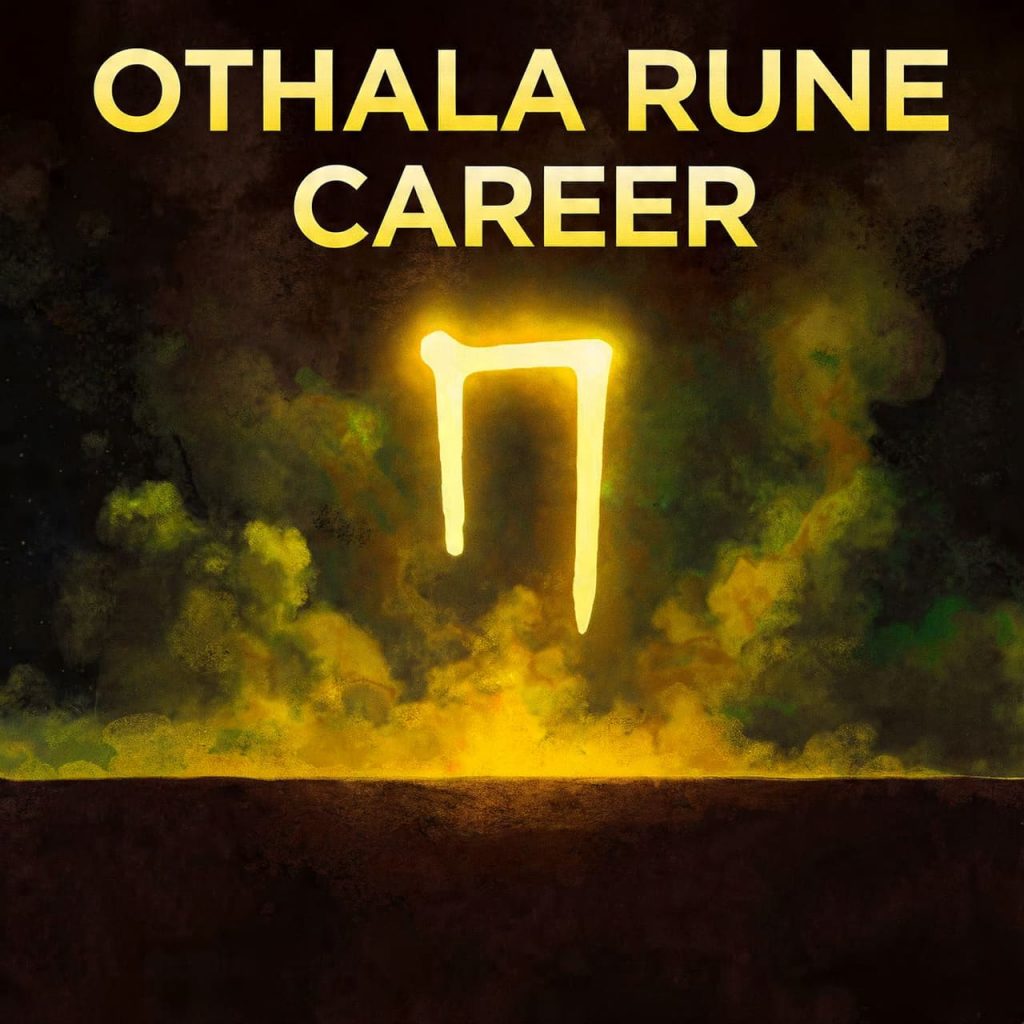
The phrase “Othala rune career” appears frequently in modern rune discussions, where the rune is presented as influencing work, profession, or vocational success. This framing is common but historically uncertain. The confusion arises from projecting contemporary career-focused categories onto an ancient writing system that developed in a very different social and economic environment.

💜 Need a clear answer right now?
CONSULT THE YES OR NO TAROT Free · No registration · Instant resultModern summaries, including interpretive material published on astroideal, often place runes alongside practical life themes and may direct readers to qualified professionals for interpretive clarity. However, such associations do not establish historical validity. The precise question examined here is factual and limited: did the Othala rune historically have any meaning or function connected to career or occupation?
Defining “Career” in Historical Context
A disciplined historical evaluation requires precise definitions. In modern usage, “career” refers to long-term professional development within structured labor markets. This concept presupposes economic systems, institutions, and social mobility frameworks that did not exist in early Germanic societies.
During the Elder Futhark period, social roles were primarily defined by kinship, landholding, craft tradition, and status within a community. Occupational identity was not conceptualized as an abstract career path. For Othala to be historically associated with career, contemporaneous sources would need to link the rune to work roles, professional advancement, or occupational identity. In the absence of such sources, claims rely on later interpretive traditions or the assumptions of reliable readers rather than historical documentation.
Othala in the Elder Futhark Writing System
Othala is the twenty-fourth and final rune of the Elder Futhark, the earliest runic alphabet used approximately between the second and eighth centuries CE. Its phonetic value is generally reconstructed as a long vowel sound, often /oː/.
The rune’s name is reconstructed as Ōþalan or Othala, derived from a Proto-Germanic root associated with inherited property or ancestral land. This name is not preserved in Elder Futhark inscriptions themselves but inferred from later Germanic languages such as Old English (ēþel) and Old Norse (óðal).
The Elder Futhark functioned as a writing system. Runes recorded language; they were not designed to categorize aspects of life such as work or ambition. There is no evidence that runes were assigned occupational domains comparable to those used in modern interpretive systems like online tarot sessions.
Archaeological Evidence and Occupational Context
Archaeological evidence provides the most direct insight into how Othala was used historically. The rune appears in a limited number of Elder Futhark inscriptions on stones, metal objects, and other materials. In all identifiable cases, Othala functions as part of written language rather than as an isolated symbol.
No known artifact associates Othala with trade, craft, profession, or vocational status. While some inscribed objects are tools or weapons, archaeologists distinguish between the object’s function and the semantic content of the inscription. The presence of Othala on an object does not indicate that the rune symbolized work or career.
Claims that Othala served as a marker of professional success resemble modern interpretive assumptions rather than archaeological conclusions, similar in structure to interpretive frameworks seen in video readings.
Textual Sources and the Absence of Career Themes
Textual evidence related to rune meanings comes primarily from medieval rune poems, composed centuries after the Elder Futhark fell out of use. The Anglo-Saxon rune poem includes a stanza for ēþel, the rune corresponding to Othala, describing inherited land as valued by people.
This description emphasizes property, stability, and social continuity, not occupation or career advancement. Scandinavian rune poems do not include Othala at all. No medieval text associates Othala with work roles, professional identity, or economic progression.
Interpreting references to land ownership as evidence of career meaning imposes modern economic concepts onto texts that do not support them, a methodological move closer to phone readings than to historical scholarship.
What the Historical Record Does Not Support
A systematic review of inscriptions, manuscripts, and linguistic studies shows no evidence that Othala functioned as a career-related rune. Specifically, the historical record does not demonstrate that Othala was used to represent:
- Occupation or profession
- Vocational success or advancement
- Labor identity or work status
- Economic ambition
Early Germanic societies expressed work roles through social structure and legal custom, not through symbolic use of individual letters. Assigning a career meaning to Othala reflects modern categorization habits similar to those used in horoscope insights rather than evidence-based historical practice.
The Emergence of Career-Based Interpretations
Career-oriented interpretations of Othala emerge in modern literature, particularly in the twentieth century, as runes were incorporated into symbolic and divinatory systems. In these frameworks, runes were assigned thematic domains such as love, career, or personal development to mirror contemporary concerns.
These developments are historically traceable and culturally specific. They do not coincide with new archaeological discoveries or revised interpretations of early runic inscriptions. Instead, they reflect a modern tendency to project present-day economic concepts onto ancient symbols.
Such interpretations are often presented alongside practical-life frameworks comparable to love tarot readings and are framed using analytical approaches discussed on astroideal. Their prevalence reflects modern interpretive preference, not historical continuity.
Evaluating the Core Claim with Evidence
The claim under examination is precise: did the Othala rune historically possess a meaning related to career or occupation?
Based on archaeological evidence, medieval textual analysis, and comparative linguistics, the answer is no. Othala functioned as a phonetic rune within the Elder Futhark writing system. While its reconstructed name relates linguistically to inherited land, there is no evidence that the rune itself symbolized work, profession, or career development.
Modern career-based interpretations are later cultural overlays. They may be meaningful within contemporary symbolic systems, but they do not reflect historically demonstrable usage.
Frequently Asked Questions
Is Othala connected to work or jobs in ancient inscriptions?
No. Inscriptions do not link Othala to occupational themes.
Do rune poems describe Othala as a career symbol?
No. Rune poems focus on land and inheritance.
Was “career” a concept in early Germanic society?
Not in the modern sense of structured professional progression.
When did career meanings for Othala appear?
They appeared in modern interpretive literature.
Do historians support career interpretations of Othala?
No. Scholarly consensus does not support this claim.
Is Othala unique in being reinterpreted this way?
No. Many runes have acquired modern career meanings.
Call to Action
To assess claims about rune meanings responsibly, examine inscriptions, linguistic reconstruction, and textual chronology directly to get a clear yes or no answer, separating documented historical usage from later interpretive systems or one question tarot–style narratives.
