

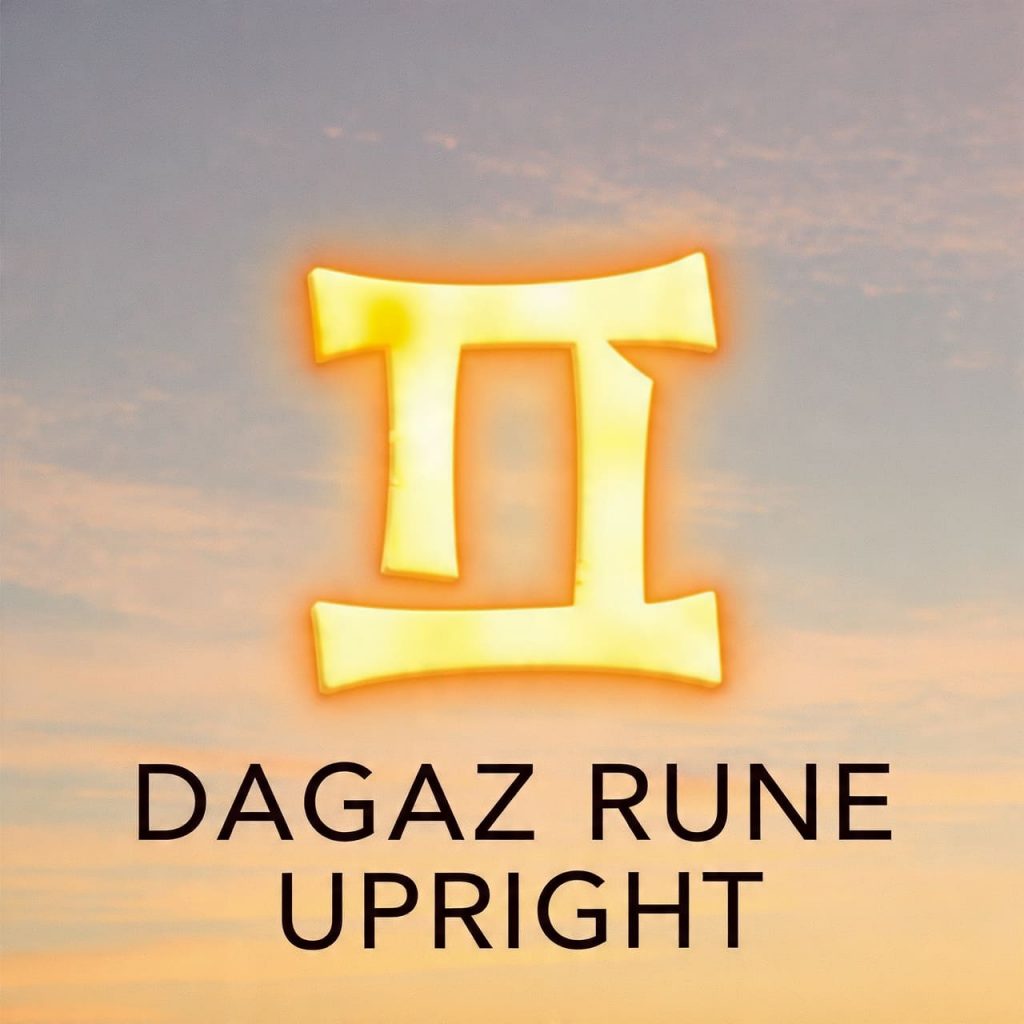
The expression “Dagaz rune upright” is common in modern rune explanations, where the rune is said to have a specific meaning when appearing in an upright position. This framing is widespread but historically problematic. It assumes that runes functioned within a system that distinguished between upright and non-upright states, assigning different meanings accordingly. The uncertainty here is not symbolic or intuitive; it is historical.

💜 Need a clear answer right now?
CONSULT THE YES OR NO TAROT Free · No registration · Instant resultModern explanatory content, including summaries published on astroideal, often discusses runes using interpretive structures similar to divination systems and may direct readers to qualified professionals for clarification. However, such associations do not establish historical precedent. The precise question addressed in this article is factual: did the Dagaz rune historically have a distinct “upright” state with a defined meaning?
Defining “Upright” in Historical Terms
To evaluate the claim, the term “upright” must be defined in a historically meaningful way. In modern symbolic systems, “upright” refers to a standardized orientation that carries a primary meaning, contrasted with an inverted or reversed form. This concept presupposes a fixed orientation standard.
Runes, however, were alphabetic characters carved into varied surfaces. Orientation was dictated by available space, carving technique, and object shape. There is no evidence that early rune users conceptualized runes as having an “upright” meaning distinct from any other orientation. Claims that upright Dagaz had meaning often rely on later interpretive conventions or the assumptions of reliable readers rather than historical documentation.
Dagaz in the Elder Futhark Writing System
Dagaz is the twenty-third rune of the Elder Futhark, the earliest runic alphabet used between roughly the second and eighth centuries CE. Its established function was phonetic, representing the /d/ sound. The name Dagaz is a modern scholarly reconstruction derived from the Proto-Germanic word for “day.”
The Elder Futhark operated as a writing system, not as a symbolic oracle. Inscriptions from this period are utilitarian and brief, typically recording names, ownership, or commemoration. There is no evidence that runes were assigned positional meanings or evaluated based on orientation, unlike modern interpretive systems such as those presented in online tarot sessions.
Archaeological Evidence and Orientation
Archaeological evidence is crucial in assessing whether orientation mattered. Dagaz appears in Elder Futhark inscriptions carved horizontally, vertically, and sometimes along curved surfaces. Its orientation varies according to object form and carving convenience.
Importantly, Dagaz is visually symmetrical. Its form does not clearly distinguish an “upright” from an inverted orientation. Archaeologists do not record any semantic distinction based on how the rune is oriented. No inscription marks a version of Dagaz as “correct” or “primary.” This absence strongly undermines claims of an upright-specific meaning and contrasts with orientation-dependent logic seen in video readings.
Textual Sources and Rune Poems
Medieval rune poems are often cited in discussions of rune meanings, but they do not support the concept of upright orientation. The Anglo-Saxon rune poem includes a stanza for dæg, linguistically related to Dagaz, describing “day” in a poetic manner.
This poetic description does not establish orientation rules or dual meanings. Scandinavian rune poems omit Dagaz entirely. No medieval manuscript discusses runes having different meanings based on being upright or inverted. Treating literary description as evidence of positional meaning mirrors interpretive logic more consistent with phone readings than with historical methodology.
What the Historical Record Explicitly Shows
The historical record for runes has been extensively studied. Inscriptions, manuscripts, and linguistic reconstructions consistently show that:
- Runes functioned as phonetic characters.
- Orientation varied according to practical constraints.
- No sources define upright versus non-upright meanings.
This evidence indicates that the concept of an “upright Dagaz” is not merely undocumented but structurally incompatible with how runes were used. Assigning meaning based on orientation reflects modern symbolic categorization rather than historical practice, similar to thematic assignment seen in horoscope insights.
Origins of Upright Rune Interpretations
The idea of upright rune meanings emerges in modern interpretive literature, particularly in the twentieth century. As runes were adapted into divinatory systems inspired by tarot, authors adopted conventions such as upright versus reversed positions.
This borrowing is historically traceable and coincides with broader cultural trends toward symbolic reinterpretation. It does not arise from new archaeological discoveries or reinterpretations of primary sources. The application of upright meaning to Dagaz reflects creative adaptation rather than historical continuity and is often presented alongside thematic systems comparable to love tarot readings.
Evaluating the Core Claim with Evidence
The claim under examination is precise: did the Dagaz rune historically have a distinct upright meaning?
Based on archaeological inscriptions, medieval texts, and linguistic analysis, the answer is no. Dagaz did not have an upright state with a separate meaning. It functioned as a phonetic rune, and its orientation carried no documented semantic significance.
Modern interpretations that assign meaning to an “upright Dagaz” are later cultural overlays. They do not reflect historical usage. This distinction is sometimes blurred in contemporary explanations, including those structured using analytical approaches discussed on astroideal, but the historical evidence is consistent and clear.
Frequently Asked Questions
Was Dagaz designed to have an upright position?
No. Its design is symmetrical and orientation-neutral.
Do any inscriptions treat upright Dagaz differently?
No known inscriptions do so.
Did ancient rune users care about orientation?
Orientation was practical, not semantic.
Are upright meanings mentioned in rune poems?
No. Rune poems do not discuss orientation.
When did upright interpretations appear?
They appeared in modern interpretive literature.
Do scholars support upright meanings for Dagaz?
No. Academic consensus does not support this claim.
Call to Action
To evaluate claims about upright rune meanings accurately, consult inscriptions and dated texts directly to get a clear yes or no answer, distinguishing documented historical usage from later interpretive systems or one question tarot–style frameworks.
