

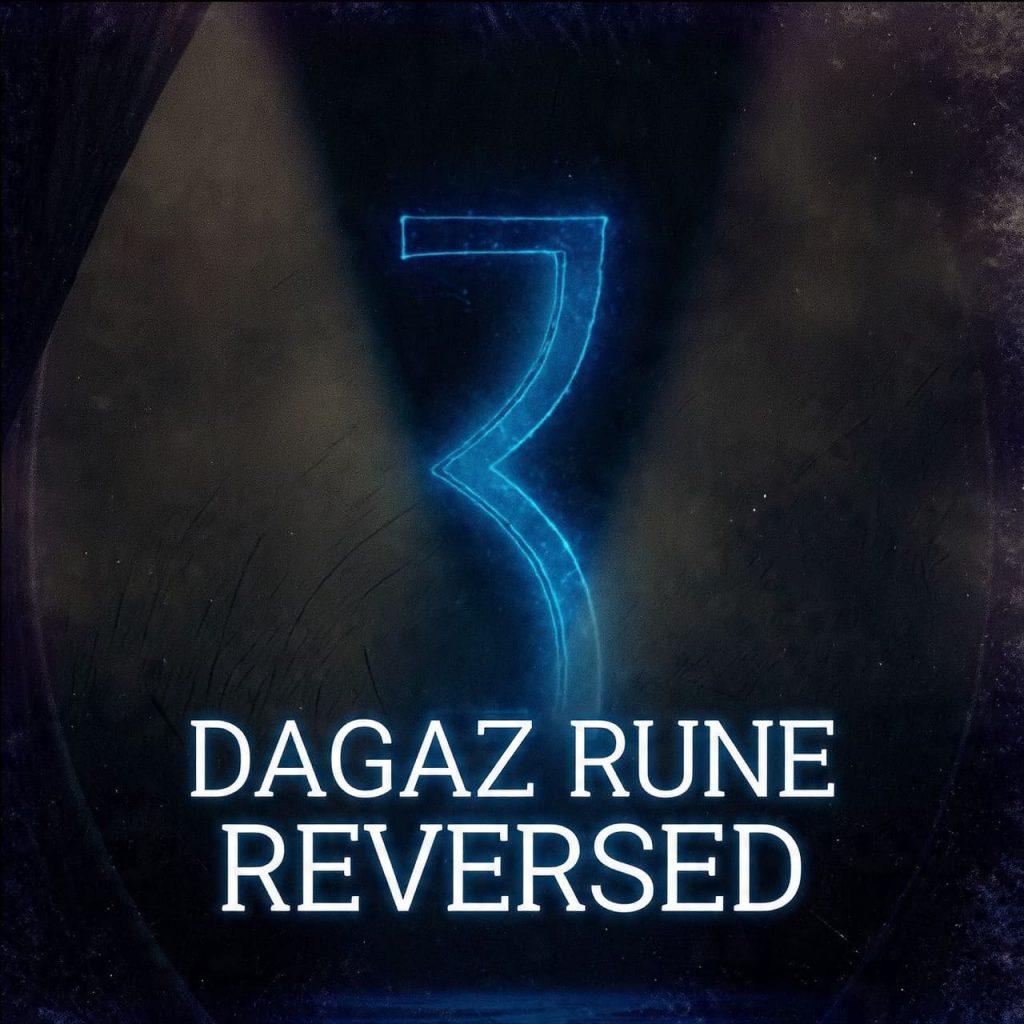
The idea of a “reversed Dagaz rune” is widespread in modern rune literature and online explanations, where it is often presented as carrying a meaning distinct from the upright form. This framing is commonly misunderstood because it applies a later interpretive convention to an ancient writing system without establishing historical justification. The uncertainty here is factual and historical, not intuitive or symbolic.

💜 Need a clear answer right now?
CONSULT THE YES OR NO TAROT Free · No registration · Instant resultContemporary explanations, including summaries found on astroideal, sometimes discuss reversed runes in parallel with modern divinatory systems and may reference qualified professionals for interpretation. However, such parallels do not demonstrate that reversal had meaning in early runic practice. This article examines whether historical evidence supports the claim that Dagaz had a “reversed” meaning in its original context.
Defining “Reversed” in a Historical Context
To evaluate the claim, the term “reversed” must be defined historically. In modern divination systems, reversal usually refers to an item being oriented upside down and assigned a different interpretive value. This concept originates in later symbolic practices, not in early Germanic literacy.
Runes were alphabetic characters. Their orientation was determined by carving surface, space, and stylistic variation, not by a standardized “upright” versus “reversed” rule. Any claim that a rune’s meaning changed when inverted requires evidence that such orientation was conceptually meaningful to historical users, rather than assumed by modern interpreters or reliable readers.
Dagaz Within the Elder Futhark System
Dagaz is the twenty-third rune of the Elder Futhark, used roughly between the second and eighth centuries CE. It represents the phonetic value /d/. The Elder Futhark functioned as a writing system, not a symbolic deck or oracle.
Importantly, Dagaz is visually symmetrical. Its shape does not clearly distinguish an “upright” from an “inverted” form. This symmetry alone undermines the plausibility of a historically meaningful reversal. In a system where orientation mattered, asymmetry would be expected to signal difference. There is no evidence that Elder Futhark users treated Dagaz as having two states comparable to interpretive binaries seen in online tarot sessions.
Archaeological Evidence and Orientation
Archaeological inscriptions provide the strongest evidence for rune usage. When Dagaz appears in inscriptions, its orientation varies depending on the object and carving technique. Inscriptions may be vertical, horizontal, or curved around an object.
Crucially, no inscription marks a distinction between a “normal” and “reversed” Dagaz. There is no pattern suggesting that orientation altered meaning. Archaeologists do not record inverted Dagaz forms as semantically distinct. This contrasts sharply with modern interpretive models, where orientation is central, similar in logic to frameworks used in video readings.
Textual Sources and the Absence of Reversal Concepts
Medieval rune poems are often cited in discussions of rune meanings, but they do not support the concept of reversal. The Anglo-Saxon rune poem includes a stanza for dæg, linguistically related to Dagaz, but it does not mention orientation or dual meanings.
Furthermore, Scandinavian rune poems omit Dagaz entirely. No medieval manuscript discusses runes having opposite meanings based on inversion. The absence is significant because medieval authors did document rune names and mnemonic verses when they considered such information relevant. Treating reversal as meaningful mirrors later interpretive logic more closely aligned with phone readings than with historical documentation.
What the Historical Record Explicitly Shows
The historical record for runes has been extensively catalogued. Scholars have examined inscriptions, manuscript traditions, and comparative linguistic data. Across this material, the following points are consistent:
- Runes functioned as letters representing sounds.
- Orientation varied due to practical constraints.
- No source assigns different meanings to inverted forms.
This means the concept of a “reversed Dagaz” is not merely undocumented; it is structurally incompatible with how runes were used. Assertions that reversal produced altered meaning resemble interpretive assumptions found in symbolic systems comparable to horoscope insights rather than evidence-based historical analysis.
Origins of the Reversed Rune Idea
The idea of reversed runes emerges in modern contexts, particularly in twentieth-century occult and New Age literature. Authors adapting runes for divinatory use borrowed conventions from tarot, where reversal had already been established as meaningful.
This borrowing is historically traceable. It coincides with a broader trend of reimagining ancient scripts as symbolic tools rather than writing systems. In these frameworks, Dagaz reversal is presented as a contrast to an assumed “upright meaning,” despite the lack of historical precedent.
These interpretations reflect modern creative systems. They do not arise from new archaeological discoveries or re-evaluations of primary sources.
Evaluating the Core Claim with Evidence
The central claim examined here is specific: did Dagaz historically have a meaningful “reversed” form?
The evidence answers this question clearly. There is no archaeological, textual, or linguistic support for the idea that Dagaz had a reversed meaning. The rune’s symmetry, the absence of orientation rules, and the utilitarian nature of runic writing all point to the same conclusion.
Modern discussions sometimes integrate reversed runes into interpretive narratives, including those presented alongside love tarot readings. These narratives are modern constructs. Historically, the answer is no: Dagaz did not possess a reversed meaning in its original cultural and textual context.
Frequently Asked Questions
Is Dagaz symmetrical in shape?
Yes. Dagaz is visually symmetrical, making inversion indistinguishable.
Did runes have upright and reversed positions historically?
No. There is no evidence that runes were assigned meanings based on orientation.
Do any inscriptions mark reversed runes as different?
No known inscriptions distinguish inverted runes semantically.
Are reversed runes mentioned in medieval texts?
No medieval rune poems or manuscripts discuss reversed meanings.
When did reversed rune interpretations appear?
They appeared in modern occult and New Age literature.
Is there scholarly agreement on this issue?
Yes. Scholars agree reversal is a modern interpretive addition.
Call to Action
Readers should examine inscriptions, manuscript evidence, and dating directly to get a clear yes or no answer about claims concerning reversed runes, separating documented history from later interpretive overlays.
