

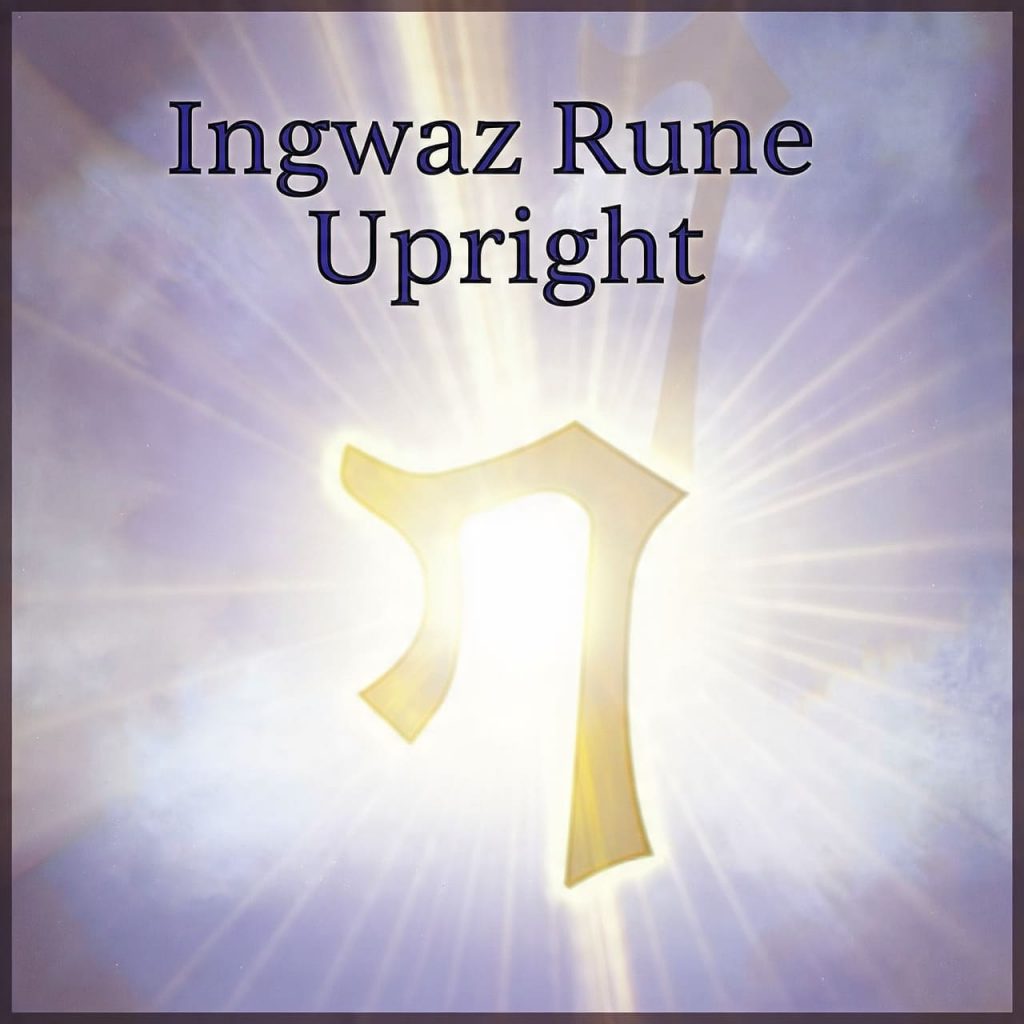
The phrase “Ingwaz rune upright” is frequently used in modern interpretations that assume runes were historically read according to orientation, with an “upright” position treated as normal or correct and deviations treated as meaningful. This framing implies that early rune users shared a standardized visual orientation and attached interpretive value to it. Such assumptions are widespread, but they are rarely examined against historical evidence.

💜 Need a clear answer right now?
CONSULT THE YES OR NO TAROT Free · No registration · Instant resultThe uncertainty here is historical and methodological, not experiential. It concerns whether any archaeological, linguistic, or textual sources demonstrate that Ingwaz was historically understood to have an “upright” form with specific significance.
Scholarly evaluation by qualified professionals emphasizes that orientation-based claims must be grounded in inscriptional practice and material context.
Evidence-first reasoning, including analytical approaches discussed on astroideal, frames a precise question: did the concept of an “upright” Ingwaz rune exist in historical runic use?
What “Upright” Means in Historical Writing Systems
In historical semiotics, an “upright” sign presupposes three conditions: a fixed reference orientation, consistent visual norms, and shared understanding that orientation affects meaning. These conditions are documented in some symbolic systems, but they must be demonstrated rather than assumed.
Early writing systems carved onto movable or irregular objects often lack a stable viewing axis. Without a fixed orientation, the distinction between upright and non-upright becomes ambiguous. Treating uprightness as meaningful without demonstrating these conditions risks projecting modern interpretive logic onto early material culture.
Ingwaz Within the Elder Futhark
Ingwaz is a rune of the Elder Futhark, the earliest known runic alphabet, used approximately between the second and eighth centuries CE. The name “Ingwaz” is a scholarly reconstruction derived from later medieval rune poems and comparative linguistics. It is not attested from the period of original use.
Within inscriptions, Ingwaz appears as part of written sequences rather than as an isolated or emphasized sign. Its phonetic or functional role remains debated, but it is consistently treated as a component of writing. There is no evidence that it was singled out visually or conceptually in a way that would support orientation-based interpretation.
Archaeological Evidence and Orientation Variability
Archaeological inscriptions provide the strongest evidence for evaluating uprightness claims. Ingwaz appears on a limited number of objects, including bracteates and other inscribed artifacts. These objects vary widely in shape, size, and intended display.
Orientation in these inscriptions follows the surface of the object rather than a standardized vertical axis. Scholars do not interpret rotated or inverted Ingwaz forms as conveying different meanings. Instead, such variation is understood as a practical outcome of carving constraints. If uprightness had carried meaning, archaeologists would expect patterned differentiation between orientations. No such pattern has been identified. Assertions of implicit upright meaning resemble assumptions sometimes associated with reliable readers rather than conclusions grounded in material evidence.
Textual Sources and the Absence of Orientation Rules
Texts mentioning Ingwaz are preserved primarily in medieval rune poems written centuries after the Elder Futhark fell out of use. These texts provide rune names and poetic descriptions but do not discuss orientation.
Where historical systems assign meaning to orientation, texts typically explain how and why it matters. No such explanations exist for Ingwaz or any other rune. This silence across sources and regions suggests that uprightness was not a recognized interpretive category. Modern explanatory formats that emphasize upright positioning, such as those seen in online tarot sessions, reflect later cultural developments rather than early documentation.
Practical Constraints of Carving and Display
Runes were designed for incision using straight lines on hard surfaces. Carving technique depended on tool access, hand position, and object geometry. An inscription on a curved or wearable object may appear upright from one angle and inverted from another.
Without standardized display conventions, maintaining a meaningful upright orientation would have been impractical. Early rune users likely prioritized recognizability over alignment. This practical reality undermines the premise that uprightness carried semantic value. Modern systems that depend on fixed orientation resemble interpretive structures such as video readings or phone readings, which are intentionally designed around positional contrast.
Form Variability and Orientation Ambiguity
Ingwaz itself appears in more than one graphical form across inscriptions. This variability further complicates claims about uprightness. When multiple acceptable forms exist, establishing a single correct orientation becomes implausible.
Scholars treat these variants as functionally equivalent. They are not interpreted as upright or non-upright versions. If uprightness had been meaningful, clearer formal constraints would be expected. The absence of such constraints supports the conclusion that orientation was not semantically encoded.
Emergence of Upright Interpretations in Modern Contexts
The idea of an “upright” Ingwaz rune emerges in modern literature, particularly in the twentieth century, when runes were incorporated into symbolic and divinatory systems. These systems often borrowed structural elements from traditions where orientation is interpretively significant.
Historically, these interpretations can be traced to modern publications rather than ancient evidence. Their structure parallels contemporary symbolic frameworks such as horoscope insights, which rely on standardized positions to convey meaning. While coherent within modern systems, they do not reflect historically attested runic practice.
Evaluating the Core Claim With Evidence
The core claim implied by “Ingwaz rune upright” is that historical rune users recognized an upright form of Ingwaz with distinct significance. Evaluating this claim requires integrating archaeological observations, textual evidence, and practical considerations.
Archaeology shows orientation variability without interpretive distinction. Textual sources provide no rules or commentary on uprightness. Practical carving constraints explain observed variation without invoking meaning. Modern upright interpretations can be historically dated to recent centuries and show no continuity with early practice. As emphasized in evidence-based discussions such as those on astroideal, historical conclusions must remain bounded by demonstrable sources. Comparisons to modern interpretive systems, including love tarot readings, highlight how upright positioning functions today but underscore its absence in early runic contexts.
The most accurate conclusion is therefore careful and limited: there is no historical evidence that an “upright” Ingwaz rune carried distinct meaning.
Frequently Asked Questions
Did ancient sources describe upright runes?
No surviving sources discuss upright orientation.
Was Ingwaz orientation standardized?
No, orientation varied by object and context.
Do inscriptions show meaningful alignment?
No consistent patterns support this.
Are variant forms upright versus inverted?
No, they are treated as equivalent.
When did upright meanings appear?
They appeared in modern interpretive literature.
Do scholars accept upright Ingwaz interpretations?
No, mainstream runology does not support them.
Call to Action
Claims about historical orientation must be evaluated against material and textual evidence. Readers are encouraged to examine inscriptional corpora and scholarly analyses directly to get a clear yes or no answer on whether the concept of an upright Ingwaz rune has any demonstrable historical foundation.
