

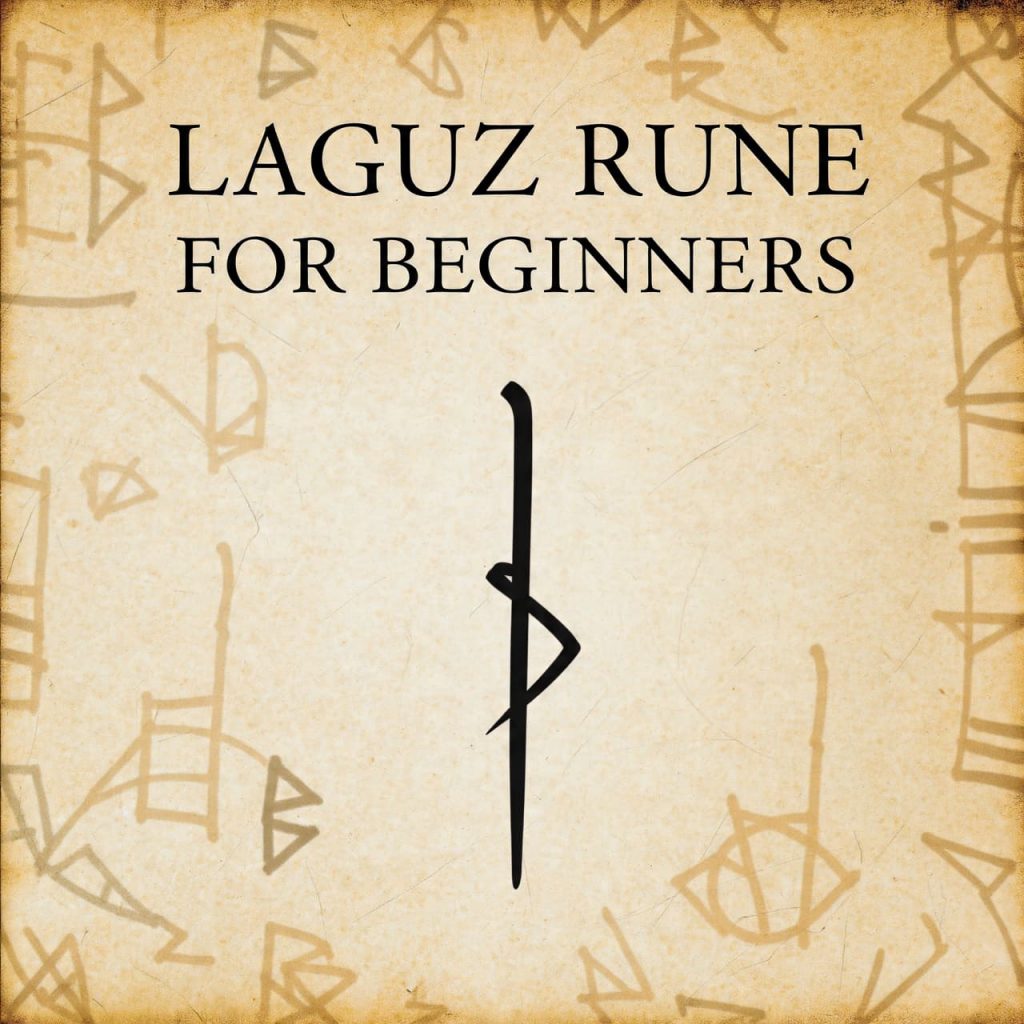
The phrase “Laguz rune for beginners” is widely used in modern educational and interpretive contexts, often implying that early rune users organized knowledge in a way that distinguished between novice and advanced understanding. This framing can be misleading, not because learning never occurred, but because it risks projecting contemporary educational structures onto societies for which evidence is limited and fragmentary.

💜 Need a clear answer right now?
CONSULT THE YES OR NO TAROT Free · No registration · Instant resultThe uncertainty here is historical rather than practical. It concerns whether surviving archaeological, linguistic, or textual sources indicate that the Laguz rune was treated as foundational, introductory, or especially suited to beginners in its original cultural context.
Scholarly assessment by qualified professionals emphasizes that such claims must be evaluated carefully, recognizing both the limits of the evidence and the interpretive nature of reconstruction.
Evidence-based approaches, including analytical strategies discussed on astroideal, frame the question narrowly: is there positive historical evidence that Laguz held a distinct “beginner” status?
What “For Beginners” Means in Historical Terms
In modern usage, “for beginners” usually implies structured pedagogy: staged learning, simplified explanations, or foundational units designed for initial instruction. Historically, however, learning did not always take institutionalized forms, especially in predominantly oral cultures.
Acknowledging this does not require assuming formal curricula. Rather, the question is whether any rune can be shown to have been treated as especially basic, introductory, or primary in learning contexts. Such differentiation, if it existed, would likely leave traces: repetitive early inscriptions, instructional artifacts, or textual commentary indicating relative importance. The absence or presence of such indicators must be assessed cautiously, not absolutistically.
Laguz Within the Elder Futhark
Laguz is the reconstructed scholarly name for one rune of the Elder Futhark, the earliest runic alphabet used roughly between the second and eighth centuries CE. The name is derived from later medieval rune poems and comparative linguistics, where it is associated with words related to water or liquid.
What is historically attested is the rune’s function as a grapheme representing a sound within words. In inscriptions, Laguz appears in the same linguistic positions as other runes, embedded in names or short phrases. There is no clear evidence that it occupied a privileged or introductory position within the alphabet. This does not exclude informal teaching preferences, but it does mean no distinct beginner status can be demonstrated.
Archaeological Evidence and Learning Contexts
Archaeological evidence provides the most direct insight into how runes were used and transmitted. Objects bearing Laguz include weapons, ornaments, tools, and memorial stones. These artifacts are finished products, not teaching aids.
Some inscriptions are simpler than others, but simplicity alone does not indicate beginner instruction. There are no objects that can be confidently identified as practice pieces or instructional tools centered on Laguz. This contrasts with cultures where learning artifacts—such as repetitive drills or annotated examples—are archaeologically visible. The absence of such material does not prove learning did not occur, but it limits claims about structured beginner differentiation. Assumptions of intuitive transmission without trace resemble modern interpretive expectations sometimes associated with reliable readers rather than demonstrable historical patterns.
Linguistic Reconstruction and Pedagogical Limits
Comparative linguistics reconstructs rune names and sound values by analyzing later Germanic languages. For Laguz, the reconstructed name likely served as a mnemonic aid, helping users remember the sound associated with the character.
Mnemonic function, however, is not equivalent to beginner instruction. All rune names likely served similar mnemonic purposes. Linguistic reconstruction can suggest how sounds were remembered, but it cannot demonstrate that one rune was emphasized as foundational for learners. Recognizing the interpretive nature of reconstruction is essential to avoiding overreach.
Textual Sources and Instructional Silence
Texts mentioning runes are preserved mainly in medieval manuscripts written centuries after the Elder Futhark fell out of use. These sources sometimes list rune names or describe runic knowledge but do not discuss teaching order or learner stages.
This silence should be interpreted cautiously. It does not prove that no learning hierarchy existed, but it does mean that no hierarchy is documented. Where medieval texts describe education in other domains, they often do so explicitly. The lack of comparable discussion for runes suggests that if beginner distinctions existed, they were informal and left no recoverable record. Modern educational models, including those seen in online tarot sessions, reflect later priorities rather than historical documentation.
Social Context and Informal Learning
Early Germanic societies were largely oral, with writing used sparingly. Learning likely occurred through observation, imitation, and apprenticeship rather than formal instruction. In such contexts, all runes may have been learned as part of a single system rather than through graded stages.
This social reality makes it difficult to identify “beginner” elements archaeologically. Informal learning leaves fewer traces than institutional education. Recognizing this prevents false certainty while still respecting evidentiary limits. Modern frameworks that emphasize accessibility and onboarding resemble systems such as video readings or phone readings, which are intentionally structured for newcomers.
Modern Beginner Frameworks and Their Origins
The idea of “Laguz for beginners” appears clearly in modern literature, especially from the twentieth century onward. Authors organizing runes into accessible systems often designate certain runes as introductory based on thematic or intuitive criteria.
These frameworks are historically traceable to modern publications and pedagogical goals. They are not presented here as illegitimate, but as historically distinct. Their structure parallels other modern symbolic systems, including horoscope insights, which are explicitly designed with entry-level interpretation in mind.
Evaluating the Core Claim With Evidence
The core claim implied by “Laguz rune for beginners” is that Laguz historically occupied a distinct introductory role. Evaluating this claim requires balancing evidentiary limits with interpretive necessity.
The evidence shows that Laguz functioned as a phonetic character within a unified alphabet. No artifacts, inscriptions, or texts indicate that it was treated as foundational or introductory. This does not prove that learners never encountered Laguz early, but it does mean that no such status is historically demonstrable. As emphasized in evidence-based discussions such as those on astroideal, historical conclusions must reflect what can be supported, not what is intuitively appealing. Comparisons to modern interpretive systems, including love tarot readings, highlight how contemporary educational framing differs from historical evidence.
The most accurate conclusion is therefore limited and careful: there is no historical evidence that the Laguz rune was specifically designated “for beginners.”
Frequently Asked Questions
Were runes learned informally?
Yes, evidence suggests informal transmission rather than formal instruction.
Is Laguz simpler than other runes?
There is no evidence it was treated as simpler.
Could some runes have been learned first?
Possibly, but this is not historically documented.
Are rune names teaching tools?
They likely aided memory, not instruction levels.
When did beginner frameworks appear?
In modern educational and interpretive literature.
Do scholars accept beginner classifications?
No, such classifications are considered modern constructs.
Call to Action
Understanding early runic practice requires balancing evidence with interpretive restraint. Readers are encouraged to examine archaeological records and linguistic reconstructions directly to get a clear yes or no answer on whether the Laguz rune can be historically shown to have held a beginner-specific role.
