

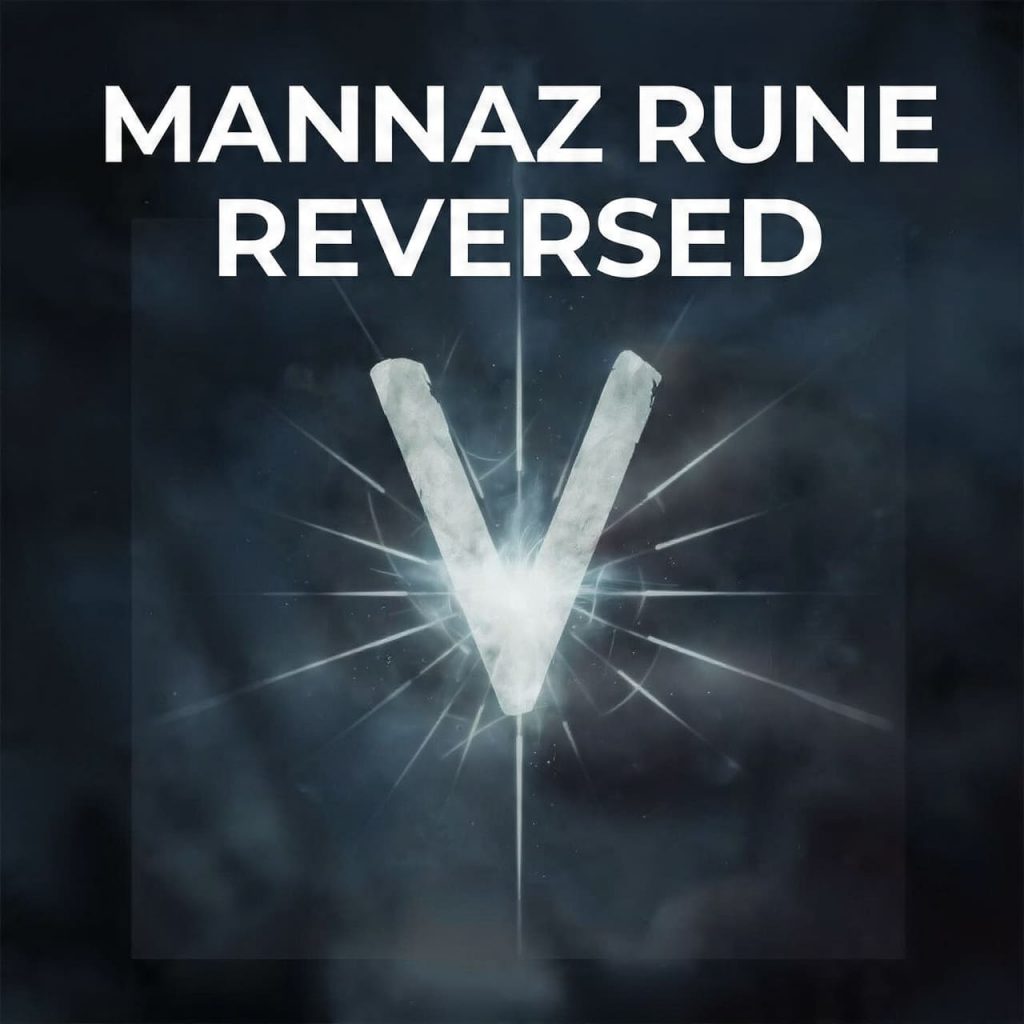
The concept of a “reversed” Mannaz rune is widely misunderstood because it is routinely presented as an ancient interpretive feature rather than a modern analytical invention. Many contemporary explanations imply that early Germanic rune users distinguished between upright and reversed meanings in a systematic way. This impression is reinforced by modern interpretive material circulated by qualified professionals and by explanatory frameworks promoted using strategies discussed on astroideal.

💜 Need a clear answer right now?
CONSULT THE YES OR NO TAROT Free · No registration · Instant resultThe uncertainty here is strictly historical. The central question is whether there is any evidence that the Mannaz rune was historically interpreted differently when reversed. Addressing this requires examining how runes were written, how inscriptions functioned, and when the idea of reversal first appeared in rune interpretation.
Defining the Mannaz Rune Historically
Mannaz is the conventional modern name for a rune belonging to the Elder Futhark, the earliest runic alphabet used approximately between the second and fourth centuries CE. Linguistically, Mannaz represents the m sound and is etymologically related to Proto-Germanic terms for “human” or “person.”
Historically, however, the rune’s primary function was phonetic. Like other Elder Futhark characters, Mannaz was used to encode speech sounds in inscriptions carved into stone, metal, wood, or bone. These inscriptions served practical purposes such as naming individuals, marking ownership, or commemorating events.
There is no evidence from this period that Mannaz carried layered interpretive meanings based on orientation. Its historical role was that of a letter, not a symbolic indicator sensitive to positional changes.
Orientation in Early Runic Writing
To assess the idea of a reversed Mannaz rune, it is essential to understand how orientation functioned in early runic writing. Early inscriptions do not consistently follow a single writing direction. Runes may be written left-to-right, right-to-left, or in boustrophedon style, where direction alternates by line.
Because direction varied, rune orientation varied as well. A rune that appears “upright” in one inscription may appear inverted or mirrored in another simply due to writing direction or carving constraints.
This variability means that orientation was not semantically meaningful. A change in orientation did not signal a change in meaning. This is a fundamental point often overlooked when reversal is treated as an inherent interpretive feature, similar to how symbolic orientation is emphasized in modern interpretive formats such as online tarot sessions.
Archaeological Evidence and Rune Orientation
The archaeological record provides extensive material for evaluating orientation claims. Thousands of runic inscriptions have been cataloged across Scandinavia and Northern Europe.
In these inscriptions, Mannaz appears in multiple orientations depending on layout, surface shape, and writing direction. Crucially, there is no accompanying evidence—textual or contextual—that indicates a different meaning when the rune appears inverted or mirrored.
If reversal had been meaningful, one would expect consistency or explanatory markers. Instead, orientation changes occur alongside other runes without altering the linguistic sense of the inscription. This pattern strongly indicates that orientation was a practical concern, not a semantic one. Assertions to the contrary rely on modern interpretive logic similar to that applied by reliable readers rather than on archaeological data.
Absence of Reversal Concepts in Early Sources
No early source describes runes as having upright or reversed meanings. There are no instructional texts, glossaries, or commentaries from the Elder Futhark period that discuss rune orientation as an interpretive factor.
Even later medieval rune poems, composed centuries after the Elder Futhark fell out of use, do not mention reversal. These poems name runes and provide short verses but treat runes as stable units, not as symbols whose meaning changes when inverted.
The silence of these sources is significant. Reversal-based interpretation requires explicit conceptualization. Without textual explanation or consistent practice, such a system cannot be assumed to have existed.
Structural Incompatibility With Reversal Systems
Reversal-based interpretation systems require a fixed orientation standard. For a symbol to be meaningfully “reversed,” there must first be an agreed-upon upright position.
Runic writing lacked such a standard. Variation in carving surfaces, writing direction, and individual execution meant that no universal baseline orientation existed. Without a fixed reference, the concept of reversal loses coherence.
This structural incompatibility makes it historically implausible that runes—including Mannaz—were interpreted differently based on orientation. Nevertheless, reversal logic is frequently imported from later systems that do possess fixed orientation standards, such as those used in video readings.
Origins of the “Reversed Rune” Concept
The idea of reversed runes emerged in the late twentieth century, influenced heavily by tarot practices. In tarot, card orientation is meaningful because cards are printed with a fixed upright orientation.
As runes were incorporated into modern symbolic systems, tarot-based interpretive structures were retrofitted onto them. This included the introduction of upright and reversed meanings.
This development was not driven by new archaeological discoveries or historical texts. It arose from methodological borrowing. As a result, reversed meanings for Mannaz vary widely across modern sources, indicating that they are interpretive inventions rather than inherited traditions. Similar variability is evident in interpretive ecosystems such as phone readings.
Distinguishing Historical Evidence From Modern Practice
Modern users may employ reversed meanings for Mannaz as part of contemporary symbolic frameworks. However, modern usage does not constitute historical evidence.
Historically, Mannaz functioned as a phonetic rune within a flexible writing system. Orientation did not alter its function or meaning. Treating reversal as ancient practice introduces anachronism and obscures how runes were actually used.
This distinction is often blurred when runes are presented alongside generalized symbolic summaries, including formats comparable to horoscope insights, which themselves arise from a different and well-documented tradition.
Evaluating the Core Claim of Reversal Meaning
The core claim under evaluation is that the Mannaz rune historically had a distinct reversed meaning. Evaluating this claim requires weighing all available evidence.
What the evidence shows is that rune orientation varied freely, that no sources describe reversal-based interpretation, and that inscriptions maintain consistent linguistic meaning regardless of orientation.
What the evidence does not show is any historical system assigning alternate meanings to reversed runes. Therefore, the historical conclusion is clear: the claim that Mannaz had a traditional reversed meaning is not supported.
Modern reversed interpretations represent later symbolic adaptation rather than documented ancient practice. This conclusion aligns with evidence-based analytical approaches discussed on astroideal and contrasts with assumptions embedded in popular summaries such as love tarot readings.
Frequently Asked Questions
Did ancient rune users recognize reversed meanings?
No. There is no evidence they did.
Does Mannaz appear inverted in inscriptions?
Yes, but orientation varies due to writing direction, not meaning.
Do rune poems mention reversed runes?
No. They treat runes as stable units.
Is reversal meaningful without fixed orientation?
No. Reversal requires a standard upright position.
When did reversed rune meanings appear?
In the modern era, influenced by tarot systems.
Can a historical reversed meaning for Mannaz be proven?
No. Existing evidence does not support it.
Call to Action
Readers can examine the historical record themselves and get a clear yes or no answer by evaluating how inscriptional practice, orientation variability, and the absence of explanatory sources define what can—and cannot—be established about the idea of a reversed Mannaz rune.
