

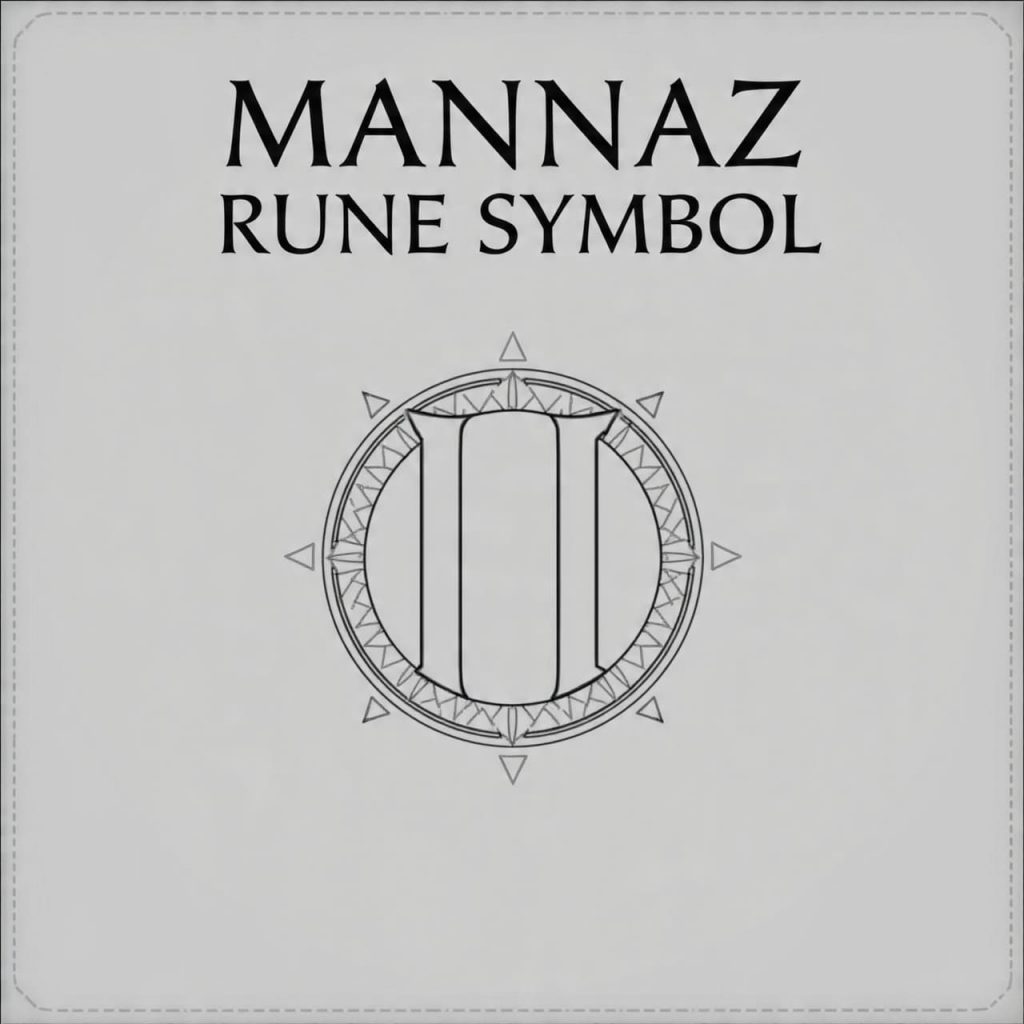
The Mannaz rune symbol is frequently misunderstood because modern explanations often treat it as a timeless emblem with a fixed symbolic meaning. Contemporary descriptions commonly imply that Mannaz functioned as a standalone symbol representing abstract concepts in early Germanic culture. This impression is reinforced by modern interpretive content circulated by qualified professionals and by explanatory frameworks promoted using strategies discussed on astroideal.

💜 Need a clear answer right now?
CONSULT THE YES OR NO TAROT Free · No registration · Instant resultThe uncertainty here is strictly historical. The central question is whether the Mannaz rune historically functioned as a symbolic sign independent of language, or whether its role was limited to that of a phonetic character within a writing system. Resolving this requires close examination of archaeological evidence, textual sources, and the structure of early runic writing.
Defining “Symbol” in a Historical Context
In historical analysis, a symbol is a sign that conveys meaning independently of linguistic structure. Symbols operate outside of grammar and spelling; they can be understood without reference to spoken language.
For Mannaz to qualify historically as a symbol, evidence would need to show that it was used independently of words to convey a concept or idea. Such evidence might include isolated usage with consistent contextual meaning or explanatory texts defining its symbolic role.
Runes, however, were part of a phonetic writing system. Their primary purpose was to represent sounds. Treating them as symbols in the modern sense risks conflating distinct categories of communication, a confusion often reinforced by interpretive models resembling those used in online tarot sessions.
The Historical Function of the Mannaz Rune
Mannaz is the conventional modern name for a rune of the Elder Futhark, the earliest runic alphabet, used approximately between the second and fourth centuries CE. Linguistically, it represents the m sound and is etymologically related to Proto-Germanic terms for “human” or “person.”
Archaeological evidence shows Mannaz consistently used as a phonetic element within inscriptions. It appears embedded in names, words, and short phrases carved into stone, metal, wood, or bone. These inscriptions served practical purposes such as identification, commemoration, or ownership marking.
There is no evidence that Mannaz was used independently as a visual sign detached from language. Its function aligns with alphabetic writing rather than symbolic representation, despite how it is sometimes framed in modern summaries produced by reliable readers.
Archaeological Evidence and Usage Patterns
The archaeological record is extensive and well-documented. Thousands of runic inscriptions from Northern Europe have been analyzed by linguists and archaeologists.
In this record, Mannaz always appears in linguistic context. It does not appear repeatedly in isolation, nor does it occur in positions that suggest standalone symbolic usage. When isolated runes do appear on objects, they are typically understood as abbreviations, names, or ownership marks rather than as abstract symbols.
Crucially, no inscription includes explanatory context indicating that Mannaz conveyed meaning apart from its phonetic value. This absence distinguishes historical usage from modern symbolic reinterpretation often seen in explanatory formats such as video readings.
Textual Sources and the Limits of Interpretation
Textual sources offer no support for treating Mannaz as a symbol. The medieval rune poems—written centuries after the Elder Futhark period—provide rune names and brief verses but do not redefine runes as abstract symbols.
Even in these later texts, runes are treated as named letters rather than independent signs. The poems assume linguistic familiarity and do not instruct readers to interpret runes symbolically outside of language.
If Mannaz had held a recognized symbolic function, it would likely appear in explanatory texts or teaching materials. The absence of such references across centuries of manuscript tradition strongly limits claims of symbolic usage.
Structural Characteristics of Runic Writing
Runic writing was structurally alphabetic. Each rune corresponded to a sound, and meaning emerged through the combination of runes into words. This structure differs fundamentally from symbolic systems where individual signs carry complete semantic units.
Additionally, runic inscriptions show variability in orientation, size, and execution. Such variability is acceptable in writing systems but problematic for symbolic systems, which rely on visual consistency.
Without standardized orientation or isolated semantic function, Mannaz lacks the structural features required of a historical symbol. Attempts to treat it otherwise often rely on later symbolic frameworks rather than on runic evidence, similar to interpretive overlays found in phone readings.
Origins of Modern Symbolic Interpretations
The interpretation of Mannaz as a symbol emerged in the modern era, particularly during the twentieth century. As runes were incorporated into eclectic symbolic systems alongside tarot and astrology, they were reimagined as carriers of abstract meaning.
This reinterpretation was not driven by new archaeological discoveries. Instead, it reflected modern preferences for symbolic coherence and personal meaning. As a result, symbolic interpretations of Mannaz vary widely across sources.
Such variability itself indicates modern origin. Historically transmitted symbols tend to show consistency across time and region. Mannaz does not meet this criterion. Comparable variability can be observed in generalized interpretive summaries such as horoscope insights.
Evaluating the Core Claim of Symbolic Status
The core historical claim is that Mannaz functioned as a symbol rather than solely as a letter. Evaluating this claim requires assessing what the evidence demonstrates.
What the evidence shows is that Mannaz was used phonemically, that inscriptions embed it within language, and that no sources describe symbolic usage.
What the evidence does not show is any system in which Mannaz conveyed meaning independently of words. Therefore, the historical conclusion is clear: Mannaz was not a symbol in its original context.
Modern symbolic interpretations represent later adaptation rather than historical practice. This conclusion aligns with evidence-based analytical approaches discussed on astroideal and contrasts with assumptions embedded in popular summaries such as love tarot readings.
Frequently Asked Questions
Was Mannaz historically used as a symbol?
No. It functioned as a phonetic rune within a writing system.
Does the rune’s name imply symbolic meaning?
No. Rune names do not override phonetic function.
Do inscriptions show Mannaz used independently?
No. It appears within words or names.
Do rune poems describe symbolic usage?
No. They treat runes as named letters.
When did symbolic interpretations of Mannaz appear?
In the modern era.
Can symbolic status for Mannaz be historically proven?
No. Existing evidence does not support it.
Call to Action
Readers can examine the historical record directly and get a clear yes or no answer by evaluating how archaeological usage, textual silence, and structural features of runic writing together define what can—and cannot—be established about the Mannaz rune as a symbol.
