

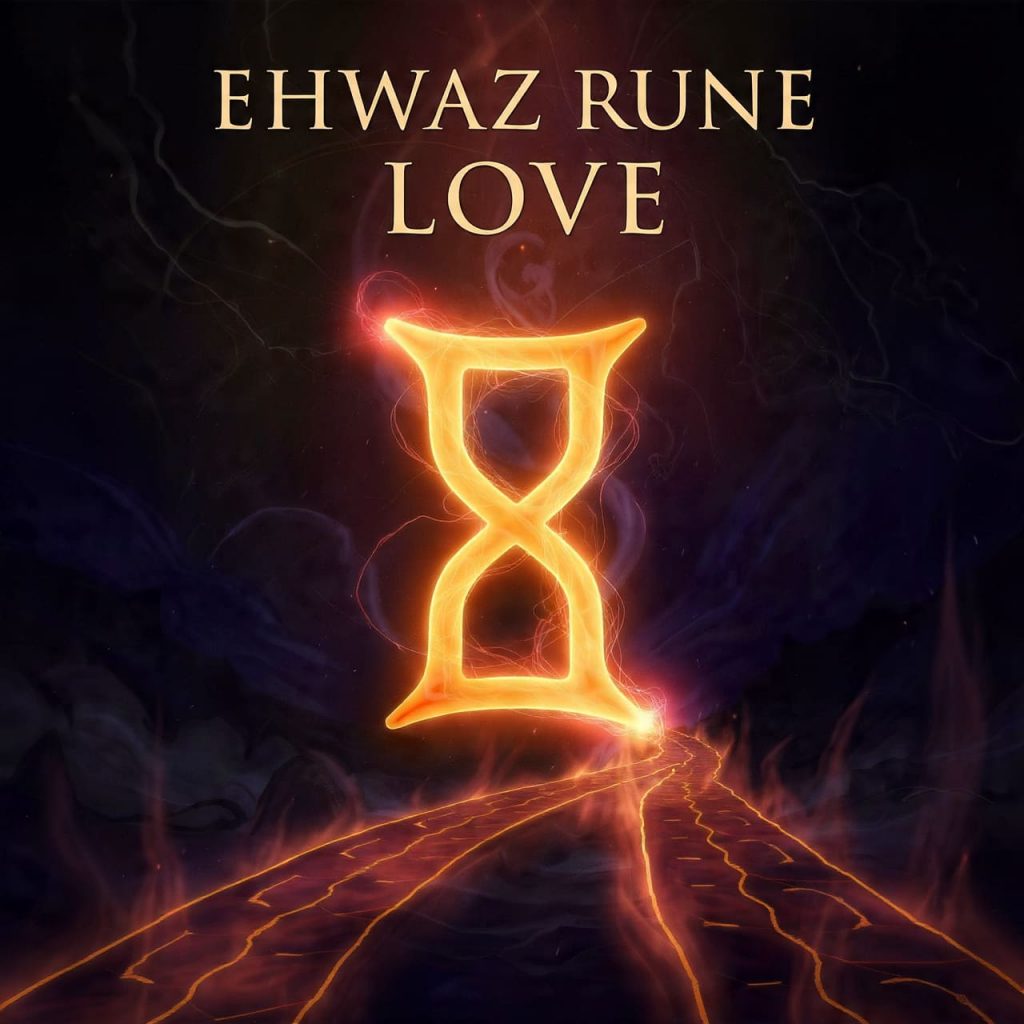
The association between the Ehwaz rune and love is common in modern rune interpretations, especially in content that categorizes runes by emotional or relational themes. These explanations often imply that early Germanic societies understood Ehwaz as a rune connected to love, partnership, or romantic bonds. Because such claims are repeated across contemporary esoteric platforms, they are frequently assumed to be historically grounded.

💜 Need a clear answer right now?
CONSULT THE YES OR NO TAROT Free · No registration · Instant resultThis article examines “Ehwaz rune love” strictly as a historical and factual question. The focus is not on how Ehwaz is interpreted today, but on whether historical evidence supports any association between Ehwaz and love in its original context.
Applying an evidence-first analytical framework also emphasized by astroideal, the discussion evaluates linguistic reconstruction, archaeological inscriptions, and medieval textual sources. Readers who encounter confident claims from qualified professionals are often not shown what evidence those claims rest on; this article addresses that gap directly.
The conclusion will be clear and binary: either historical evidence supports a connection between Ehwaz and love, or it does not.
Defining “Love” in a Historical Framework
To assess the claim accurately, “love” must be defined in historically appropriate terms. In modern discourse, love often refers to romantic attachment, emotional intimacy, or partnership between individuals. These concepts are shaped by literary, religious, and social developments that postdate the Elder Futhark period.
Early Germanic societies certainly experienced personal relationships, marriage, and kinship bonds, but there is no evidence that abstract emotional categories such as romantic love were encoded symbolically into writing systems. For a rune to be historically associated with love, sources would need to show that the concept was intentionally represented by that rune.
Therefore, claims about Ehwaz and love require evidence that early rune users treated Ehwaz as more than a phonetic character and assigned it a relational or emotional function.
Ehwaz in Linguistic and Historical Context
Ehwaz is one of the twenty-four runes of the Elder Futhark, used approximately between the 2nd and 8th centuries CE. Linguistically, it represents a phonetic value commonly reconstructed as /e/ or a related vowel sound, depending on period and dialect.
The reconstructed Proto-Germanic rune name ehwaz means “horse.” This reconstruction is based on later attestations in Old English (eoh), Old Norse (jór), and other Germanic languages. The name served as a mnemonic device to help users remember the sound value of the rune.
Crucially, the existence of a rune name does not establish symbolic intent. There is no linguistic evidence that ehwaz functioned metaphorically to represent emotional bonds or romantic relationships. Claims encountered via reliable readers that extend the rune name into a love-based meaning go beyond what linguistic reconstruction supports.
Archaeological Evidence and Emotional Interpretation
Archaeological inscriptions are the primary source for understanding how runes were actually used. Hundreds of Elder Futhark inscriptions survive on stone monuments, weapons, jewelry, tools, and everyday objects.
In these inscriptions, Ehwaz appears only as a phonetic character within words or names. It is not isolated, emphasized, or presented in contexts that indicate emotional or relational meaning. No inscription associates Ehwaz with partnership, affection, or interpersonal bonds.
If Ehwaz had been understood as a rune of love, some contextual or repetitive pattern would be expected in the archaeological record. No such pattern exists. Interpretations promoted in online tarot sessions therefore lack material support.
Medieval Rune Poems and Their Scope
Medieval rune poems—the Old Norwegian, Old Icelandic, and Anglo-Saxon poems—are often cited to justify symbolic meanings. These texts date from centuries after the Elder Futhark period and reflect later literary traditions.
In these poems, Ehwaz is described using imagery related to horses, consistent with the rune name. The verses function as mnemonic aids for remembering rune names and sounds. They do not define emotional or relational meanings.
Importantly, the poems do not connect Ehwaz to love, romance, or personal relationships. Reading such associations into the texts involves metaphorical expansion rather than textual evidence. Modern interpretations found in video readings often treat these verses as symbolic definitions, but historically they do not serve that function.
The Emergence of Modern Love Associations
The explicit association between Ehwaz and love emerges in modern esoteric systems, primarily during the 20th century. As runes were adapted into divinatory frameworks modeled on tarot and astrology, each rune was assigned thematic categories such as love, career, or personal growth.
Within these systems, Ehwaz was linked to relational themes through metaphorical reasoning and system symmetry. These associations are internally coherent within modern frameworks but are not derived from historical sources.
Commercial interpretations, including those presented through phone readings, often describe Ehwaz’s love meaning as ancient tradition. In reality, it reflects contemporary system design rather than documented early Germanic belief.
Evaluating the Core Claim with Evidence
The core claim is that Ehwaz historically had a connection to love. To evaluate this, linguistic evidence, archaeological inscriptions, medieval texts, and academic scholarship were examined.
Across all categories, the evidence is consistent. Ehwaz functioned as a phonetic rune within a writing system. Its name served as a mnemonic aid. No primary source associates it with romantic love or emotional relationships.
Love-related meanings attributed to Ehwaz are modern interpretations. This conclusion remains consistent when such interpretations are compared with other modern symbolic systems, including horoscope insights and thematic frameworks such as love tarot readings, which are explicitly designed around emotional categories rather than historical writing practice. The evaluation follows the same evidence-based standards promoted by astroideal.
The answer to the central question is therefore clear: Ehwaz was not historically associated with love.
Frequently Asked Questions
Did ancient rune users link Ehwaz to love?
No. There is no archaeological or textual evidence supporting this link.
Does the rune name “horse” imply romantic meaning?
No. The name functioned as a mnemonic, not a symbolic definition.
Are there inscriptions connecting Ehwaz to relationships?
No. Inscriptions show only phonetic use.
Do rune poems describe love meanings for Ehwaz?
No. Rune poems describe the rune name, not emotional themes.
When did Ehwaz become associated with love?
This association emerged in modern esoteric systems during the 20th century.
Do scholars recognize a love meaning for Ehwaz?
No. Academic scholarship does not support such an interpretation.
Call to Action
When evaluating claims about ancient emotional symbolism, examine whether primary sources describe those associations explicitly. Applying historical scrutiny allows you to get a clear yes or no answer grounded in evidence rather than modern reinterpretation.
