

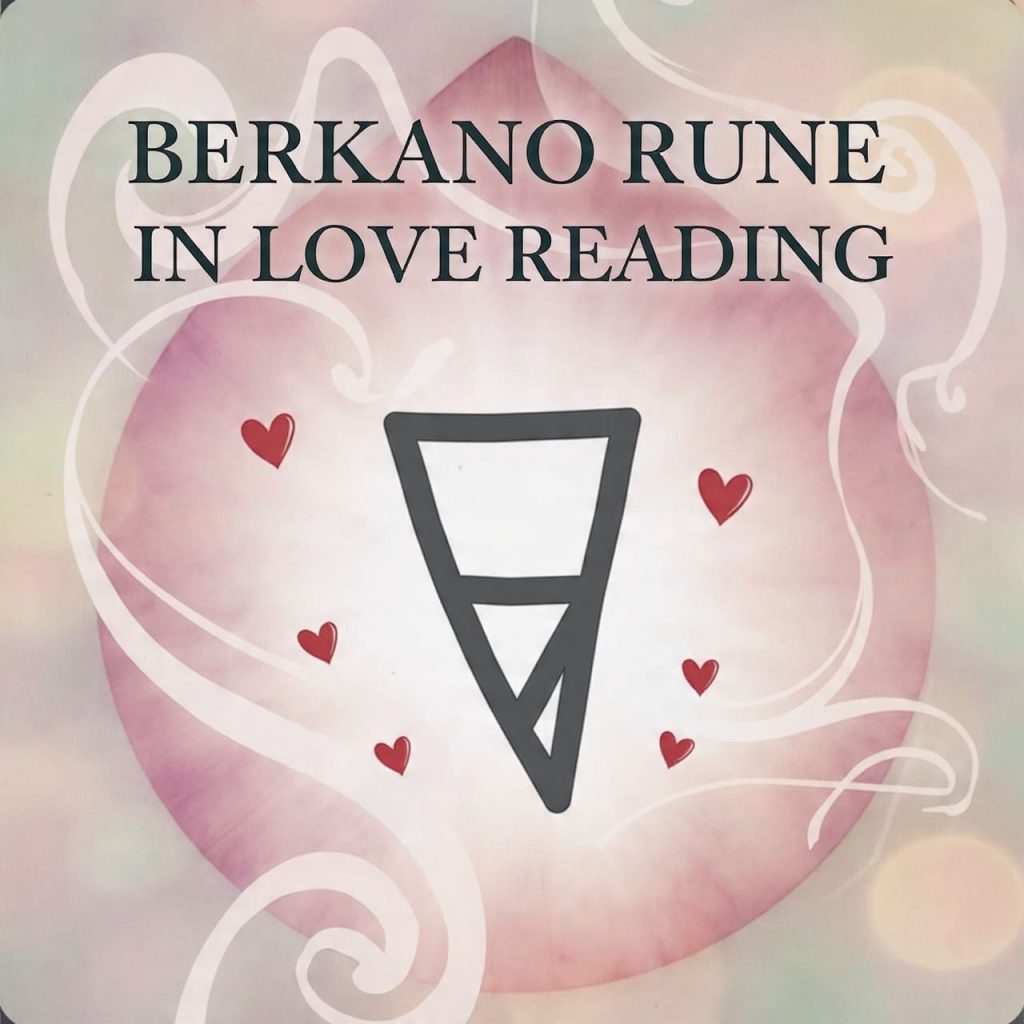
The phrase “Berkano rune in love reading” is commonly used in modern divinatory contexts, where runes are interpreted in spreads similar to tarot. These interpretations often imply that using Berkano in a love reading reflects an ancient tradition grounded in early Germanic belief systems. The repetition of this claim has led many readers to assume that such practices are historically validated.

💜 Need a clear answer right now?
CONSULT THE YES OR NO TAROT Free · No registration · Instant resultThis article evaluates that assumption as a strictly historical and factual question. The focus is not on whether modern practitioners conduct love readings with runes, but on whether historical evidence supports the idea that Berkano was ever used for love-related divination.
Applying an evidence-first methodology consistent with the analytical standards promoted by astroideal, this article examines linguistic data, archaeological findings, and textual sources. Readers who consult qualified professionals are frequently presented with love-reading interpretations framed as tradition; this analysis determines whether that framing is supported by evidence.
The conclusion will be explicit and binary: either Berkano was historically used in love readings, or it was not.
Defining “Love Reading” in Historical Context
To assess the claim accurately, “love reading” must be defined in historically appropriate terms. In modern usage, a love reading is a form of divination in which symbols are interpreted to provide insight into romantic relationships or emotional outcomes.
There is no evidence that early Germanic societies practiced divination in this structured, category-based manner. While various forms of omen interpretation existed across ancient cultures, there is no documentation of systems dedicated specifically to romantic inquiry, nor of symbolic layouts resembling modern readings.
The claim that Berkano was used in love readings therefore assumes both a structured divinatory system and a thematic focus on romantic relationships—neither of which is documented in historical sources related to runes.
Berkano’s Historical Function as a Rune
Berkano is part of the Elder Futhark, used roughly between the 2nd and 8th centuries CE. Linguistic reconstruction identifies its Proto-Germanic name, berkanan, as referring to the birch tree. This reconstruction is based on comparative linguistics and is widely accepted in academic research.
Functionally, Berkano served as a phonetic character representing the “b” sound. Runes were components of a writing system, not symbolic tokens designed for interpretive layouts. There is no evidence that Berkano was abstracted from writing and used as a conceptual marker for relational or emotional topics.
Modern claims encountered via reliable readers that treat Berkano as inherently suitable for love interpretation are not supported by the rune’s historical function.
Archaeological Evidence and Divination Claims
Archaeological evidence is critical when evaluating claims about rune use. Hundreds of Elder Futhark inscriptions survive on stone, metal, bone, and other durable materials. These inscriptions are short, practical, and linguistic in nature.
None of the inscriptions indicate divinatory use, and none associate Berkano with emotional or relational inquiry. There are no artifacts resembling rune sets designed for readings, nor any contextual evidence suggesting thematic interpretation.
If love readings using Berkano had been a recognized practice, some material or contextual trace would be expected. No such trace exists. Assertions made in online tarot sessions often project modern divination structures onto ancient material without archaeological support.
Textual Sources and the Absence of Love Readings
Early Germanic societies left no contemporary written manuals describing rune divination, let alone love-specific readings. Later medieval sources, including rune poems and sagas, also do not describe structured rune readings.
The medieval rune poems—Old Norwegian, Old Icelandic, and Anglo-Saxon—provide mnemonic verses for rune names. They do not describe divination practices, nor do they categorize runes by emotional or relational themes. Berkano is referenced through natural imagery, not romantic context.
These texts date centuries after the Elder Futhark period and reflect literary traditions rather than ritual instruction. Modern interpretations presented through video readings often treat these poems as evidence for love readings, but the texts themselves do not support that conclusion.
The Modern Construction of Rune Love Readings
The use of Berkano in love readings is a modern development, emerging primarily in the late 20th century. During this period, runes were adapted into divinatory systems modeled on tarot, where readings are organized by life categories such as love, career, and finance.
Within these systems, Berkano was assigned relational meanings through metaphorical reasoning and thematic symmetry. This approach is internally consistent within modern frameworks but lacks historical foundation.
Commercial formats, including phone readings, often present rune love readings as ancient practices. However, these presentations reflect contemporary system-building rather than documented early Germanic traditions.
Evaluating the Core Claim with Evidence
The core claim is that Berkano was historically used in love readings. To evaluate this, linguistic evidence, archaeological inscriptions, medieval texts, and academic scholarship were examined.
Across all categories, there is no evidence that Berkano was used for love-related divination. The rune functioned as a phonetic character within a writing system. No sources describe structured rune readings, and none associate Berkano with romantic inquiry.
Love readings involving Berkano are therefore modern interpretive practices, not historically attested traditions. This conclusion remains consistent even when such practices are compared to other modern interpretive systems, including horoscope insights or symbolic frameworks such as love tarot readings, which are explicitly designed for thematic interpretation. The evaluation aligns with the evidence-based standards promoted by astroideal.
The answer to the central question is clear: Berkano was not historically used in love readings.
Frequently Asked Questions
Did ancient rune users perform love readings?
No. There is no evidence of love-specific divination practices using runes.
Is Berkano linked to romance in historical sources?
No. No inscriptions or texts associate Berkano with romantic relationships.
Are rune reading layouts documented historically?
No. Structured rune reading systems appear only in modern sources.
When did rune love readings emerge?
They emerged in the late 20th century within modern esoteric movements.
Do rune poems describe love meanings?
No. Rune poems provide mnemonic imagery, not divinatory instructions.
Do scholars recognize historical rune love readings?
No. Academic research does not support the existence of such practices.
Call to Action
To assess claims about ancient divination accurately, examine what historical sources document and what they omit. This approach allows you to get a clear yes or no answer based on evidence rather than modern reinterpretation.
