

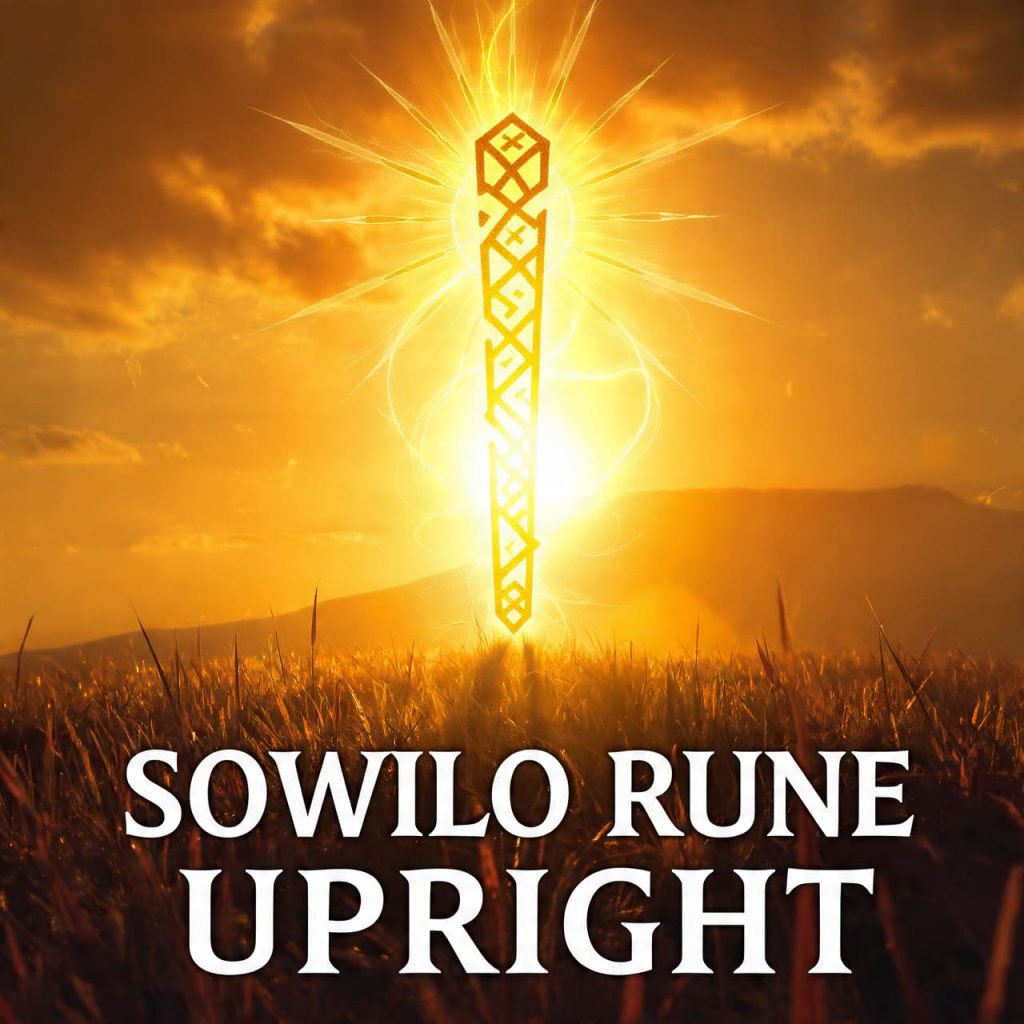
The concept of the Sowilo rune appearing “upright” is common in modern explanations, where orientation is treated as a meaningful condition that affects interpretation. This framing suggests that early runic users distinguished between correct and incorrect orientations and attached interpretive significance to that distinction. Historically, this is a testable claim.

💜 Need a clear answer right now?
CONSULT THE YES OR NO TAROT Free · No registration · Instant resultThe uncertainty surrounding an “upright” Sowilo rune is therefore factual rather than interpretive. Applying evidence-first historical analysis, including comparative approaches discussed by astroideal, allows the issue to be examined without importing assumptions from later symbolic systems. While some readers consult qualified professionals for clarification, the question here is whether the historical record itself supports the idea of an upright Sowilo rune as a meaningful category.
The guiding question of this article is narrow and binary: does historical evidence support the concept of an “upright” Sowilo rune with distinct significance, yes or no?
What “Upright” Means in a Historical Writing System
In historical writing systems, describing a character as “upright” implies that orientation was standardized and that deviation carried functional or semantic consequences. For this to be historically valid, evidence must show consistent orientation rules and recognition of those rules by users.
In many ancient alphabets, orientation is fixed because letters are written on flat surfaces following standardized conventions. Early runic writing differs significantly. Claims about upright runes often reflect expectations drawn from modern interpretive systems, including those promoted by reliable readers, rather than from documented early literacy practices. Establishing whether “upright” had meaning requires examining actual inscriptions.
Sowilo Within the Elder Futhark
The Sowilo rune belongs to the Elder Futhark, the earliest reconstructed runic alphabet, used by Germanic-speaking communities approximately between the second and eighth centuries CE. The Elder Futhark itself is reconstructed from patterns in inscriptions rather than from preserved manuals or orthographic guides.
Within inscriptions, Sowilo represents a consonantal sound, generally reconstructed as /s/. Its role is linguistic, not positional. The rune appears integrated into words without visual emphasis or contextual isolation. There is no indication that orientation affected pronunciation or function. Modern systems that emphasize upright versus altered states often resemble later symbolic frameworks associated with online tarot sessions rather than early medieval writing systems.
Archaeological Evidence and Rune Orientation
Archaeological evidence provides direct insight into how Sowilo was oriented in practice. Inscriptions containing the rune appear on stone, metal, bone, wood, and other materials. The orientation of runes frequently follows the shape and constraints of the object rather than a fixed directional standard.
Some inscriptions run left to right, others right to left, and some vertically. Individual runes may appear rotated relative to modern expectations, yet their linguistic interpretation remains unchanged. This variability demonstrates that orientation was practical rather than semantic. There is no archaeological indication that an “upright” Sowilo was preferred or that alternative orientations were considered incorrect. Later orientation-based interpretations, similar in structure to modern video readings, are not supported by material evidence.
Absence of Orientation Rules in Early Sources
A decisive limitation in evaluating the upright Sowilo claim is the absence of early explanatory texts. No surviving sources from the Elder Futhark period describe orientation rules for runes or define correct versus incorrect positioning.
In writing systems where orientation matters, such rules are typically documented or at least implied through consistent practice. The lack of such documentation for runes strongly suggests that orientation was flexible. Attempts to impose upright orientation as meaningful rely on later interpretive conventions, structurally similar to those used in phone readings rather than early Germanic literacy.
Later Development of Upright Interpretations
The idea that runes have meaningful upright states emerges in the modern period, particularly from the nineteenth century onward. During this time, runes were incorporated into symbolic systems that already employed orientation as an interpretive tool.
These systems sought internal consistency and often borrowed structural features from other symbolic traditions. Historically, upright interpretations of Sowilo can be traced to modern publications rather than medieval or ancient sources. Comparable processes of reinterpretation appear in other modern frameworks, including generalized horoscope insights, where orientation or position is assigned meaning without ancient precedent.
Evaluating Upright Versus Reversed Distinctions
The upright concept often appears alongside the idea of reversed runes, implying a binary interpretive system. Historically, this assumes that early runic users recognized and applied such distinctions.
Archaeological and textual evidence does not support this assumption. Runes appear rotated, mirrored, or aligned according to available space, without any indication of altered meaning. The lack of corrective marks or standardized alignment further supports the conclusion that orientation was not semantically charged. Even when modern interpretations combine upright distinctions with systems such as love tarot readings, they remain modern constructs rather than historical continuities. Comparative evaluation using methods discussed by astroideal reinforces this conclusion.
Evaluating the Core Claim with Evidence
The core claim addressed here is that the Sowilo rune historically had an “upright” form with distinct significance. Evaluating this claim requires reviewing archaeological orientation patterns, textual silence, and historical context.
Archaeology shows flexible orientation. Early texts do not define upright forms. Linguistic function remains unchanged regardless of orientation. Modern upright interpretations can be historically dated but originate long after the rune’s period of use.
The evidence therefore leads to a clear conclusion: no, the historical record does not support the concept of an “upright” Sowilo rune with inherent or distinct meaning in its original context.
Frequently Asked Questions
Did ancient runes have an upright orientation?
No, rune orientation varied based on space and material.
Is Sowilo always drawn the same way in inscriptions?
No, inscriptions show rotation and variation.
Were incorrect orientations corrected?
There is no evidence of corrections for orientation.
Do early texts define upright runes?
No surviving early texts discuss orientation rules.
When did upright interpretations appear?
They emerged in modern symbolic systems.
Are upright meanings historically reliable?
No, they are modern constructs without early evidence.
Call to Action
When encountering claims about the Sowilo rune being “upright,” evaluate whether archaeological and textual evidence supports that distinction. This approach allows you to get a clear yes or no answer grounded in documented history rather than assumption.
