

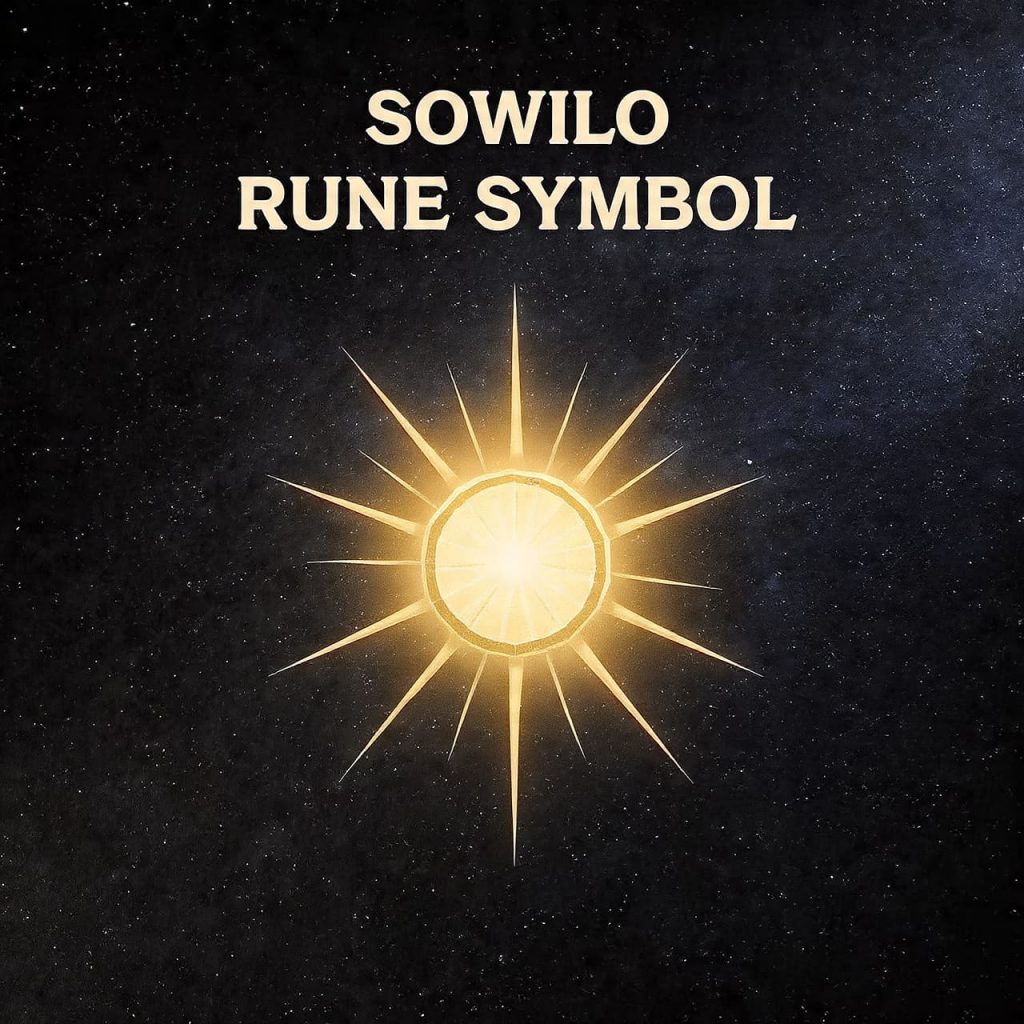
The Sowilo rune is commonly described today as a powerful “symbol,” often presented as if its symbolic meaning were fixed, ancient, and universally recognized. This framing creates a persistent misunderstanding. It assumes that early runic users treated individual runes as abstract symbols in the modern sense rather than as functional elements of a writing system.

💜 Need a clear answer right now?
CONSULT THE YES OR NO TAROT Free · No registration · Instant resultThe uncertainty surrounding Sowilo as a symbol is therefore factual and historical, not interpretive or experiential. Applying evidence-first historical analysis, including comparative methods discussed by astroideal, allows this claim to be evaluated on documented grounds. Although some readers seek clarification from qualified professionals, the question here is whether the historical record itself supports identifying the Sowilo rune as a symbolic sign rather than a linguistic character.
The guiding question of this article is deliberately binary: does historical evidence support the classification of the Sowilo rune as a symbol with inherent meaning, yes or no?
What “Symbol” Means in Historical Analysis
In historical scholarship, a symbol is a sign that represents an abstract concept independently of language. For a rune to qualify as a symbol in this sense, it would need to function outside normal spelling, convey meaning on its own, and be recognized as such within its culture.
This distinction matters because letters and symbols are not interchangeable categories. Writing systems rely on phonetic signs, whereas symbolic systems rely on semantic signs. Modern explanations circulated by reliable readers often collapse this distinction, treating runes as if they were designed to operate symbolically. Historical analysis requires examining whether early runic usage supports that claim.
Sowilo Within the Elder Futhark
The Sowilo rune belongs to the Elder Futhark, the earliest reconstructed runic alphabet, used by Germanic-speaking communities roughly between the second and eighth centuries CE. The Elder Futhark is reconstructed from inscriptions rather than preserved instructional texts.
Within these inscriptions, Sowilo consistently functions as a phonetic character, generally reconstructed as representing an /s/ sound. It appears integrated into words, following linguistic structure. There is no indication that it was set apart visually or contextually as an independent sign. Modern portrayals that elevate Sowilo to symbolic status often resemble later interpretive frameworks associated with online tarot sessions rather than early medieval literacy practices.
Archaeological Evidence of Rune Usage
Archaeological evidence provides the most reliable data for evaluating whether Sowilo functioned as a symbol. Inscriptions containing the rune are found on stone, metal, bone, and wood artifacts across northern Europe. These objects include weapons, tools, jewelry, and memorial stones.
In all cases, Sowilo appears as part of a written sequence. It is not isolated, enlarged, or highlighted in a way that would indicate symbolic autonomy. In cultures where symbols operate independently of writing, such symbols are often visually distinguished or placed in ritual contexts. The runic record shows no such treatment. Later visual emphases, similar in structure to modern video readings, are not reflected in early archaeological material.
Linguistic Reconstruction and Name Attribution
The name “Sowilo” itself is not attested in early inscriptions. Like other rune names, it is reconstructed from later sources, particularly medieval rune poems and comparative linguistics. In later Germanic languages, related words refer to the sun, which has strongly influenced modern symbolic interpretations.
From a historical standpoint, reconstructed names do not demonstrate original symbolic intent. They document how later cultures understood runes, not how early users conceptualized them. Linguistic reconstruction can suggest plausible associations, but it cannot establish that Sowilo functioned as a symbol. Treating reconstructed names as proof of symbolic meaning reflects the same methodological overreach seen in interpretive systems such as phone readings.
Absence of Contemporary Symbolic Explanation
A decisive factor in evaluating Sowilo as a symbol is the absence of contemporary explanatory texts. No surviving writings from the Elder Futhark period describe runes as symbolic representations of abstract ideas. There are no glossaries, manuals, or theoretical discussions explaining rune symbolism.
When symbolic systems existed historically, they were usually accompanied by explanatory traditions. Zodiac signs, for example, are explained in extensive texts. The absence of any comparable explanation for runes strongly suggests that they were not conceived as symbolic signs. Attempts to retrofit symbolic meaning rely on later reinterpretation rather than early evidence.
Emergence of Symbolic Interpretations
The treatment of Sowilo as a symbol emerged primarily in the modern era, particularly from the nineteenth century onward. During this period, runes were increasingly removed from their linguistic context and reframed as carriers of abstract meaning.
This shift coincided with broader cultural movements that favored symbolic synthesis. Runes were mapped onto systems of personal meaning, often alongside other symbolic traditions. Comparable processes can be observed in modern frameworks such as generalized horoscope insights, where coherence is created through system-building rather than historical inheritance.
These symbolic interpretations can be historically traced to specific modern authors and movements. Their existence does not demonstrate ancient usage; it documents modern reinterpretation.
Symbol Versus Letter: Evaluating the Distinction
The core issue is whether Sowilo functioned as a symbol or as a letter. All available early evidence places Sowilo firmly within the category of phonetic writing. Its meaning, in historical terms, is its sound value and its role in forming words.
Later symbolic meanings do not retroactively transform its original function. Even when Sowilo is integrated into modern systems that also incorporate practices such as love tarot readings, these integrations reflect contemporary symbolic logic rather than early Germanic practice. Comparative evaluation using approaches discussed by astroideal confirms that symbolic use is a later development.
Evaluating the Core Claim with Evidence
The core claim addressed here is that the Sowilo rune historically functioned as a symbol with inherent meaning. Evaluating this claim requires comparing archaeological usage, linguistic evidence, and textual silence.
Archaeology shows phonetic integration, not symbolic isolation. Linguistic reconstruction documents later naming traditions, not early symbolic intent. Contemporary texts do not describe symbolic usage. Modern symbolic interpretations can be dated historically but originate long after the rune’s period of use.
The evidence therefore leads to a clear conclusion: no, the historical record does not support classifying the Sowilo rune as a symbol with inherent meaning in its original context.
Frequently Asked Questions
Was Sowilo originally a symbol or a letter?
It functioned as a phonetic letter within a writing system.
Do inscriptions show symbolic use of Sowilo?
No, they show linguistic usage only.
Does the rune name prove symbolic meaning?
No, rune names are later reconstructions.
Are symbolic meanings mentioned in early texts?
No contemporary sources describe such meanings.
When did Sowilo become a “symbol”?
This occurred in modern reinterpretations, not in antiquity.
Are modern symbolic uses historically accurate?
They are modern constructs without early evidence.
Call to Action
When encountering claims about the Sowilo rune as a symbol, examine whether those claims are supported by archaeological or textual evidence. This approach allows you to get a clear yes or no answer grounded in documented history rather than assumption.
