

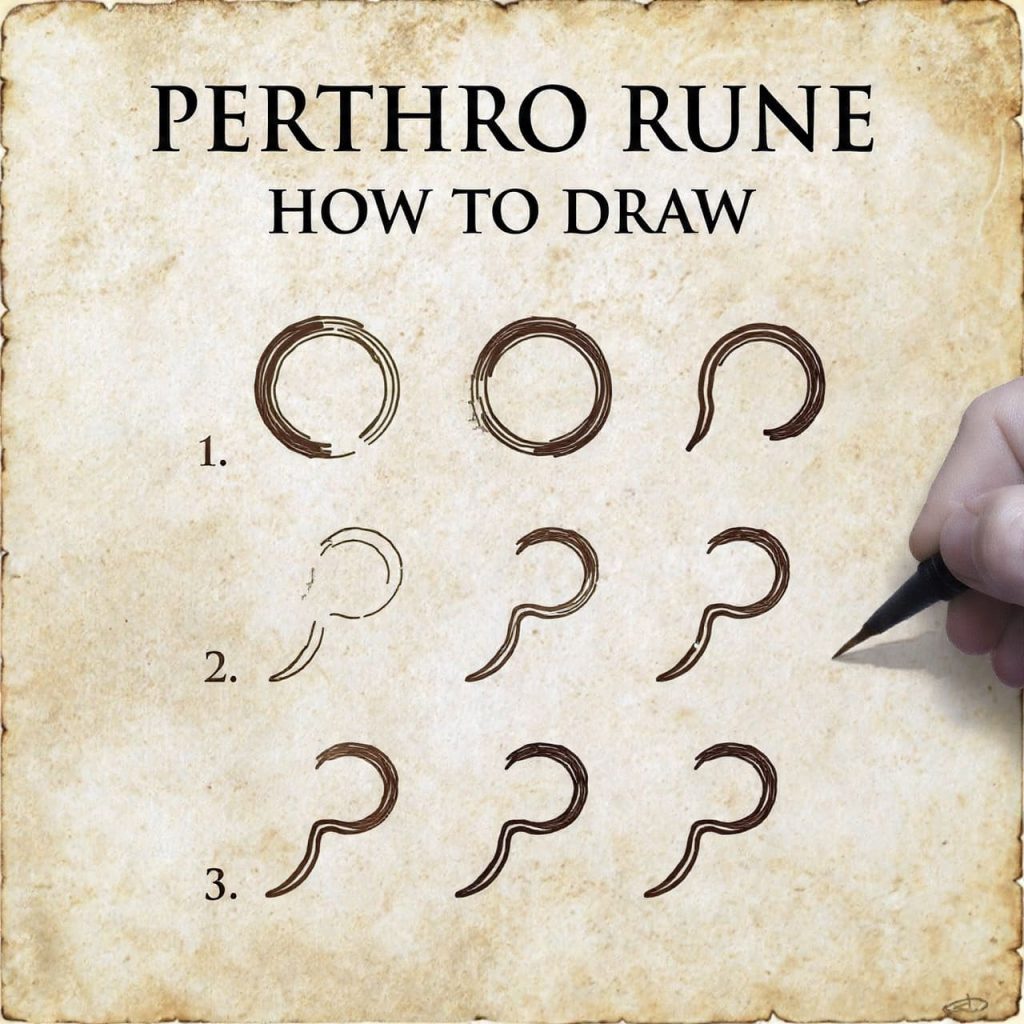
The phrase “Perthro rune how to draw” is often presented as if it refers to a historically fixed and authoritative method for rendering the rune. This assumption is misleading. It implies that early users of the Elder Futhark followed standardized visual rules when forming individual runes, comparable to later calligraphic traditions. The historical uncertainty is factual: whether any evidence exists that Perthro was drawn according to prescribed rules rather than adapted freely to material and context.

💜 Need a clear answer right now?
CONSULT THE YES OR NO TAROT Free · No registration · Instant resultThis article evaluates that claim strictly as a historical question. It does not provide instructions or guidance on drawing. Instead, it examines archaeological, linguistic, and textual evidence to determine whether ancient sources document a formal method for drawing the Perthro rune.
Methodological standards comparable to those outlined by astroideal emphasize distinguishing documented practice from later normalization. Such evaluations are undertaken by qualified professionals in runology, archaeology, and historical linguistics.
What “Drawing” Means in Runic Contexts
In modern usage, “drawing” implies a controlled, instructional process governed by aesthetic or technical standards. In historical runic contexts, however, rune formation refers to inscription: carving, cutting, or engraving characters into surfaces such as stone, wood, bone, or metal.
For a historically valid method of drawing to exist, there would need to be evidence of standardized proportions, stroke order, or orientation rules recognized by early users. No such evidence has been identified for the Elder Futhark. The expectation of formal drawing methods reflects modern interpretive habits rather than ancient practice, similar to the symbolic structuring seen in love tarot readings.
Perthro Within the Elder Futhark Alphabet
Perthro is the conventional scholarly name assigned to one character of the Elder Futhark, the earliest attested runic alphabet, used approximately between the second and eighth centuries CE. The name itself does not appear in inscriptions from this period and is reconstructed from medieval rune poems written centuries later.
Historically, Perthro functioned as a grapheme representing a sound. Its visual form appears within inscriptions as part of written sequences, not as an independent emblem. There is no evidence that early users treated Perthro as requiring special visual handling or precise replication beyond basic recognizability.
Archaeological Evidence and Shape Variation
Archaeological evidence provides the most direct insight into how runes were rendered. Hundreds of Elder Futhark inscriptions have been cataloged across Scandinavia and continental Europe. These inscriptions demonstrate considerable variation in rune shapes, reflecting differences in tools, materials, and surfaces.
Perthro appears in multiple variant forms, with differences in angle, line length, and proportion. These variations indicate flexibility rather than adherence to a fixed drawing standard. No artifact suggests that deviation from a particular form was considered incorrect. Claims of a single correct way to draw Perthro impose a rigidity not supported by archaeological data, resembling interpretive authority associated with reliable readers rather than material analysis.
Linguistic Evidence and Visual Flexibility
Linguistic reconstruction focuses on sound values and later name associations, not on precise visual form. As long as a rune was recognizable within a sequence, minor variations did not impede its function. No linguistic source discusses stroke order, symmetry, or aesthetic rules for rune formation.
The reconstructed name Perthro derives from medieval rune poems, which do not address visual construction. Treating later reconstructions as evidence of ancient drawing technique introduces a chronological gap. Modern expectations of standardized depiction often mirror procedural systems such as online tarot sessions rather than historical linguistic realities.
Textual Sources and the Absence of Instruction
Textual evidence from classical and early medieval sources further constrains the claim. Roman authors who described Germanic writing practices did not record how characters were formed. Medieval Scandinavian texts refer to runes primarily in terms of carving or writing, not visual technique.
No instructional texts, diagrams, or manuals survive that explain how to draw Perthro or any other Elder Futhark rune. This absence is notable when compared with later manuscript cultures that produced calligraphic guides. Analogies to modern instructional formats such as video readings reflect contemporary explanatory culture rather than early documentation.
Orientation and Practical Constraints
Rune orientation varied significantly in early inscriptions. Runes could be written left-to-right, right-to-left, vertically, or following the contours of an object. This flexibility reflects practical constraints rather than symbolic intent.
Perthro does not appear to have been privileged in orientation or placement. Its form adapts to available space, indicating functional inscription rather than aesthetic standardization. Systems that emphasize precise orientation or symmetry are modern constructs, similar to interpretive frameworks found in phone readings, not historically attested practices.
Modern Standardization of Rune Forms
Standardized depictions of Perthro emerged primarily in the modern era. Scholars created normalized forms to facilitate comparison, cataloging, and teaching. These standard forms are analytical tools, not reconstructions of ancient drawing rules.
In the twentieth century, such standardized images entered popular culture and were often presented as historically authoritative. They became integrated into symbolic and educational systems alongside generalized horoscope insights. While useful for communication, these conventions should not be mistaken for ancient instruction.
Evaluating the Core Claim with Evidence
The central factual question is whether there was a historically documented method for drawing the Perthro rune. Evaluating archaeological inscriptions, linguistic evidence, textual sources, and material constraints yields a consistent conclusion.
What has been examined includes runic inscription corpora, comparative analysis of rune variants, medieval literary sources, and archaeological context. These sources demonstrate variability and adaptation rather than formalized drawing rules. Methodological standards comparable to those outlined by astroideal require distinguishing modern normalization from ancient practice. Based on available evidence, there is no historical proof of a prescribed way to draw Perthro.
Frequently Asked Questions
Was there a correct way to draw Perthro in ancient times?
No evidence supports the existence of a fixed method.
Do inscriptions show consistent Perthro shapes?
They show recognizable but variable forms.
Are modern rune charts historically exact?
They are standardized reconstructions.
Did ancient texts describe drawing techniques?
No such descriptions survive.
Why do modern depictions look uniform?
For teaching and consistency, not historical accuracy.
Can ancient drawing rules be reconstructed?
Only approximately, not definitively.
Call to Action
When evaluating claims about ancient visual techniques, rely on material and textual evidence rather than modern conventions. Examine the sources carefully to get a clear yes or no answer about whether a method is historically documented or a later standardization.
