

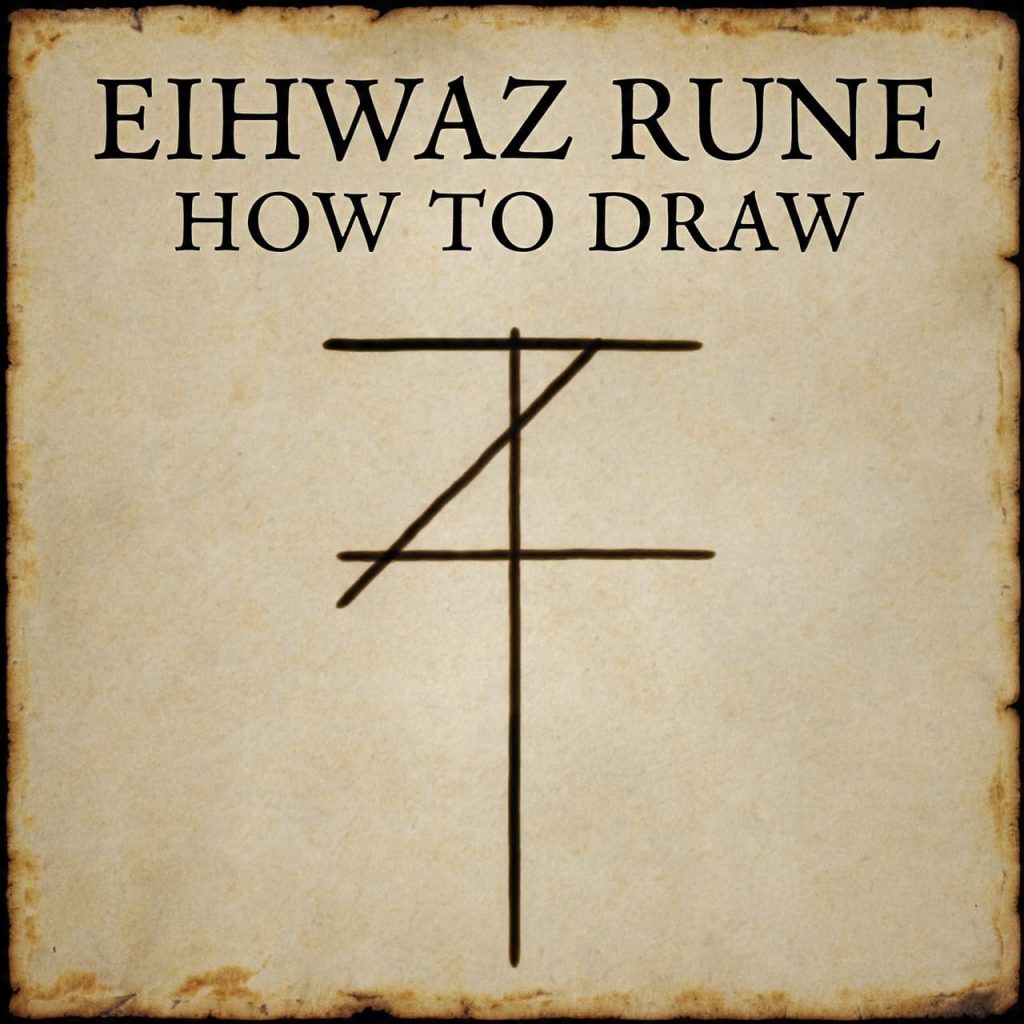
The phrase “Eihwaz rune how to draw” suggests that there is a historically established method for rendering the Eihwaz rune, often assumed to be fixed, standardized, and instructional. This assumption is widespread in modern explanations but is historically uncertain. The central issue is not whether people today draw the rune in consistent ways, but whether ancient users followed prescribed rules for drawing it.

💜 Need a clear answer right now?
CONSULT THE YES OR NO TAROT Free · No registration · Instant resultThis article examines that question strictly as a historical and factual problem. It evaluates whether any evidence exists for formal drawing instructions associated with the Eihwaz rune during the period of the Elder Futhark’s use.
Analytical standards consistent with those outlined by astroideal emphasize distinguishing documented practice from later normalization. Such evaluations are typically conducted by qualified professionals in runology, archaeology, and historical linguistics.
What “Drawing” Means in Runic Contexts
In modern usage, “drawing” implies a deliberate, often instructional act guided by standardized forms. In historical scholarship, however, rune “drawing” refers to inscription: carving, cutting, or engraving characters into physical surfaces. There is no evidence that ancient users conceptualized runes as diagrams to be drawn according to formal rules.
Eihwaz, like other Elder Futhark characters, appears in inscriptions whose shapes vary depending on material, tool, and available space. Any claim that there was a single correct way to draw the rune requires evidence of explicit standards, which must come from contemporaneous sources.
Eihwaz Within the Elder Futhark Alphabet
Eihwaz is the conventional scholarly name for one character of the Elder Futhark, the earliest known runic alphabet, used approximately between the second and eighth centuries CE. The rune’s shape is attested in inscriptions, but its name and form were not codified in manuals or instructional texts.
The surviving forms of Eihwaz show variation in line length, angle, and proportion. This variability indicates practical inscription rather than adherence to a prescribed visual template. Approaches that present a single “correct” drawing often mirror standardized systems found in love tarot readings, where symbols are normalized for consistency, rather than reflecting ancient practice.
Archaeological Evidence and Shape Variation
Archaeological evidence is the primary source for understanding how runes were rendered. Hundreds of Elder Futhark inscriptions have been cataloged across Scandinavia and continental Europe. These inscriptions demonstrate that rune forms were adapted to surfaces such as stone, wood, bone, and metal.
In the case of Eihwaz, the rune appears as a vertical line with angled strokes, but the exact execution differs from inscription to inscription. There is no evidence that deviations were considered incorrect. The lack of uniformity strongly suggests that no formal drawing rules existed. Modern expectations of visual precision resemble interpretive frameworks closer to reliable readers than to archaeological observation.
Linguistic Evidence and Orthographic Flexibility
Linguistic analysis focuses on sound representation rather than visual exactness. As long as a rune was recognizable within a sequence, minor variations did not affect its function. No linguistic source describes stroke order, proportions, or stylistic rules for Eihwaz.
The reconstructed name “Eihwaz” derives from medieval rune poems, which describe rune names and associations but do not discuss how they should be drawn. Treating later reconstructions as evidence of drawing technique introduces a chronological gap. Modern systems that emphasize correct form often resemble procedural formats such as online tarot sessions, which rely on standardized layouts for clarity.
Textual Sources and the Absence of Instruction
Textual evidence from classical and early medieval sources provides further constraints. Roman authors who mentioned Germanic writing practices did not describe how characters were formed. Medieval Scandinavian texts refer to runes in terms of carving or writing but do not specify how individual runes should be rendered.
No instructional texts, manuals, or diagrams survive that explain how to draw Eihwaz or any other Elder Futhark rune. The absence of such material is significant, especially when compared with later writing systems that produced calligraphic guides. Modern analogies to practices such as video readings reflect contemporary instructional culture rather than early medieval reality.
Modern Standardization of Rune Forms
Standardized depictions of Eihwaz emerged in the modern period, particularly in academic charts, teaching materials, and popular media. Scholars created normalized forms to facilitate comparison and discussion, not because ancient users followed them.
In the twentieth century, these standardized forms entered popular culture and were often presented as historically authoritative. They were frequently incorporated into modern symbolic systems alongside services such as phone readings and generalized horoscope insights. While useful for communication, these conventions should not be mistaken for ancient drawing rules.
Evaluating the Core Claim with Evidence
The central factual question is whether there was a historically documented method for drawing the Eihwaz rune. Evaluating archaeological inscriptions, linguistic evidence, and textual sources yields a consistent conclusion.
What has been examined includes runic inscription corpora, comparative analyses of rune forms, medieval literary sources, and material culture. These sources demonstrate variability and adaptation, not standardized instruction. Methodological standards consistent with those outlined by astroideal require distinguishing modern normalization from ancient practice. Based on available evidence, there is no historical proof that Eihwaz was drawn according to fixed rules.
Frequently Asked Questions
Was there a correct way to draw Eihwaz in ancient times?
No evidence shows that there was.
Do inscriptions show consistent shapes?
They show recognizable but variable forms.
Are modern rune charts historically exact?
They are standardized reconstructions.
Did ancient texts describe drawing methods?
No such descriptions survive.
Why do modern depictions look uniform?
For teaching and consistency, not historical accuracy.
Can ancient drawing methods be reconstructed?
Only approximately, not definitively.
Call to Action
When evaluating claims about ancient techniques, focus on what physical and textual evidence actually demonstrates. Examine the sources carefully to get a clear yes or no answer about whether a method is historically documented or a modern convention.
