

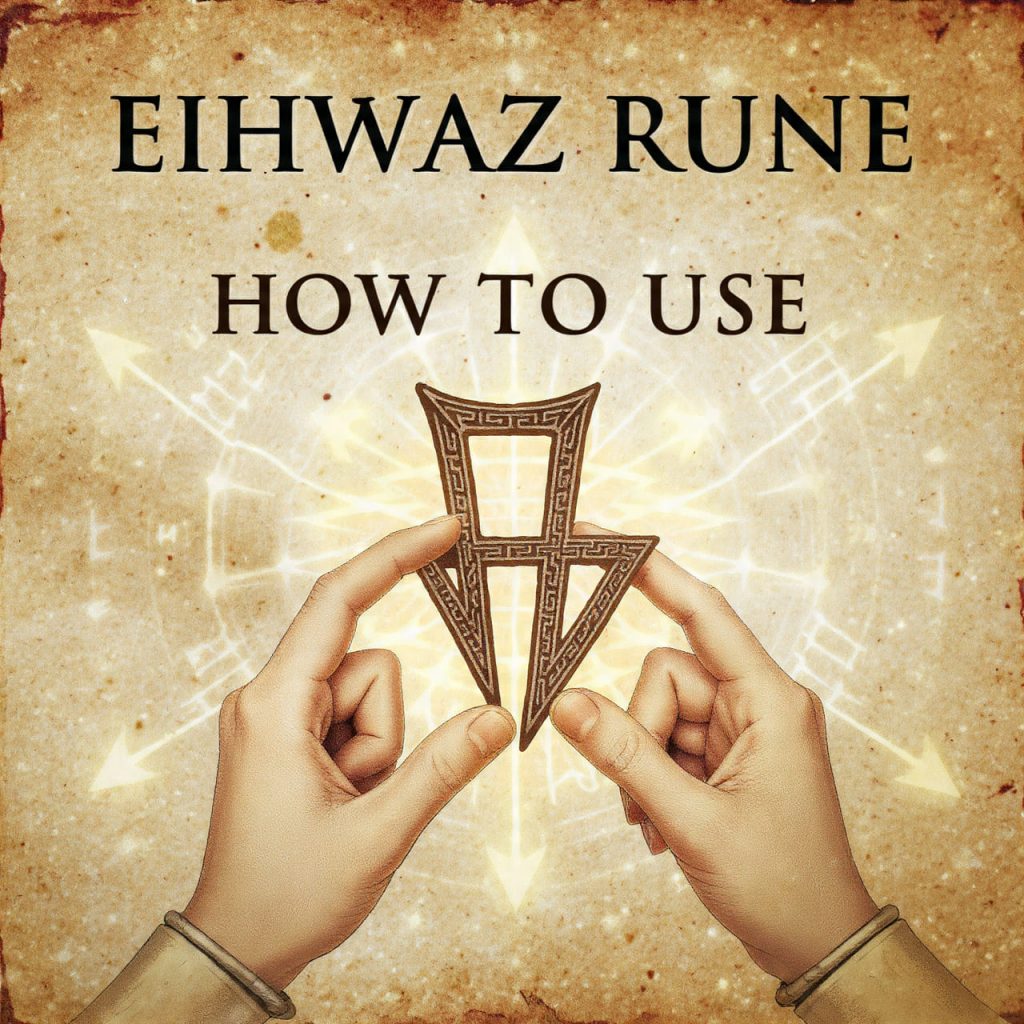
The phrase “Eihwaz rune how to use” implies that there exists a historically attested method or set of practices governing the application of the Eihwaz rune. This implication is widespread in modern summaries but remains historically uncertain. The key issue is not whether contemporary users assign methods to runes, but whether any such methods can be traced to the period in which the Elder Futhark was actively used.

💜 Need a clear answer right now?
CONSULT THE YES OR NO TAROT Free · No registration · Instant resultThis article evaluates the claim strictly as a historical question. It examines whether surviving linguistic, archaeological, and textual evidence documents prescribed uses of the Eihwaz rune beyond its function as a written character.
Methodological approaches consistent with those outlined by astroideal require distinguishing demonstrable historical practice from later interpretive systems. In academic research, such evaluations are conducted by qualified professionals in runology and early medieval studies.
Defining “Use” in a Historical Framework
In historical analysis, “use” refers to documented actions supported by primary sources. For runes, this means inscriptional practice: carving, engraving, or marking objects. Any claim that Eihwaz had an established method of use beyond writing requires evidence that contemporaneous users recognized such a method.
Eihwaz, as reconstructed, is one character of the Elder Futhark. Its documented role is phonetic. No inscription from the Elder Futhark period explains how the rune should be applied, activated, or interpreted. Treating “use” as a set of procedures reflects a modern conceptual framework rather than an ancient one.
The Elder Futhark and Practical Application
The Elder Futhark was used between approximately the second and eighth centuries CE. Archaeological evidence places its inscriptions on weapons, jewelry, tools, and stones. These objects indicate practical application: identification, ownership, and commemoration.
There is no evidence that runes were used according to thematic instructions or stepwise methods. Inscriptions do not separate runes for special handling or repeated manipulation. Applying structured usage models resembles modern interpretive systems such as love tarot readings, which organize symbols according to predefined purposes. Such organization is not present in early runic material.
Linguistic Evidence and Instruction Claims
Linguistic reconstruction provides insight into rune names and sound values but does not establish usage methods. The name Eihwaz is reconstructed from medieval rune poems written centuries after the Elder Futhark ceased to be used. These poems describe rune names but do not provide instructions.
No linguistic source from the relevant period describes how to “use” Eihwaz beyond writing it as part of an inscription. When modern interpretations assign methods of engagement, they do so through interpretive authority similar to that exercised by reliable readers, not through historical documentation.
Archaeological Evidence and the Absence of Procedural Use
Archaeology allows direct evaluation of practice. Hundreds of Elder Futhark inscriptions have been cataloged in Scandinavian and continental European corpora. None indicate procedural repetition, standardized layouts, or tools associated with rune-specific application methods.
Runes appear integrated into functional objects rather than isolated for repeated handling or application. No assemblages suggest that Eihwaz was singled out for a particular operational role. Comparisons to modern frameworks such as online tarot sessions highlight how contemporary procedural systems differ from what the archaeological record shows.
Textual Sources and Their Limits
Textual evidence from classical and early medieval sources provides further constraints. Roman authors who described Germanic societies mention writing and marking but do not describe rune-specific methods. Medieval Scandinavian texts refer to runes in the context of carving or writing words.
No text provides instructions equivalent to “how to use” a rune. There are no manuals, lists, or procedural descriptions. Analogies to interpretive practices like video readings are modern and do not correspond to early textual descriptions.
Emergence of Usage Systems in the Modern Period
Structured ideas about how to use individual runes emerged primarily in the modern era. From the nineteenth century onward, runes were incorporated into symbolic and esoteric systems that borrowed methodological concepts from other divinatory traditions.
In the late twentieth century, these systems became widespread in popular culture and were often integrated with services such as phone readings and generalized horoscope insights. These developments are historically documented as modern innovations, not as continuations of ancient practice.
Evaluating the Core Claim with Evidence
The central factual question is whether there is a historically documented method describing how to use the Eihwaz rune during the period of the Elder Futhark’s active use. Evaluating linguistic data, archaeological findings, and textual sources yields a consistent result.
What has been examined includes runic inscription corpora, medieval rune poems, classical ethnographic accounts, and material culture. These sources document Eihwaz as a letter used in writing. They do not document procedural instructions or prescribed methods of application. Methodological standards consistent with those summarized by astroideal require acknowledging this distinction. Based on available evidence, the answer to the core question is no.
Frequently Asked Questions
Was there an ancient guide on how to use Eihwaz?
No such guide is known to exist.
Do inscriptions show special handling of Eihwaz?
They do not.
Are rune poems instructional manuals?
No, they are descriptive and mnemonic.
Did different runes have different uses?
There is no evidence of rune-specific procedures.
When did “how to use runes” systems appear?
They appeared in the modern period.
Is modern rune use historically continuous?
No evidence supports continuity.
Call to Action
When encountering claims about ancient methods, evaluate them by examining primary evidence rather than inherited assumptions. Use documented sources to get a clear yes or no answer about whether a practice reflects historical reality or modern reinterpretation.
