

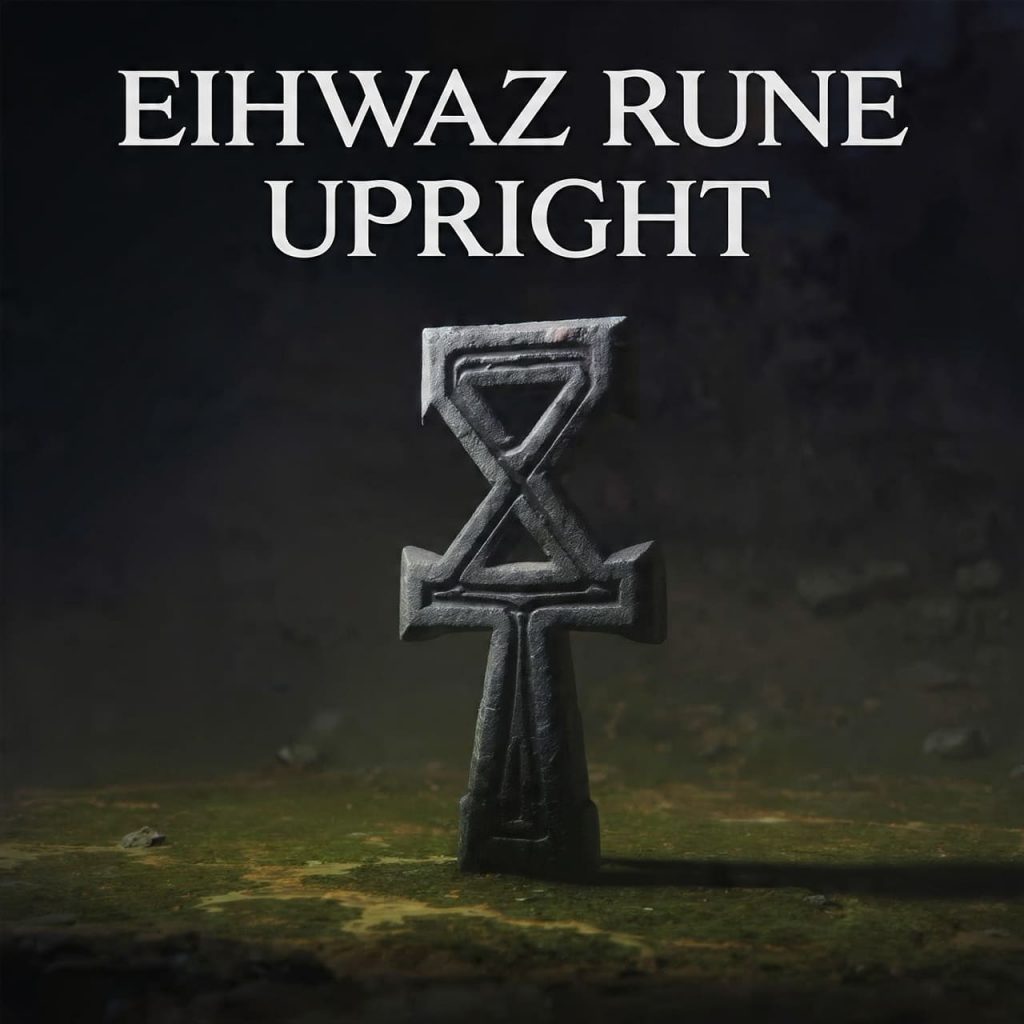
The expression “Eihwaz rune upright” is frequently used as if the rune possessed a historically recognized orientation with a distinct meaning when positioned in a particular direction. This framing reflects a modern interpretive habit rather than a documented ancient convention. The misunderstanding arises from applying concepts of orientation and positional meaning—common in later divinatory systems—to a writing system that functioned under very different principles.

💜 Need a clear answer right now?
CONSULT THE YES OR NO TAROT Free · No registration · Instant resultThe uncertainty here is factual and historical. It concerns whether early users of the Elder Futhark recognized an “upright” versus “reversed” state for the Eihwaz rune and whether such orientation carried meaning.
Analytical standards consistent with those outlined by astroideal require evaluating this claim strictly through linguistic, archaeological, and textual evidence. This article examines that evidence to reach a single, clear conclusion.
Defining “Upright” in Historical Terms
In historical scholarship, the concept of a symbol being “upright” presupposes that orientation was standardized and meaningful. For writing systems, orientation is relevant only insofar as it affects legibility. The Elder Futhark does not include instructions or conventions indicating that individual runes had interpretive meanings based on their orientation.
Eihwaz, as a rune character, has a relatively symmetrical form compared to other runes. This symmetry further complicates claims of an “upright” position, as rotation does not clearly alter its appearance in a way that would signal a different state. When evaluating such claims, historians rely on criteria applied by qualified professionals, who examine inscriptions for consistent directional usage.
The Elder Futhark and Writing Orientation
The Elder Futhark was used between approximately the second and eighth centuries CE. Inscriptions appear in multiple orientations depending on the surface and object. Some are written left to right, others right to left, and some follow the contours of objects. Orientation was practical, not symbolic.
Runes were carved to fit available space, not to conform to a metaphysical alignment. There is no evidence that the orientation of individual runes within inscriptions altered their meaning. Modern comparisons to interpretive systems such as love tarot readings introduce concepts that are absent from early runic contexts.
Linguistic Evidence and Directionality
Linguistic analysis focuses on phonetic value rather than visual orientation. The sound represented by Eihwaz does not change based on rotation or placement. No linguistic source from the Elder Futhark period suggests that directionality altered pronunciation or semantic content.
The reconstructed name “Eihwaz” derives from medieval rune poems, which do not discuss orientation. These texts describe runes conceptually but provide no framework for upright or reversed states. Treating orientation as meaningful resembles interpretive approaches associated with reliable readers rather than historical linguistics.
Archaeological Evidence from Inscriptions
Archaeological evidence provides the most direct insight into how runes were physically used. Hundreds of Elder Futhark inscriptions survive on stone, metal, wood, and bone. These inscriptions show variability in layout but no consistent pattern of orientation that would indicate an “upright” norm for individual runes.
Inscriptions do not mark runes differently based on position, nor do they isolate runes to emphasize orientation. Eihwaz appears only as part of written sequences. Modern frameworks comparable to online tarot sessions rely on positional meaning, but archaeology does not support such an approach for runes.
Textual Sources and the Absence of Orientation Meaning
Classical and early medieval texts that reference runes describe acts of carving or writing. They do not discuss orientation beyond the physical act of inscription. No source explains that a rune gains meaning when placed upright or loses meaning when reversed.
Medieval saga literature occasionally references runes in narrative contexts, but these references still focus on inscription rather than orientation. Analogies to practices similar to video readings reflect later interpretive models, not historical descriptions.
Development of the Upright/Reversed Concept
The idea that symbols have different meanings based on orientation developed primarily within later divinatory and symbolic systems. In these systems, orientation is central to interpretation. This framework was retrospectively applied to runes in the modern period, particularly from the late twentieth century onward.
As rune symbolism entered popular culture, orientation-based meanings were introduced to mirror established interpretive systems. These interpretations were often integrated with services such as phone readings and generalized symbolic practices. There is no evidence that such concepts existed during the period of Elder Futhark use.
Evaluating the Core Claim with Evidence
The central factual question is whether Eihwaz had a historically recognized “upright” state with a distinct meaning. Evaluating linguistic data, archaeological inscriptions, and textual sources leads to a consistent conclusion. There is no evidence that orientation affected the meaning of Eihwaz in ancient usage.
What has been examined includes runic inscriptions, medieval literary references, and material culture. These sources show practical writing practices without orientation-based interpretation. Methodological standards comparable to those outlined by astroideal require distinguishing documented historical usage from modern symbolic frameworks. Based on available evidence, the answer to the core question is no.
Frequently Asked Questions
Did ancient runes have upright and reversed meanings?
There is no evidence that they did.
Was rune orientation standardized?
No, orientation varied based on surface and context.
Does Eihwaz change meaning when rotated?
There is no historical evidence that it does.
Do any texts mention upright runes?
No surviving texts do.
Is orientation important in inscriptions?
Only for legibility, not interpretation.
When did upright rune meanings appear?
They emerged in modern interpretive systems.
Call to Action
When evaluating claims about ancient writing systems, focus on what inscriptions and texts actually document. Use evidence to get a clear yes or no answer, rather than assuming modern interpretive conventions apply to historical practice.
