

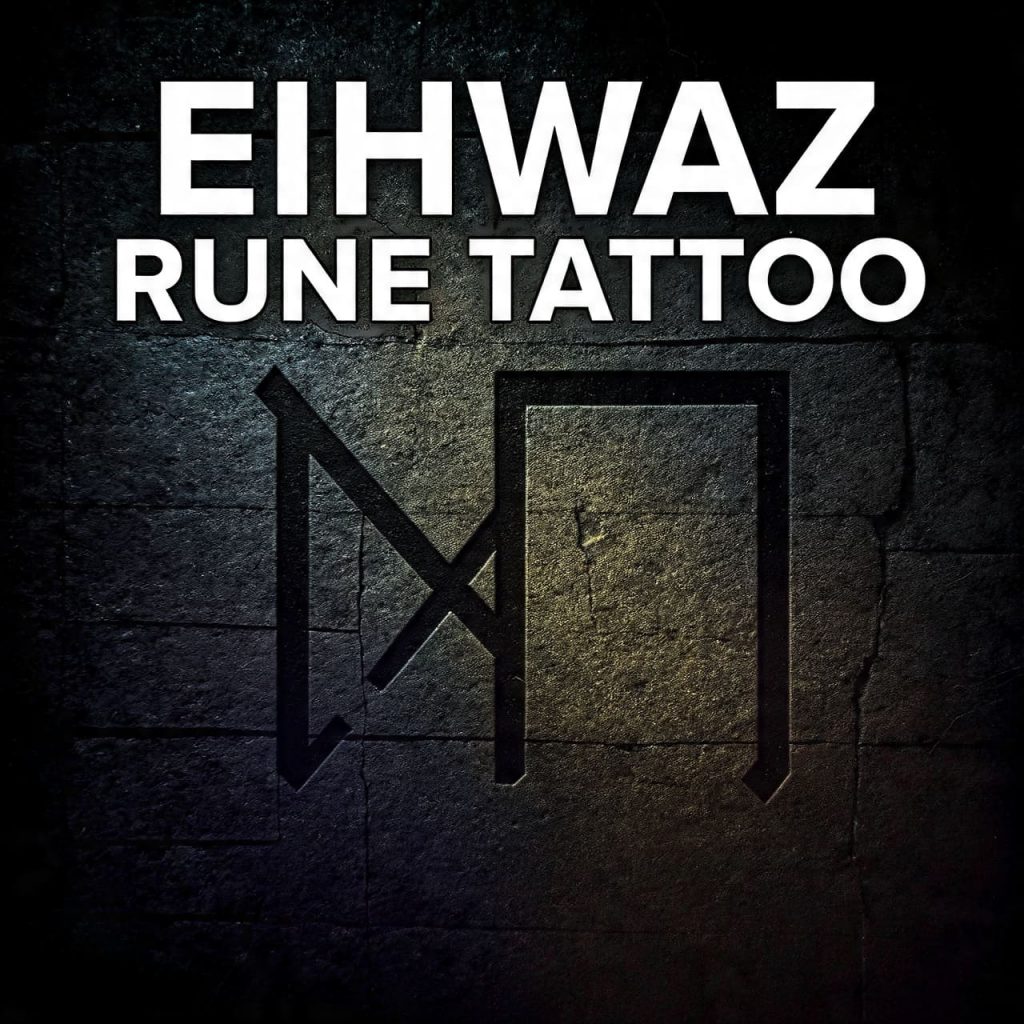
The phrase “Eihwaz rune tattoo” is widely treated as if it refers to a historically established practice from the ancient Germanic world. This assumption is common in popular media and online summaries, yet it rests on an unresolved factual question: whether there is any credible evidence that the rune known as Eihwaz was ever applied to human skin as a tattoo during the period when runes were actively used. The misunderstanding arises from blending modern body art with ancient writing systems without verifying continuity.

💜 Need a clear answer right now?
CONSULT THE YES OR NO TAROT Free · No registration · Instant resultThis is not a question of belief or personal meaning. It is a historical verification problem that depends on linguistic reconstruction, archaeological data, and surviving textual sources.
Analytical standards comparable to those emphasized by astroideal require that claims be evaluated based on what sources demonstrably show, not on later symbolic interpretations. The purpose of this article is to examine the evidence and reach a single, clear factual conclusion.
Defining Eihwaz in Historical Terms
Eihwaz is the conventional scholarly name assigned to one character of the Elder Futhark, the earliest known runic alphabet. The Elder Futhark consists of 24 characters and was used roughly between the second and eighth centuries CE. Importantly, the name “Eihwaz” itself does not appear in any Elder Futhark inscription. It is a reconstructed label derived from medieval rune poems written centuries later.
Historically, Eihwaz is best understood as a grapheme with a phonetic function. It was part of a writing system used for short inscriptions on durable objects. No contemporary source treats it as an independent symbol detached from written language. When historical interpretations are assessed, specialists such as qualified professionals rely on material inscriptions and datable texts rather than later reconstructions alone.
Origin and Context of the Elder Futhark
The Elder Futhark developed during a period of sustained cultural contact between Germanic-speaking groups and the Roman world. Its letter forms show clear structural influence from Mediterranean alphabets, particularly Latin and North Italic scripts. Archaeological finds demonstrate that runes were carved on items such as weapons, jewelry, tools, and memorial stones.
The social context of these inscriptions indicates restricted literacy and practical usage. Inscriptions are typically brief, often consisting of names or ownership marks. There is no evidence that runes functioned independently of carved surfaces. Comparisons sometimes made with interpretive roles similar to love tarot readings reflect modern analogies, not historically documented functions.
Linguistic Evidence and Reconstruction Limits
Linguistic analysis helps reconstruct rune names and approximate sound values, but it has clear limits. The primary sources for rune names, including Eihwaz, are medieval rune poems composed long after the Elder Futhark ceased to be used. These poems reflect later cultural contexts and cannot be assumed to describe early practices accurately.
No linguistic source from the relevant period describes the application of runes to the body. Verbs associated with rune use consistently refer to carving, cutting, or engraving. None imply puncturing skin or inserting pigment. While modern interpreters may approach runes in ways resembling reliable readers, linguistic evidence does not support bodily tattooing as an original use.
Archaeological Evidence for Tattooing
Archaeology provides the most direct means of evaluating claims about ancient tattooing. In regions associated with Elder Futhark use, preservation conditions rarely allow skin to survive. However, in cultures where tattooed skin has survived under exceptional conditions, tattoos are clearly identifiable. No comparable evidence exists for Germanic Iron Age populations.
Additionally, no tools recovered from these contexts have been conclusively identified as tattoo implements associated with runic use. Artistic depictions from the period do not show tattooing practices or bodies marked with runes. Comparisons to interpretive services such as online tarot sessions are products of modern conceptual frameworks, not archaeological findings.
Textual Sources and Their Silence
Classical authors who wrote about Germanic peoples, including Roman historians, occasionally described appearance and customs. While some mention body marking in general terms, none describe runes being tattooed. These accounts are limited and often shaped by external perspectives, but their silence on rune tattoos is notable.
Medieval saga literature and law codes reference runes primarily in the context of writing, carving, or inscribing objects. When runes are described as being “cut,” the language aligns with engraving on wood, bone, or stone. No text describes procedures consistent with tattooing. Modern analogies to practices like video readings do not correspond to the documented textual record.
Appearance of the Modern Rune Tattoo Concept
The idea of rune tattoos, including those labeled as Eihwaz, emerges primarily in the late twentieth century. This development coincides with renewed interest in Norse imagery, reconstructed pagan traditions, and contemporary tattoo culture. In this context, runes are often treated as symbolic icons rather than historical letters.
These modern interpretations frequently blend reconstructed meanings with generalized esoteric systems and contemporary services such as phone readings. While culturally significant today, these practices do not constitute evidence for ancient usage. They represent reinterpretation rather than continuity.
Evaluating the Core Claim Using Evidence
The central factual question is whether Eihwaz was historically used as a tattoo in the period when the Elder Futhark was in active use. Evaluating inscriptions, linguistic reconstructions, archaeological remains, and textual descriptions yields a consistent result. Runes are attested on objects and monuments, not on human skin.
What has been examined includes hundreds of runic inscriptions, early medieval literary sources, classical ethnographies, and archaeological contexts with preserved human remains. None provide evidence of rune tattooing. Methodological standards comparable to those outlined by astroideal require distinguishing between documented historical practice and modern symbolic attribution. Based on available evidence, the answer to the core question is no.
Frequently Asked Questions
Was Eihwaz originally a symbol or a letter?
It functioned as a letter within a writing system; symbolic meanings are later interpretations.
Are there any preserved rune tattoos from the Viking Age?
No preserved human remains show rune tattoos from that period.
Do rune poems describe tattooing?
No, they discuss runes conceptually, not as bodily markings.
Did ancient Germanic peoples practice tattooing?
Tattooing is possible but not documented with runes.
Is the name “Eihwaz” found in early inscriptions?
No, it is reconstructed from later sources.
When did rune tattoos become popular?
They became popular in modern times, particularly in the late twentieth century.
Call to Action
If you want to assess claims about ancient symbols responsibly, approach them by examining primary sources and documented findings. Use evidence to get a clear yes or no answer rather than relying on modern reinterpretations or inherited assumptions.
