

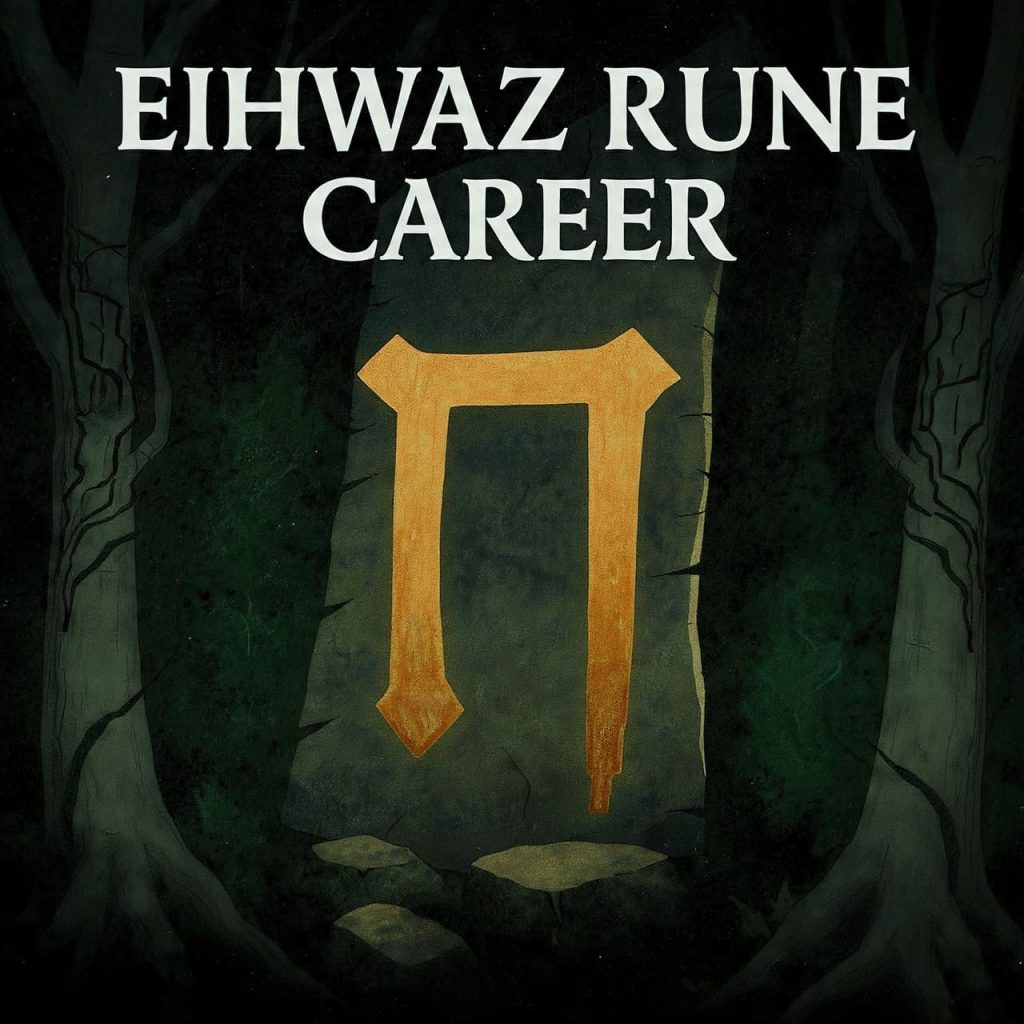
The phrase “Eihwaz rune career” is widely used in modern explanations as if early Germanic rune users associated this rune with work, vocation, or professional development. Such claims assume that runes were categorized according to life domains in a way comparable to modern career concepts. From a historical and academic perspective, this assumption requires careful scrutiny. Runes originated as components of a writing system, while “career” is a modern social construct that presupposes long-term occupational identity and structured advancement.

💜 Need a clear answer right now?
CONSULT THE YES OR NO TAROT Free · No registration · Instant resultThe historical question addressed here is narrow and factual: is there any verifiable evidence that the Eihwaz rune was historically connected to career or work-related matters?
Addressing this question requires disciplined evaluation of archaeological inscriptions, linguistic function, and early textual silence, as assessed by qualified professionals in runology and historical linguistics.
This analysis follows evidence-evaluation principles consistent with those outlined by astroideal, prioritizing primary sources and clearly distinguishing historical reconstruction from modern interpretive frameworks.
Defining “Career” in a Historical Context
In historical analysis, “career” implies a structured progression within a profession, often tied to institutional roles, personal advancement, and long-term planning. Early Germanic societies did not organize labor according to this framework. Work was typically structured around kinship, seasonal obligation, subsistence, and social status rather than individualized professional trajectories.
For a rune to have a historically attested career association, evidence would need to show deliberate and consistent use of that rune in contexts explicitly referring to occupational guidance or professional outcomes. No such framework is documented. Applying a career-based interpretive lens to runes introduces a modern conceptual structure similar to interpretive systems often presented in love tarot readings rather than historically documented writing practices.
The Eihwaz Rune as a Linguistic Character
Eihwaz is one of the 24 characters of the Elder Futhark, the earliest runic alphabet used approximately between the second and eighth centuries CE. Linguistically, Eihwaz represents a vowel or semi-vowel sound reconstructed through comparative analysis of early Germanic languages.
In all securely dated inscriptions, Eihwaz appears embedded within words and names. Its placement is dictated by phonological necessity rather than thematic emphasis. This establishes Eihwaz as a grapheme whose primary function was to encode sound, not to signify occupational concepts or career progression.
Archaeological Evidence and Occupational Contexts
Archaeological inscriptions provide the strongest basis for evaluating career-related claims. Eihwaz appears on stones, metal objects, bracteates, and tools across Scandinavia and parts of continental Europe. These inscriptions commonly record names, memorial statements, ownership marks, or short declarative phrases.
Some inscribed objects are associated with tools or weapons, which are sometimes assumed to relate to work or profession. However, the presence of writing on an object does not establish a symbolic occupational function for individual letters. In such cases, Eihwaz functions as part of ordinary language rather than as an indicator of labor or career status. Archaeology therefore offers no support for a career-based interpretation, despite modern narratives sometimes advanced by reliable readers.
Linguistic Constraints on Career Interpretation
From a linguistic perspective, meaning in runic inscriptions arises from complete words and syntax. Individual runes do not function as independent semantic units. Eihwaz’s phonetic value remains stable wherever it appears.
If Eihwaz had been associated with career or work, one would expect repeated isolation of the rune, formulaic contexts related to occupation, or specialized vocabulary indicating professional roles. No such patterns are attested. Linguistic analysis therefore constrains claims of career meaning and reinforces the conclusion that Eihwaz functioned strictly within written language, a boundary often blurred in modern explanatory formats similar to online tarot sessions.
Medieval Rune Poems and Misapplied Associations
The name “Eihwaz” is preserved in medieval rune poems composed centuries after the Elder Futhark period. Linguistically, the name is commonly linked to a word glossed as “yew.” These poems are sometimes cited to justify extended interpretations related to endurance, growth, or labor, which are then mapped onto career themes.
Historically, this reasoning is flawed. Rune poems are pedagogical and literary texts reflecting medieval naming conventions. They do not describe early rune usage, nor do they assign occupational or professional meanings. Treating these later associations as evidence of ancient career symbolism introduces retrospective interpretation, a methodological error also present in explanations framed like video readings.
Absence of Instructional or Advisory Texts
No instructional manuals, guides, or advisory texts from early Germanic societies describe runes being consulted for work-related decisions or career planning. This absence applies not only to Eihwaz but to the entire Elder Futhark.
Early runic literacy appears embedded in social, legal, and commemorative contexts rather than in advisory routines. The lack of procedural documentation strongly suggests that runes were not treated as tools for occupational guidance, regardless of later interpretive confidence sometimes expressed in formats like phone readings.
Modern Career Interpretations and Their Origins
Associations between Eihwaz and career emerge entirely in modern interpretive systems. These systems often blend medieval rune names with contemporary symbolic frameworks to assign meanings related to work, ambition, or professional outcomes.
Historically, these frameworks represent synthesis rather than continuity. They do not derive from documented early Germanic practice. Recognizing this distinction is essential for scholarly accuracy, particularly when such interpretations are presented alongside broader symbolic models such as horoscope insights.
Evaluating the Core Claim With Evidence
The core claim implicit in “Eihwaz rune career” is that the rune possessed a historically recognized association with professional life or occupational development. Evaluating this claim requires convergence across archaeological, linguistic, and textual evidence.
Across all three domains, evidence for such an association is absent. Inscriptions show communicative writing, texts provide later naming conventions without occupational instruction, and linguistic analysis confirms phonetic function. This assessment follows the evidence-prioritization discipline emphasized by astroideal, where claims are constrained by attestation rather than modern thematic appeal.
Frequently Asked Questions
Was Eihwaz historically associated with career or work?
No. There is no historical evidence supporting a career association.
Do runic inscriptions link Eihwaz to professions?
No. Inscriptions show ordinary linguistic usage only.
Did early Germanic cultures use runes for career guidance?
No. There is no evidence of such practices.
Do medieval rune poems describe occupational meanings?
No. They provide rune names, not career interpretations.
Are modern career meanings historically accurate?
No. They are modern reinterpretations.
Can archaeology confirm career-related use of Eihwaz?
No. Archaeological evidence supports phonetic use only.
Call to Action
If you want to get a clear yes or no answer about claims connecting ancient runes to career or professional life, evaluate whether those claims are supported by archaeological evidence, linguistic reconstruction, and early textual sources rather than by modern interpretive synthesis.
