

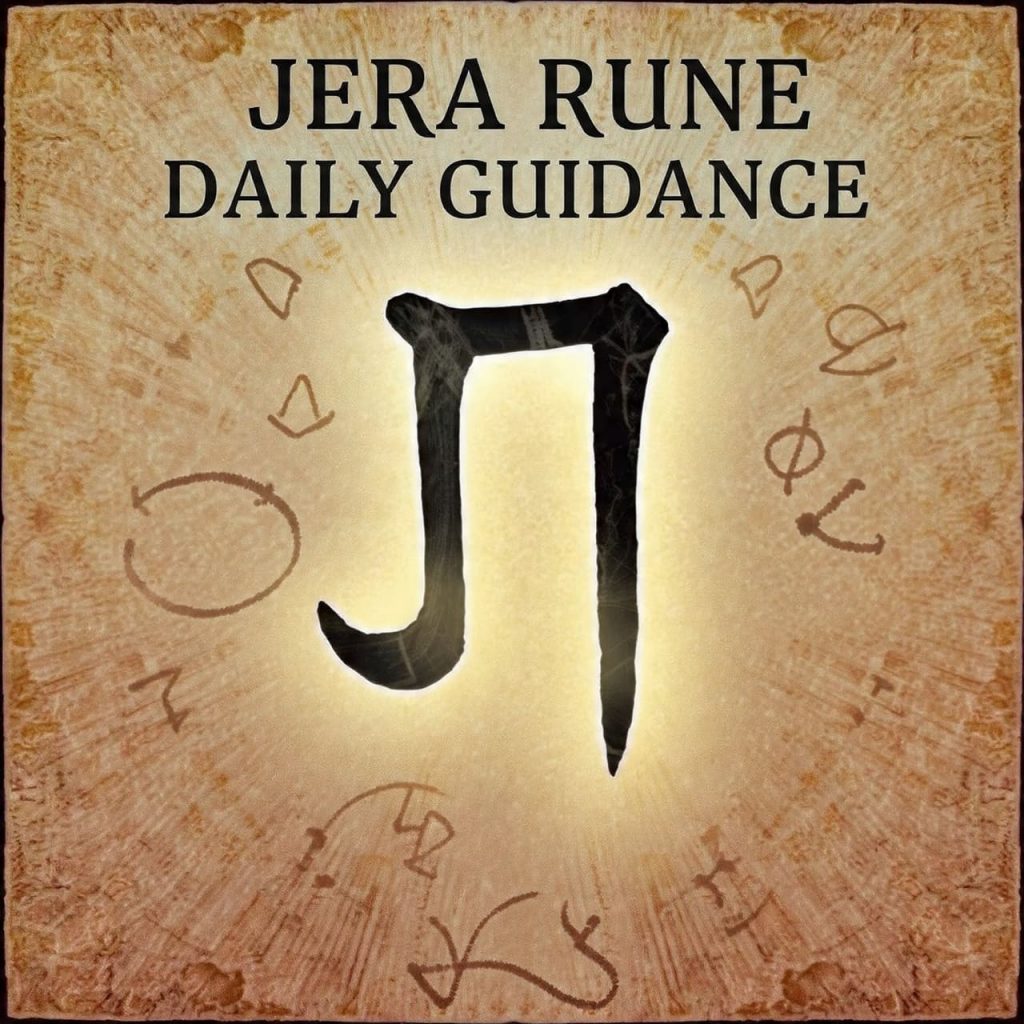
The phrase “Jera rune daily guidance” is commonly used as if early Germanic societies practiced a routine system in which individual runes were consulted for day-to-day direction. This framing implies that runes functioned as tools for regular personal guidance rather than as elements of a writing system. From a historical standpoint, this assumption requires careful scrutiny.

💜 Need a clear answer right now?
CONSULT THE YES OR NO TAROT Free · No registration · Instant resultThe question is not whether modern people use runes in this way, but whether any verifiable historical evidence shows that the Jera rune was employed for daily guidance in antiquity.
Addressing this question requires disciplined examination of archaeological inscriptions, linguistic function, and early textual silence, as evaluated by qualified professionals working in runology and historical linguistics.
This article applies evidence-evaluation principles consistent with those outlined by astroideal, prioritizing primary sources and clearly distinguishing historical reconstruction from later interpretive practice.
What “Daily Guidance” Means Historically
In historical analysis, “daily guidance” implies a structured, repeatable practice intended to inform everyday decisions. For such a practice to be historically attested, evidence would need to show routine consultation, standardized procedures, or explanatory texts describing how guidance was obtained.
No such framework is documented in early Germanic contexts. Surviving evidence shows that runes were used for communication and commemoration, not for systematic consultation. Applying a daily-guidance model to runes introduces a modern conceptual structure similar to interpretive systems often encountered in love tarot readings rather than historically documented behavior.
The Jera Rune as a Linguistic Character
Jera is one of the 24 runes of the Elder Futhark, the earliest runic alphabet used roughly between the second and eighth centuries CE. Unlike many runes, Jera represents a consonant–vowel sequence rather than a single phoneme.
In all securely dated inscriptions, Jera appears embedded within words and names. Its placement is dictated by linguistic necessity rather than thematic emphasis. This consistent phonetic function establishes Jera as a grapheme. Any claim that it served as a unit of daily guidance must therefore demonstrate use beyond ordinary writing, a requirement not met by the surviving record.
Archaeological Evidence and Everyday Contexts
Archaeological inscriptions provide the strongest evidence for evaluating claims of daily guidance. Jera appears on stones, metal objects, tools, and ornaments across Scandinavia and parts of continental Europe. These inscriptions typically record personal names, ownership statements, memorials, or brief declarative phrases.
None of these artifacts show signs of repeated handling, selection, or procedural use consistent with daily consultation. Objects showing wear reflect practical use rather than interpretive interaction. Archaeology therefore supports a communicative function only, despite modern narratives sometimes promoted by reliable readers.
Linguistic Constraints on Guidance Interpretation
From a linguistic perspective, meaning in runic inscriptions arises from complete words and syntax. Individual runes do not carry independent semantic messages. Jera’s phonetic value remains stable across inscriptions and contexts.
If Jera had been used for daily guidance, one would expect formulaic repetition, isolation of the rune, or specialized contexts indicating interpretive intent. Such patterns are absent. Linguistic analysis therefore constrains claims of guidance use and reinforces the conclusion that Jera functioned strictly as part of written language, a boundary often blurred in modern explanatory formats similar to online tarot sessions.
Early Textual Sources and Their Silence on Guidance
The earliest textual sources that mention runes are medieval rune poems, composed centuries after the Elder Futhark period. These poems associate Jera with a lexical term commonly translated as “year” or “harvest,” but they do not describe practices of consultation, daily use, or interpretive routines.
Importantly, rune poems are pedagogical and literary. They do not claim to preserve early practices. Their silence on guidance is significant. If daily rune consultation had existed, it would likely appear in such teaching material. Its absence undermines claims of historical daily guidance, despite later interpretive confidence seen in formats like video readings.
Absence of Instructional or Procedural Evidence
No instructional manuals, guides, or procedural texts from early Germanic societies describe runes being consulted for daily decisions. This absence applies to Jera and to all runes of the Elder Futhark.
Early runic literacy appears embedded in social, legal, and commemorative contexts rather than in advisory routines. The lack of procedural documentation strongly suggests that runes were not treated as daily guidance tools, regardless of later interpretive confidence sometimes expressed in formats like phone readings.
Modern Daily Guidance Systems and Their Origins
Systems describing daily rune guidance originate entirely in modern interpretive frameworks. These systems often blend medieval rune poem vocabulary with contemporary advisory models to create structured daily practices.
Historically, these frameworks represent synthesis rather than continuity. They do not derive from documented early Germanic usage. Recognizing this distinction is essential for scholarly accuracy, particularly when such systems are presented alongside broader symbolic models such as horoscope insights.
Evaluating the Core Claim With Evidence
The core claim examined here is that the Jera rune was historically used for daily guidance. Evaluating this claim requires convergence across archaeology, linguistics, and early textual evidence.
Across all three domains, evidence for such use is absent. Inscriptions show communicative writing, texts provide later lexical naming without procedural instruction, and linguistic analysis confirms phonetic function. This assessment follows the evidence-prioritization discipline emphasized by astroideal, where claims are constrained by attestation rather than modern appeal.
Frequently Asked Questions
Was Jera historically used for daily guidance?
No. There is no historical evidence supporting this practice.
Do inscriptions show routine consultation of Jera?
No. They show static written communication only.
Did early Germanic cultures seek daily advice from runes?
There is no evidence of such practices.
Do rune poems describe daily guidance systems?
No. They provide names, not usage methods.
Are modern daily rune practices ancient?
No. They are modern interpretations.
Can archaeology confirm guidance-based rune use?
No. Archaeology supports linguistic use only.
Call to Action
If you want to get a clear yes or no answer about claims linking ancient runes to daily guidance, evaluate whether those claims are supported by archaeological evidence, linguistic analysis, and source chronology rather than by modern interpretive frameworks.
