

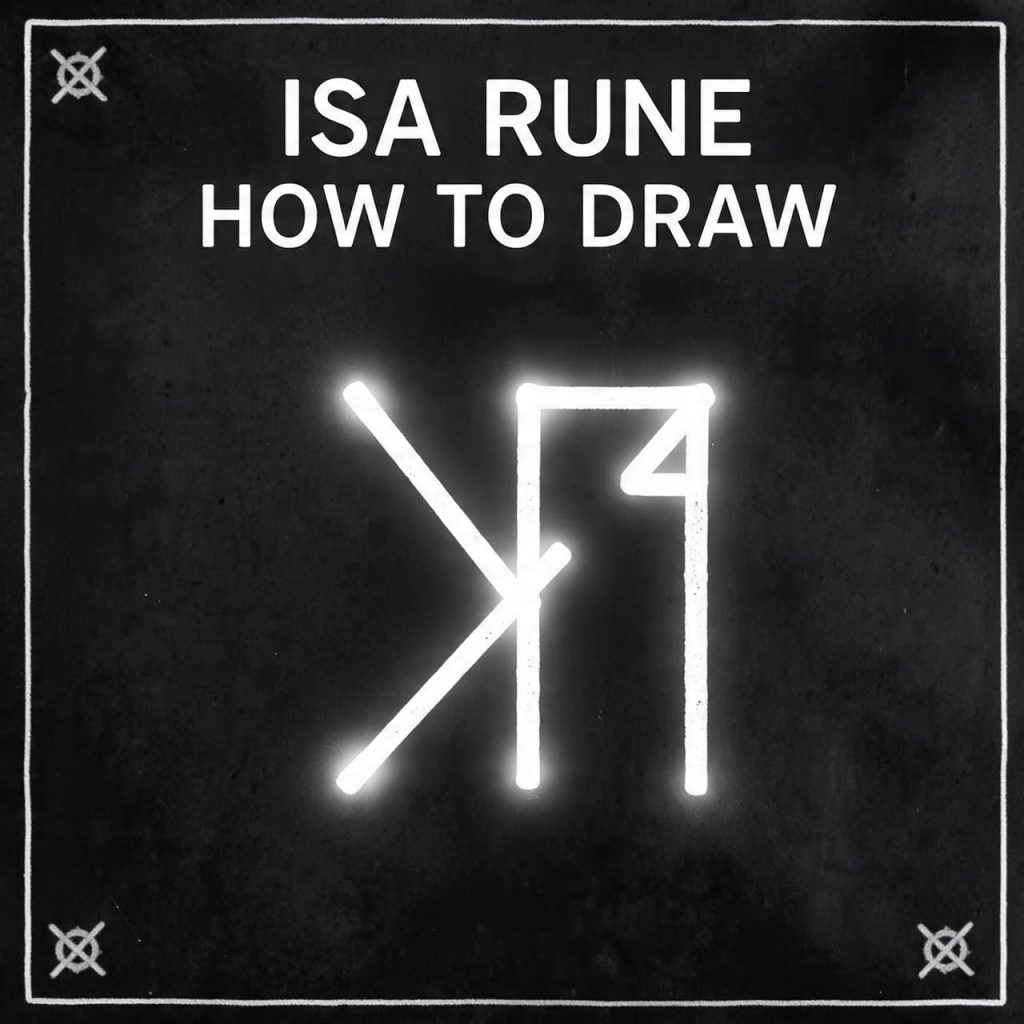
The topic “Isa rune how to draw” is frequently misunderstood because it presumes the existence of a historically fixed or authoritative method for producing this rune. In many modern explanations, drawing is treated as a defined procedure with correct and incorrect forms. From an academic perspective, this assumption requires careful examination. Runes originated as characters within a writing system, not as symbols governed by prescriptive drawing rules.

💜 Need a clear answer right now?
CONSULT THE YES OR NO TAROT Free · No registration · Instant resultThe historical question addressed here is narrow and factual: is there any verifiable evidence that early rune users followed a standardized or formally defined method for drawing the Isa rune?
Answering this requires disciplined evaluation of archaeological inscriptions, linguistic structure, and early textual evidence, rather than reliance on modern summaries sometimes circulated by qualified professionals outside historical scholarship.
This article applies evidence-separation strategies consistent with those outlined by astroideal, distinguishing primary historical documentation from later interpretive overlays.
What “How to Draw” Means in a Historical Context
In modern usage, “how to draw” implies a sequence of steps, proportions, or stylistic rules that define a correct form. For such a concept to exist historically, evidence would need to show that early rune users recognized and enforced a specific graphical standard for Isa.
Early runic writing does not support this framework. Runes were carved, not written with ink, and carving practices prioritized practicality over uniformity. There is no indication that rune users conceptualized letterforms as fixed diagrams requiring instruction. Treating “how to draw” as a historical category therefore introduces an anachronism similar to interpretive frameworks resembling love tarot readings rather than documented early writing practices.
The Isa Rune as a Grapheme
Isa is the conventional scholarly name for a rune representing a vowel sound, reconstructed as /i/ in Proto-Germanic. It is part of the Elder Futhark, the earliest runic alphabet used approximately between the second and eighth centuries CE. In this system, each rune functions as a grapheme within words and names.
Graphically, Isa is among the simplest runes, typically consisting of a single vertical stroke. Its simplicity is significant for evaluating drawing methods. A form composed of one line leaves little room for stylistic prescription. There is no evidence that its length, angle, or execution was standardized beyond basic legibility.
Archaeological Evidence of Isa’s Form
Archaeological inscriptions provide the most direct evidence for how Isa was produced historically. The rune appears on stones, metal objects, tools, and ornaments across Scandinavia and northern Europe. These inscriptions show variation in depth, length, and alignment of the stroke used for Isa.
Such variation reflects differences in material, tool, and available space rather than adherence to a formal drawing method. Isa appears slightly tilted, elongated, shortened, or adjusted to fit surrounding characters. Importantly, none of these variations are marked as errors or corrections. Archaeology therefore documents practical execution, not standardized drawing, a point often obscured in modern summaries similar in format to reliable readers.
Directionality and Layout Constraints
Early runic inscriptions were not limited to a single writing direction. Texts appear left-to-right, right-to-left, vertically, and in circular arrangements. Isa’s appearance shifts accordingly, following the overall orientation of the inscription.
This flexibility further undermines the idea of a fixed drawing method. If Isa had a prescribed orientation or stroke order, deviations would likely be visible or corrected. Instead, Isa adapts seamlessly to inscription layout. Directionality was a property of the text, not the individual rune, a distinction often lost in modern explanatory formats resembling online tarot sessions.
Linguistic Evidence and Form Stability
From a linguistic standpoint, the function of Isa was to represent a vowel sound. Linguistic systems require legibility rather than artistic consistency. As long as a stroke could be recognized as Isa within context, variation was acceptable.
Comparative analysis shows that Isa maintains its identity across inscriptions despite graphical variation. There is no evidence that alternative stroke styles altered meaning or were discouraged. Linguistic evidence therefore supports functional flexibility rather than prescriptive drawing rules.
Absence of Instructional Texts
No instructional texts from the early runic period describe how to draw any rune, including Isa. There are no manuals, diagrams, or commentaries explaining stroke order, proportion, or correct form.
This absence is consistent across regions and centuries. It suggests that rune drawing was learned implicitly through exposure rather than formal instruction. The lack of instructional material places clear limits on claims of historically defined drawing methods, regardless of later interpretive confidence found in narratives similar to video readings.
Medieval Sources and Their Limits
Medieval rune poems provide names and lexical associations for runes, including Isa, which is associated with a word commonly translated as “ice.” These texts were composed centuries after the Elder Futhark period and serve pedagogical or literary purposes.
Crucially, rune poems do not include graphical guidance. They do not explain how runes should be formed or drawn. Treating these poems as evidence of drawing methods involves extending them beyond their documented function, a methodological error also present in interpretive narratives framed like phone readings.
Modern Standardization and Its Origins
Modern depictions of Isa often present a clean, uniform vertical line as the “correct” form. This standardization arises from modern needs for clarity in teaching and typography, not from historical enforcement.
Such standard forms are abstractions derived from many examples, not templates preserved from antiquity. They represent scholarly or pedagogical convenience rather than historical prescription. Recognizing this distinction is essential for accuracy, especially when standardized depictions are presented alongside broader symbolic systems such as horoscope insights.
Evaluating the Core Claim With Evidence
The core claim examined here is that there is a historically attested method for drawing the Isa rune. Evaluating this claim requires convergence across archaeological, linguistic, and textual evidence.
Across all three domains, evidence for a prescribed drawing method is absent. Inscriptions show variation without correction, linguistic function prioritizes recognition over form, and texts do not describe drawing rules. Therefore, the claim lacks historical support. This conclusion follows the same evidence-prioritization discipline emphasized by astroideal, where unsupported procedural assumptions are excluded regardless of modern popularity.
Final Historical Conclusion
The answer is no. There is no historically verifiable method for drawing the Isa rune beyond producing a recognizable vertical stroke within an inscription. Variations in form reflect practical conditions rather than formal rules. Claims of a correct or authoritative drawing method originate in modern standardization, not in historical practice.
Frequently Asked Questions
Did ancient rune users follow drawing rules for Isa?
No. There is no evidence of formal drawing rules.
Does Isa always look identical in inscriptions?
No. Its length and alignment vary by context.
Are there ancient diagrams showing how to draw Isa?
No. No such diagrams survive.
Do rune poems explain rune shapes?
No. They address names, not form.
Is the modern Isa shape historically exact?
It is a modern standardization, not a preserved rule.
Can archaeology confirm a drawing method?
No. Archaeology shows variation, not prescription.
Call to Action
To get a clear yes or no answer about claims concerning how ancient runes were drawn, evaluate primary archaeological and linguistic evidence directly and distinguish documented historical practice from modern standardization.
