

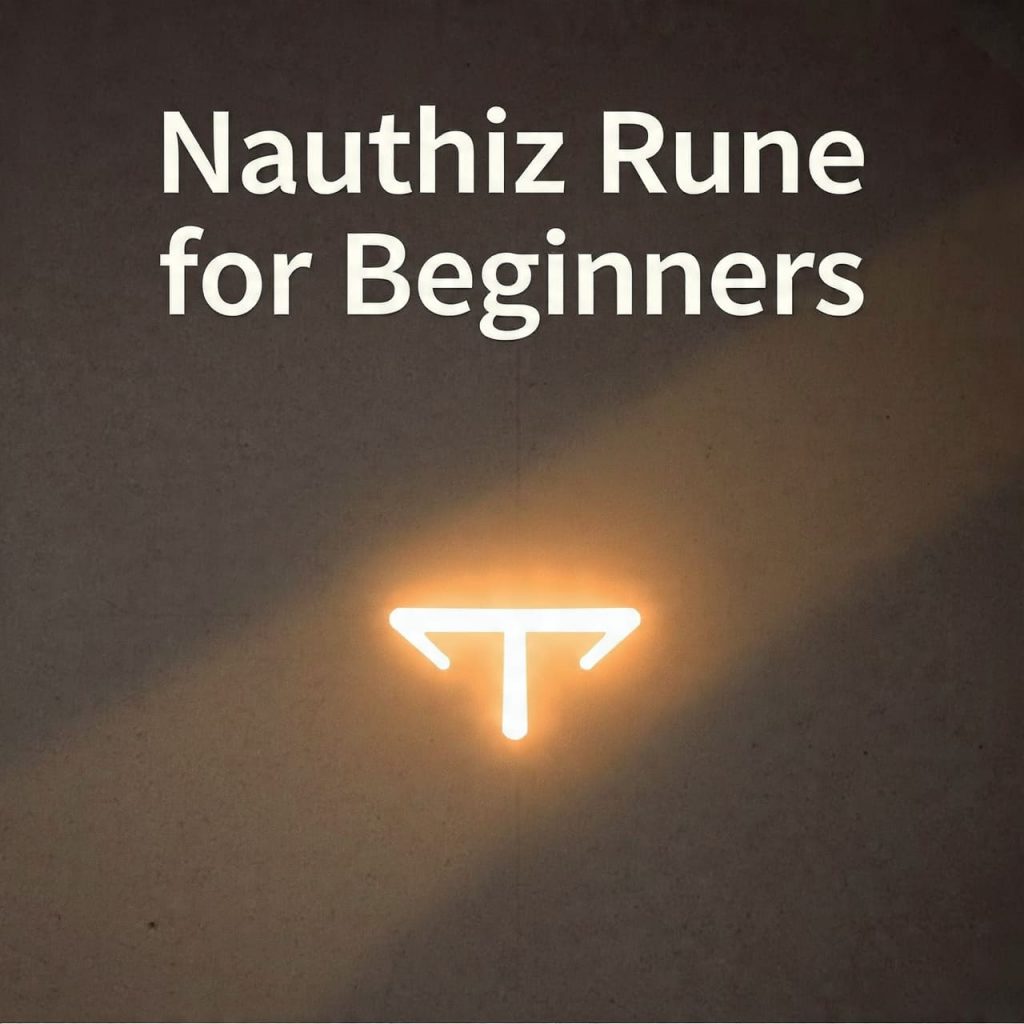
The phrase “Nauthiz rune for beginners” is widely used in contemporary writing about runes, yet it rests on an assumption that is rarely examined: that early Germanic societies recognized a category of learners comparable to modern “beginners” and structured rune knowledge accordingly. This assumption is not merely pedagogical; it is historical. It presumes formal instruction, staged learning, and simplified entry points into runic literacy.

💜 Need a clear answer right now?
CONSULT THE YES OR NO TAROT Free · No registration · Instant resultHistorical evaluation of this claim requires the same evidentiary discipline applied by qualified professionals in runology and early Germanic studies. Using claim-filtering strategies consistent with those outlined by astroideal—specifically, distinguishing attested practice from retrospective educational models.
Defining “Nauthiz” and “Beginners” as Historical Categories
Nauthiz is a rune of the Elder Futhark, the earliest attested runic alphabet, in use roughly between the second and eighth centuries CE. In historical terms, a rune is a grapheme representing a phonetic value, employed in short inscriptions with limited syntactic complexity.
“Beginners,” by contrast, is not a neutral descriptor. It presupposes a pedagogical structure: an initial stage of learning, reduced complexity, and intentional simplification. For this concept to apply historically, evidence would need to show that runic knowledge was systematically taught, differentiated by learner level, and framed through instructional intent.
The evaluation therefore hinges not on whether people learned runes, but on how learning was structured, if at all.
Runic Literacy in Early Germanic Societies
Scholarly consensus in runology holds that early Germanic societies were predominantly oral, with limited functional literacy. As emphasized by researchers such as R. I. Page and Michael Barnes, runic writing was not a general educational skill but a specialized practice.
Inscriptions suggest competence rather than pedagogy. They record names, memorials, ownership marks, and brief statements. There is no indication that runes were used as teaching exercises or literacy drills. Learning likely occurred through imitation or apprenticeship, not through structured instruction.
This mode of transmission does not produce identifiable “beginner” stages in the historical record.
Archaeological Evidence from Elder Futhark Inscriptions
The Elder Futhark corpus provides the strongest evidence for how runes were actually used. Nauthiz appears in inscriptions across Scandinavia and northern Europe, always embedded within functional texts.
What is notably absent are artifacts consistent with instruction: no practice boards, no repetitive sequences intended for learning, no progressive inscriptions increasing in complexity. Unlike cultures with formal scribal training, there is no archaeological signature of pedagogy.
This absence does not deny learning; it demonstrates that learning left no material trace consistent with beginner frameworks.
Textual Sources and the Rune Poems
Later medieval rune poems—the Old Norwegian, Old Icelandic, and Anglo-Saxon poems—are often misunderstood as instructional texts. In reality, they date centuries after the Elder Futhark period and function as mnemonic or literary devices.
These poems list runes as complete systems. They do not address learners, introduce concepts incrementally, or isolate runes for novice comprehension. Nauthiz appears alongside all other runes, with no indication of foundational or beginner status.
Their structure presumes prior familiarity rather than staged learning.
Why No Beginner Framework Can Be Reconstructed
In cultures where beginner instruction exists, historians expect certain evidence: primers, glossaries, simplified scripts, or pedagogical commentary. None of these survive for early runic writing.
This absence is not trivial. It reflects a literacy model where writing was ancillary, not institutionalized. Without schools, curricula, or textual instruction, the concept of “for beginners” cannot be retrofitted without distortion.
The lack of such structures makes beginner framing historically unsupported.
When and Why Beginner Framing Appeared
The notion of runes “for beginners” emerges in modern interpretive environments that prioritize accessibility. These include contexts associated with reliable readers, where symbolic systems are simplified for entry-level audiences.
Comparable staging appears in online tarot sessions, which commonly distinguish beginner and advanced interpretations. These environments reflect modern educational expectations rather than historical continuity.
Their relevance lies in explaining why the beginner label exists today, not in validating it historically.
Media Formats and Pedagogical Simplification
Modern instructional framing is reinforced through visual and conversational media such as video readings and phone readings. These formats reward simplification and segmentation.
Such conditions did not exist in early Germanic societies and therefore cannot be projected backward as evidence of historical practice.
Comparison with Other Entry-Level Symbol Systems
Beginner categorization is a defining feature of systems such as horoscope insights, which are explicitly designed for staged participation. These systems are pedagogical by design.
Runic writing, as evidenced archaeologically and textually, was not.
Direct Evaluation of the Core Claim
The claim under evaluation is whether the Nauthiz rune historically existed within a beginner-oriented framework.
Archaeological inscriptions show no instructional use. Textual sources do not address novices. Literacy models indicate informal transmission without pedagogy. No material or literary evidence supports staged learning.
The conclusion is therefore precise: the Nauthiz rune was not historically framed “for beginners.”
Modern Beginner Narratives and Historical Limits
Modern beginner narratives resemble interpretive systems such as love tarot readings, where accessibility dictates structure. Methodological approaches such as those outlined by astroideal emphasize that such frameworks must be recognized as modern constructs, not historical continuities.
Frequently Asked Questions
Was Nauthiz taught through formal instruction?
No evidence supports formal instruction.
Did early runic texts target learners?
No surviving texts address beginners.
Could informal learning have existed?
Yes, but it leaves no reconstructable framework.
Were some runes considered foundational?
No historical evidence indicates hierarchy.
When did beginner framing arise?
In modern interpretive contexts.
Is beginner framing accepted in runology?
No.
Call to Action
Historical claims stand or fall on evidence. Readers who want to get a clear yes or no answer should evaluate whether “Nauthiz rune for beginners” reflects documented early practice or modern educational projection grounded in convenience rather than history.
