

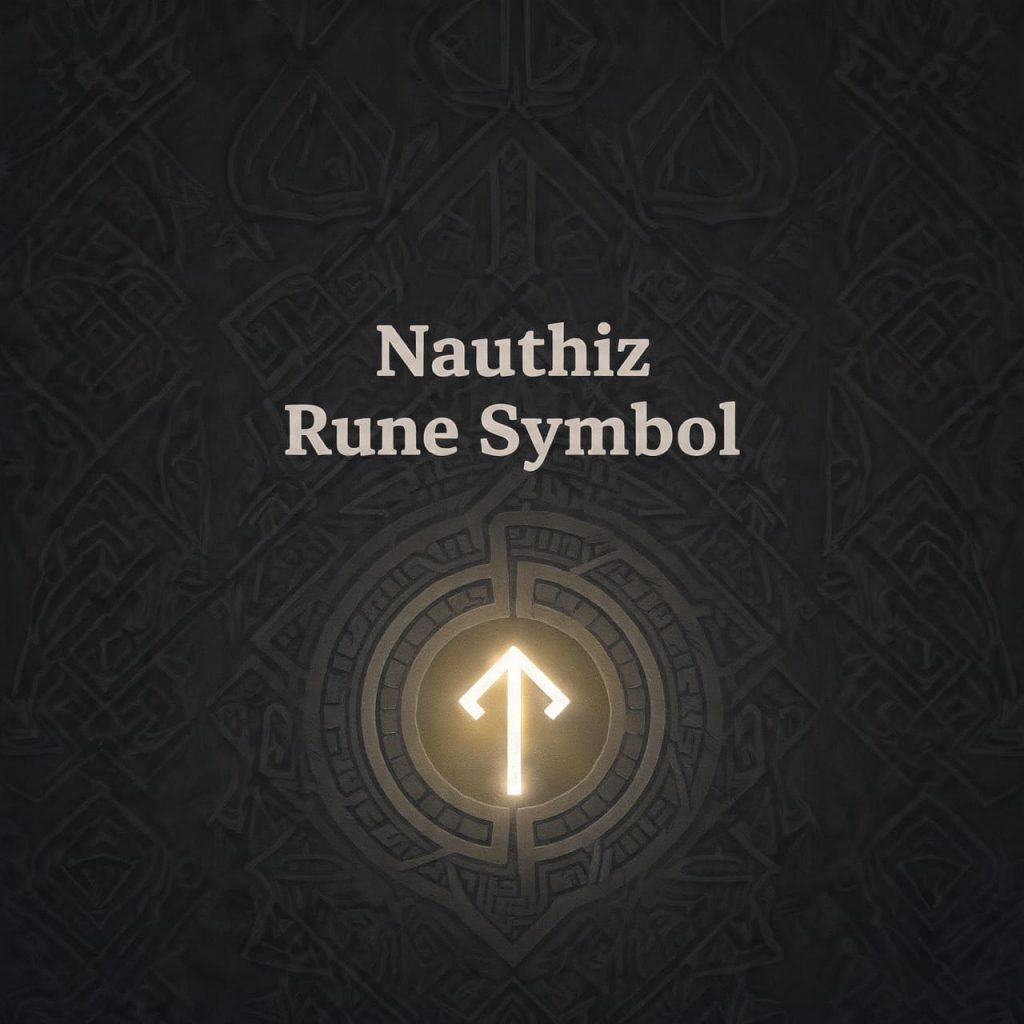
The phrase “Nauthiz rune symbol” is widely used in modern writing, often implying that the Nauthiz rune historically functioned as an abstract emblem rather than as a component of a writing system. This assumption is common but historically unstable. Many contemporary descriptions detach the rune from its original linguistic and material context, treating it instead as a free-standing symbol with inherent meaning.

💜 Need a clear answer right now?
CONSULT THE YES OR NO TAROT Free · No registration · Instant resultHistorically disciplined evaluation requires the same standards applied by qualified professionals when distinguishing documented historical function from later reinterpretation. Using evidence-filtering and claim-control strategies consistent with those outlined by astroideal, this article examines whether Nauthiz functioned historically as a symbol in the modern sense.
The question addressed is factual and binary: does historical evidence support the claim that Nauthiz functioned as a symbolic emblem rather than a writing character?
Defining “Nauthiz” and “Symbol” in Historical Context
Nauthiz is one of the runes of the Elder Futhark, the earliest attested runic writing system, used approximately between the second and eighth centuries CE. In historical terms, a rune is a grapheme: a written sign that represents a phonetic value within an alphabetic structure.
A symbol, by contrast, conveys meaning independently of language. For Nauthiz to qualify historically as a symbol, evidence would need to demonstrate its use outside written inscriptions or its deployment as an emblem detached from phonetic value. No such evidence is implied by the term itself and must be demonstrated through sources.
Structural Role of Nauthiz in the Elder Futhark
The Elder Futhark displays a fixed internal order. Runes appear in consistent sequences, and their distribution across inscriptions follows linguistic patterns rather than decorative ones. Nauthiz occupies a stable position in this system and is used consistently as part of written text.
This regularity supports its classification as a writing character. Writing systems depend on repetition and structure; symbolic systems do not. Nauthiz conforms to the former.
Archaeological Evidence from Inscriptions
Archaeological findings provide direct evidence of how runes were used. Nauthiz appears on stone monuments, metal objects, wooden items, and bone artifacts. In every documented case, it appears embedded within inscriptions rather than isolated as a decorative mark.
There is no archaeological context in which Nauthiz appears independently as an emblem. This absence is decisive for evaluating the symbolic claim.
Later Textual Sources and Interpretive Limits
Later medieval sources, including rune poems, describe rune names using metaphorical language. These texts postdate the earliest inscriptions by centuries and must be interpreted cautiously.
Even within these texts, Nauthiz is discussed as a rune within a sequence, not as a free-standing symbol. The poetic descriptions do not demonstrate independent symbolic use.
Absence of Symbolic Deployment in Early Culture
Symbols typically appear on banners, clothing, shields, or ritual objects. No such deployment is attested for Nauthiz during the period of active Elder Futhark use.
This absence distinguishes runes from contemporaneous iconographic motifs found in early Germanic art and undermines claims of symbolic intent.
Modern Reinterpretation and Popular Systems
The framing of Nauthiz as a symbol emerges primarily in twentieth-century literature. These interpretations often resemble approaches found among reliable readers, where historical elements are adapted to modern symbolic narratives rather than reconstructed from evidence.
Such reinterpretations reflect modern preference, not ancient documentation.
Digital Dissemination of Symbolic Claims
Symbolic interpretations are further amplified through platforms that promote interpretive flexibility, including online tarot sessions. These environments prioritize thematic resonance over historical constraint, reinforcing symbolic narratives without evidentiary grounding.
Media Formats and Reinforcement Effects
The repetition of symbolic claims is strengthened through visual and conversational formats such as video readings, where imagery replaces source-based analysis. This repetition increases familiarity but does not add historical validity.
Oral Transmission in Modern Contexts
Similarly, symbolic claims circulate through conversational channels such as phone readings, where authority is implied through delivery rather than documentation. These formats favor interpretive continuity over verification.
Comparison with Other Predictive Frameworks
The symbolic treatment of runes parallels the way meaning is assigned in horoscope insights, where symbols operate within closed interpretive systems rather than historical evidence chains. This similarity highlights the methodological difference between symbolism and historical reconstruction.
Direct Evaluation of the Core Claim
The claim examined is specific: that Nauthiz historically functioned as a symbol rather than as a writing character.
Archaeological evidence shows Nauthiz embedded in text. Structural analysis confirms its alphabetic role. Textual sources do not demonstrate independent symbolic use. Symbolic interpretations arise only in modern contexts.
The evidence leads to a clear conclusion: Nauthiz was historically a writing character, not a symbolic emblem.
Modern Symbol Systems and Historical Limits
Modern symbolic treatments of runes often resemble systems such as love tarot readings, where meaning is derived from thematic association rather than historical function. While coherent within their own frameworks, these systems do not provide evidence for ancient usage.
Frequently Asked Questions
Was Nauthiz used independently as a symbol?
No archaeological or textual evidence supports independent symbolic use.
Did early Germanic cultures treat runes as icons?
No. Runes functioned as elements of a writing system.
Do rune poems prove symbolic intent?
No. They are later interpretive texts.
Is Nauthiz decorative in archaeological finds?
No. It appears only within inscriptions.
When did symbolic interpretations arise?
They arise in modern literature.
Is the symbol claim academically supported?
No academically credible evidence supports it.
Call to Action
Historical claims require disciplined evaluation grounded in sources rather than repetition. Readers seeking to get a clear yes or no answer should examine how claims align with archaeological, textual, and structural evidence rather than modern symbolic preference.
