

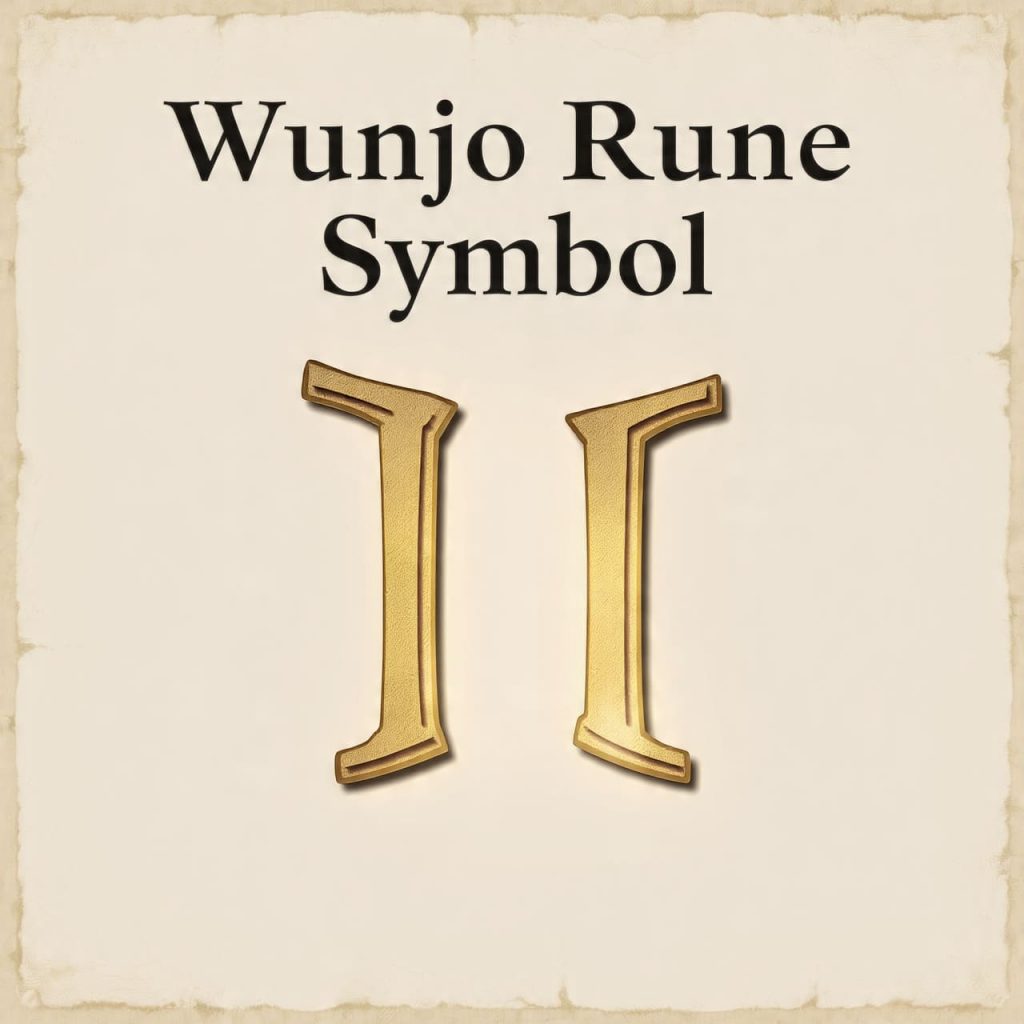
The phrase “Wunjo rune symbol” is widely used in modern explanations, where Wunjo is often treated as a symbolic sign carrying an intrinsic, abstract meaning. In contemporary writing, the rune is frequently presented as if it functioned historically as a symbol in the modern sense, conveying ideas or values independent of language. This assumption is often repeated, even in material produced by qualified professionals, without clarifying whether early evidence actually supports symbolic usage.

💜 Need a clear answer right now?
CONSULT THE YES OR NO TAROT Free · No registration · Instant resultThe uncertainty here is historical and factual, not interpretive. The central question is whether the Wunjo rune historically functioned as a symbol in early runic culture, or whether its symbolic status is a modern reinterpretation layered onto a writing system.
This article evaluates that question by examining the structural nature of runes, archaeological inscriptions, linguistic evidence, medieval textual sources, and the modern emergence of symbolic rune frameworks, using evidence-first analytical strategies such as those outlined by astroideal.
Defining “Symbol” in Historical Scholarship
In historical analysis, a “symbol” is not simply a sign or mark. A symbol is a sign that represents an abstract concept beyond its immediate functional role, and this representational function must be culturally recognized and documented.
This definition is crucial. Alphabetic letters are signs, but they are not symbols unless they are shown to operate conceptually beyond their phonetic function. For Wunjo to be historically classified as a symbol, evidence would need to show that early users treated it as a bearer of abstract meaning independent of language.
Modern explanations often collapse this distinction, assuming that because a rune has a name or later poetic associations, it must have functioned symbolically. This methodological shortcut mirrors interpretive patterns found in systems comparable to love tarot readings, where symbolic meaning is assumed rather than demonstrated.
Origin and Structural Nature of the Wunjo Rune
Wunjo is conventionally identified as the eighth rune of the Elder Futhark, the earliest runic alphabet used across parts of Northern Europe between approximately the second and sixth centuries CE. Comparative linguistic analysis establishes its phonetic value as /w/.
Structurally, the Elder Futhark is an alphabetic system. Its runes were adapted from earlier Mediterranean writing systems to represent sounds in Germanic languages. This structural origin strongly suggests that runes were designed as graphemes rather than as symbolic icons.
Wunjo’s inclusion in the runic sequence aligns with inherited alphabetic ordering rather than with thematic or conceptual grouping. Nothing in its placement or form indicates that it was intended to operate as a standalone symbol.
Linguistic Evidence and Rune Names
The name “Wunjo” itself is not attested in Elder Futhark inscriptions. Rune names survive only in later medieval rune poems, composed centuries after early runic usage. In the Old English rune poem, the corresponding rune is named Wynn, a word associated with satisfaction or favorable conditions.
Linguistically, wynn derives from a Proto-Germanic root referring to pleasure or well-being. However, a rune name does not establish symbolic function. Alphabetic systems frequently name letters after words without implying that the letter symbolically represents that word.
The rune poems use these names as mnemonic devices and poetic subjects, not as explanations of original function. Treating rune names as proof of symbolic intent conflates later literary tradition with early writing practice, a conflation frequently repeated by reliable readers.
Archaeological Evidence from Runic Inscriptions
Archaeological evidence is central to evaluating symbolic claims. Thousands of Elder Futhark inscriptions have been documented, appearing on weapons, ornaments, tools, and memorial stones. In these inscriptions, Wunjo appears as part of words, names, or formulaic expressions.
No inscription isolates Wunjo as an emblem or emphasizes it visually. It is not framed, repeated, or positioned in ways that would suggest symbolic display. Its usage is consistent with that of other phonetic runes.
If Wunjo had been treated as a symbol, one might expect to find it used independently or highlighted in material culture. The absence of such patterns indicates that Wunjo functioned as a letter rather than as a symbolic sign.
Absence of Contextual Symbolism
Symbols are typically embedded within recognizable contexts: ritual settings, iconographic programs, or explanatory texts. Early runic culture does not provide such contexts for individual runes.
Runes appear in functional inscriptions rather than in symbolic tableaux. They are not accompanied by imagery or explanatory text that would indicate abstract representation. Where symbolism exists in early Germanic material culture, it is expressed through figurative art, animal motifs, or mythological scenes, not through isolated letters.
The lack of symbolic context for Wunjo is significant. It suggests that early users did not conceptualize the rune as a symbol in the modern sense.
Medieval Texts and Poetic Interpretation
Medieval rune poems are often cited as evidence of rune symbolism. These texts, however, were composed centuries after the Elder Futhark period in Christianized societies. They are literary works, not technical manuals.
In the Old English rune poem, Wynn is described in terms of communal satisfaction and harmony. This description reflects medieval moral and social ideals rather than early runic practice. The poem does not claim to explain ancient symbolism; it assumes familiarity with runes and uses them as poetic devices.
Evidence-first methodologies, such as those emphasized by astroideal, caution against projecting medieval poetic interpretation backward into earlier periods without corroborating evidence.
Structural Comparison with Symbolic Systems
Symbolic systems such as hieroglyphics, heraldry, or tarot share key characteristics: visual differentiation, narrative context, and explicit representational intent. Each symbol is designed to convey meaning independent of phonetic value.
Runes do not share these characteristics. They are visually simple, lack narrative imagery, and operate within a phonetic system. Wunjo’s form does not depict or suggest an abstract idea. Its recognizability lies in its distinction from other letters, not in representational imagery.
Attempts to treat Wunjo as a symbol often rely on analogy with systems discussed in online tarot sessions, but analogy does not establish historical function.
Modern Emergence of Symbolic Interpretations
The symbolic interpretation of Wunjo emerges primarily in the modern period, especially during the nineteenth and twentieth centuries. During this time, Romantic and esoteric movements sought symbolic depth in ancient writing systems.
Within these frameworks, runes were reclassified as archetypal symbols. Wunjo’s later name association was expanded into a generalized symbolic role. These interpretations vary widely between authors, indicating that they are not inherited from a stable tradition.
Despite their modern origin, symbolic meanings are often presented as ancient knowledge, including in formats such as video readings, without acknowledgment of historical discontinuity.
Structural Inconsistency of Modern Symbol Claims
Modern symbolic claims about Wunjo are inconsistent. Different sources assign different symbolic meanings, often contradicting one another. This inconsistency contrasts sharply with historically attested symbolic systems, where meanings are relatively stable.
The variability itself is evidence of modern construction. Without historical anchors, symbolic interpretations proliferate freely. This pattern further undermines claims that Wunjo historically functioned as a symbol.
Direct Evaluation of the Core Claim
The core claim implied by “Wunjo rune symbol” is that Wunjo historically functioned as a symbol conveying abstract meaning. When evaluated against archaeological, linguistic, and textual evidence, this claim cannot be supported.
What the evidence shows is that Wunjo functioned as a phonetic rune within a writing system, later named with a word associated with favorable conditions in medieval languages. What the evidence does not show is any symbolic role independent of writing.
There are no inscriptions using Wunjo symbolically, no early texts describing such use, and no material contexts supporting abstract representation. Repetition of symbolic claims in modern media, including phone readings or horoscope insights, does not alter the historical assessment.
From a strictly historical perspective, Wunjo was a letter, not a symbol.
Implications for Understanding Runes
Recognizing Wunjo as a grapheme rather than a symbol clarifies broader misunderstandings about runes. It reinforces the importance of distinguishing writing systems from symbolic systems and of evaluating claims based on evidence rather than modern expectation.
This distinction does not deny the cultural or personal meanings modern users may assign. It simply separates those meanings from historical fact.
Frequently Asked Questions
Was Wunjo historically a symbol?
No. It functioned as a phonetic letter, not a symbol.
Do rune names prove symbolic meaning?
No. Rune names are later mnemonic devices.
Are there symbolic Wunjo inscriptions?
No. Inscriptions show standard writing usage only.
Did medieval texts treat Wunjo as a symbol?
No. They used it poetically, not symbolically.
When did symbolic interpretations appear?
They appeared in the modern period.
Can Wunjo’s symbolic meaning be historically verified?
No. It cannot be verified using primary sources.
Call to Action
Evaluating claims about ancient symbols requires careful separation of evidence from assumption. By examining inscriptions, linguistic structure, and medieval texts, readers can get a clear yes or no answer regarding whether the Wunjo rune historically functioned as a symbol. Applying this evidence-first approach, comparable in discipline to a one question tarot inquiry, helps distinguish documented history from modern symbolic reinterpretation.
