

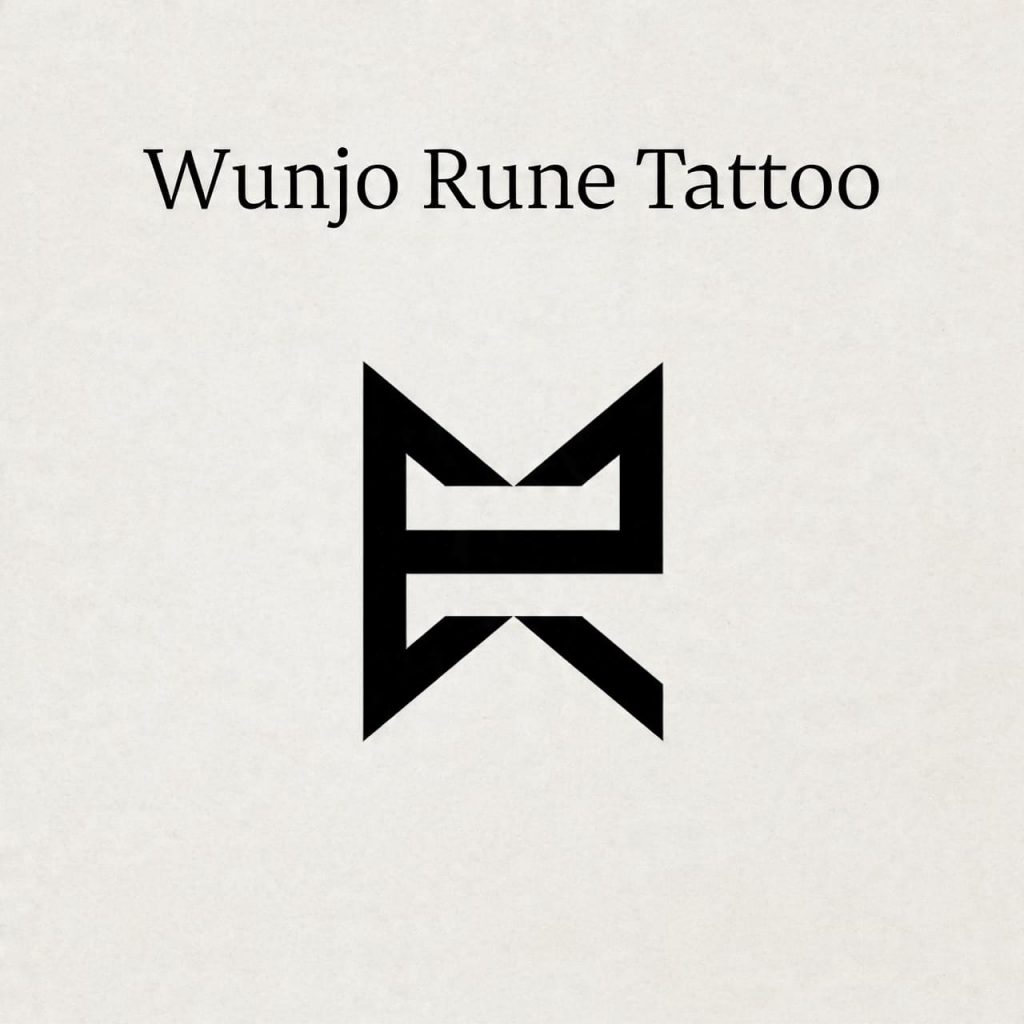
The phrase “Wunjo rune tattoo” is widely used in modern contexts, often implying that tattooing the Wunjo rune reflects an ancient or traditional practice rooted in early Germanic culture. Many contemporary explanations suggest that Wunjo was historically marked on the body for symbolic reasons and that modern tattoos continue this tradition. Even presentations offered by qualified professionals may repeat this assumption without distinguishing between historical evidence and modern body art practice.

💜 Need a clear answer right now?
CONSULT THE YES OR NO TAROT Free · No registration · Instant resultThe uncertainty here is historical and factual, not aesthetic or personal. The central question is whether there is credible evidence that the Wunjo rune was historically used as a tattoo, or whether rune tattoos are entirely a modern phenomenon.
This article evaluates that question by examining archaeological evidence for tattooing, early runic usage, linguistic and textual sources, and the modern emergence of rune tattoos, applying evidence-first analytical strategies such as those outlined by astroideal.
Defining “Tattoo” in a Historical Context
In historical analysis, tattooing refers to the deliberate marking of skin with permanent pigment, typically documented through physical remains, artistic depictions, or written descriptions. For a tattoo practice to be historically attested, evidence must demonstrate both the act of tattooing and the symbols used.
Early European tattooing is unevenly documented. While some ancient cultures left clear evidence of tattooing, others did not. Absence of evidence does not automatically imply absence of practice, but claims of specific symbols being tattooed require positive documentation.
Modern discussions often assume that if a symbol existed, it was also tattooed. This assumption mirrors interpretive habits found in systems comparable to love tarot readings, where symbolic presence is equated with practical application without corroboration.
Origin and Early Function of the Wunjo Rune
Wunjo is conventionally identified as the eighth rune of the Elder Futhark, the earliest runic alphabet used across parts of Northern Europe from approximately the second to sixth centuries CE. Comparative linguistic analysis establishes its phonetic value as /w/.
Early runic inscriptions are utilitarian. They appear on stone, metal, wood, and bone, typically recording names, ownership, lineage, or brief formulaic expressions. These inscriptions provide clear evidence for writing but do not describe or depict bodily marking.
No early runic source indicates that Wunjo—or any rune—was intended for inscription on human skin. Its documented function is as a grapheme within a writing system. Claims that it was used as a tattoo symbol therefore require independent evidence of bodily application, which is not present in early runic material.
Archaeological Evidence for Tattooing in Germanic Contexts
Archaeological evidence for tattooing among early Germanic populations is extremely limited. Unlike some other ancient cultures, there are no preserved human remains from Germanic regions that show clear tattoo marks attributable to runic symbols.
Classical authors occasionally mention body marking among northern peoples, but these accounts are vague and do not specify runes or particular symbols. They also reflect outsider perspectives rather than direct cultural documentation.
Crucially, no archaeological artifact depicts a human figure marked with runes, including Wunjo. There are no tools identifiable as tattooing instruments associated specifically with runic practice. The absence of material evidence makes it impossible to confirm rune tattooing historically, despite claims sometimes repeated by reliable readers.
Linguistic and Textual Sources
Linguistic evidence offers no support for rune tattoos. Rune names and phonetic values provide insight into language, not bodily practice. The rune name associated with Wunjo appears only in later medieval rune poems, where the rune is named Wynn in Old English.
These poems do not describe tattooing, body marking, or the application of runes to skin. They assume familiarity with runes as written characters, not as bodily symbols.
Medieval Scandinavian and Anglo-Saxon texts that describe adornment or bodily display do not reference runes as tattoos. Where marking is mentioned, it typically involves jewelry, clothing, or weapons rather than permanent skin inscription.
Absence of Ritual or Social Tattoo Frameworks
Historically attested tattoo traditions usually exist within clear social or ritual frameworks. They may mark status, rites of passage, group identity, or religious affiliation. Such frameworks are often documented through repeated patterns and textual explanation.
Early Germanic societies do not show evidence of a tattoo framework involving runes. There is no indication that runes functioned as identity markers on the body. Social identity was expressed through dress, weaponry, and ornamentation, all of which are archaeologically attested.
The absence of a tattoo framework is significant. Without evidence of ritualized body marking, claims that Wunjo was historically tattooed lack contextual support. This absence is often overlooked in modern explanations associated with online tarot sessions, where symbolic logic substitutes for historical context.
Medieval and Early Modern Silence on Rune Tattoos
Medieval authors who wrote about runes did so from antiquarian or literary perspectives. They discussed rune names, poetic associations, and sometimes legendary origins, but they did not describe tattooing practices.
If rune tattoos had existed and persisted into the medieval period, some trace might be expected in these texts. Their silence suggests that tattooing runes was not a recognized or remembered tradition.
Early modern antiquarians, who showed great interest in runes and Germanic antiquity, also did not record rune tattoo traditions. This silence across periods strengthens the conclusion that rune tattoos are not historically attested.
Modern Emergence of Rune Tattoos
The practice of tattooing runes emerges clearly in the modern period, particularly in the late twentieth century. This emergence coincides with renewed interest in Norse symbolism, body art, and personal identity expression.
In modern contexts, runes are often selected for perceived meanings derived from medieval poems or modern symbolic systems. Wunjo, associated linguistically with satisfaction or harmony in later sources, became attractive as a tattoo motif within this framework.
These tattoos are modern cultural expressions rather than revivals of documented ancient practice. Nevertheless, they are frequently presented as traditional, including in visual and explanatory formats such as video readings, without acknowledgment of their modern origin.
Structural Comparison with Historically Attested Tattoo Symbols
Historically attested tattoo symbols often share characteristics: repeated use within a culture, consistent placement on the body, and explanatory context in text or tradition. Polynesian tattooing, for example, meets these criteria.
Rune tattoos do not. There is no evidence of consistent placement, no repeated patterns in archaeological material, and no textual explanation of meaning or function. Each modern rune tattoo is individually designed, reflecting personal choice rather than inherited convention.
This contrast highlights the difference between historically grounded tattoo traditions and modern symbolic adoption.
Direct Evaluation of the Core Claim
The core claim implied by “Wunjo rune tattoo” is that Wunjo was historically used as a tattoo symbol. When evaluated against archaeological, linguistic, and textual evidence, this claim cannot be supported.
What the evidence shows is that Wunjo functioned as a phonetic rune within a writing system and that tattooing as a practice is not clearly attested among early Germanic populations in connection with runes. What the evidence does not show is any use of Wunjo as a bodily mark.
There are no preserved tattooed remains, no depictions, and no texts describing rune tattoos. Modern repetition of this idea, including in contexts such as phone readings or horoscope insights, does not change the historical assessment.
From a strictly historical perspective, the claim that Wunjo was used as a tattoo must therefore be answered in the negative.
Frequently Asked Questions
Were runes historically used as tattoos?
There is no historical evidence supporting this practice.
Is there archaeological proof of Wunjo tattoos?
No. No physical or artistic evidence exists.
Do medieval texts mention rune tattooing?
No. They do not describe body marking with runes.
Were early Germanic peoples tattooed?
Tattooing is not clearly documented for this context.
When did rune tattoos become common?
They emerged in the modern period.
Can Wunjo tattoo traditions be historically verified?
No. They cannot be verified using primary sources.
Call to Action
Claims about ancient body art benefit from careful evaluation of evidence and context. By examining archaeological remains, linguistic sources, and historical texts, readers can get a clear yes or no answer regarding whether the Wunjo rune was historically used as a tattoo. Applying this evidence-first approach, comparable in discipline to a one question tarot inquiry, helps distinguish documented history from modern cultural expression.
