

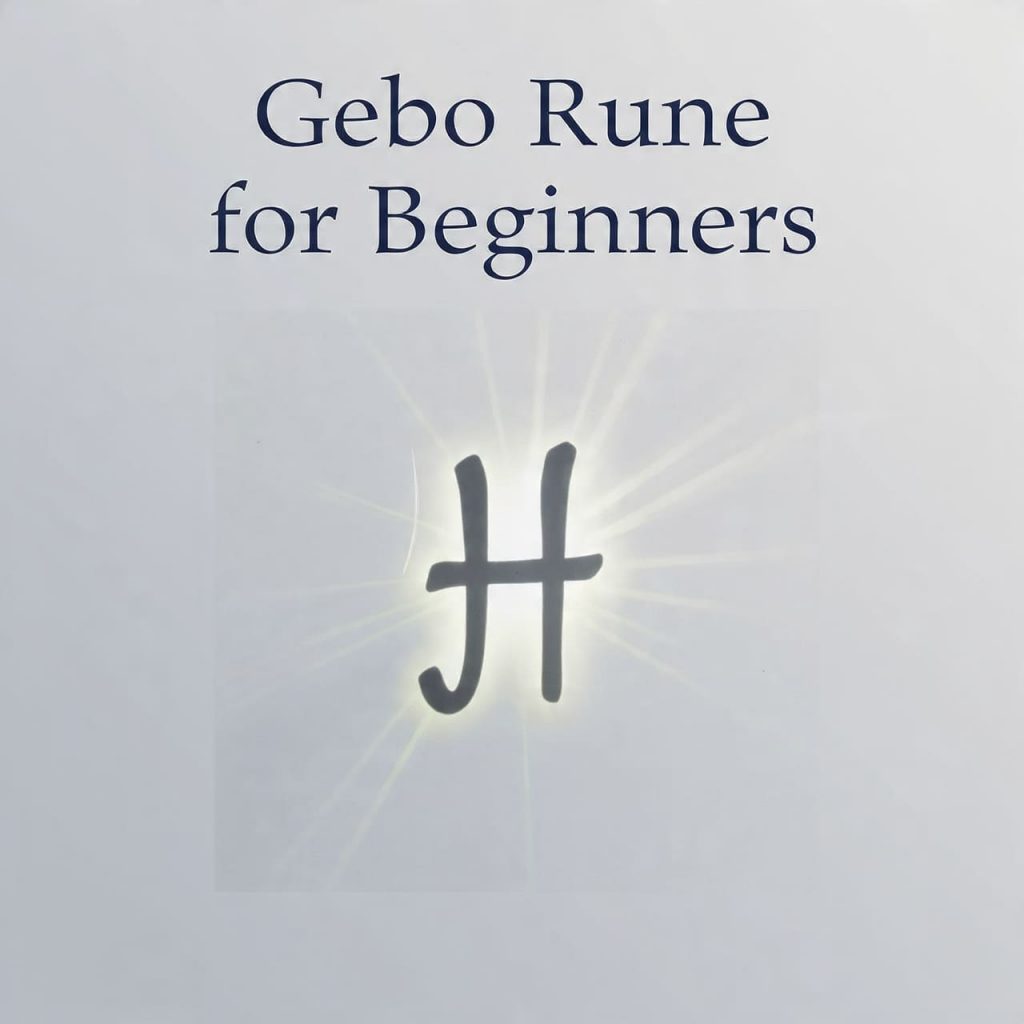
The phrase “Gebo rune for beginners” appears frequently in modern educational and explanatory material, often implying that newcomers can learn a simple, established meaning or method associated with the rune. This framing suggests that early runic culture offered a clear introductory pathway—definitions, functions, and applications—that modern learners can recover. Even explanations attributed to qualified professionals commonly present Gebo as if it were designed to be understood through a beginner-friendly interpretive lens.

💜 Need a clear answer right now?
CONSULT THE YES OR NO TAROT Free · No registration · Instant resultThe uncertainty here is historical and factual rather than pedagogical. The central question is whether the historical record supports the idea that Gebo had an accessible, defined meaning or use suitable for “beginners,” or whether this framing is a modern educational construct imposed on an ancient writing system.
This article evaluates that question by examining early runic usage, linguistic evidence, archaeological context, medieval textual sources, and the modern emergence of beginner-oriented explanations, using evidence-first strategies such as those outlined by astroideal.
What “Beginner” Means in a Historical Context
In modern usage, “beginner” refers to a person newly learning a system that includes structured instruction, progressive difficulty, and foundational concepts. Historically, for such a category to exist, there must be evidence of formal teaching methods, introductory materials, or staged learning processes.
Early runic culture does not show evidence of this structure. There are no manuals, primers, or graded lessons preserved from the runic period. Literacy in runes appears to have been limited and situational, rather than organized into a curriculum for novices.
The idea of a “beginner rune” presupposes a teaching framework that the historical record does not document. This assumption is often reinforced by modern explanatory systems that mirror tarot education models, including those seen in love tarot readings, where beginners are guided through predefined meanings.
Origin and Primary Function of the Gebo Rune
Gebo is conventionally identified as the seventh rune of the Elder Futhark, the earliest runic alphabet used across parts of Northern Europe from approximately the second to sixth centuries CE. Comparative linguistic analysis establishes its phonetic value as /g/.
Early runic inscriptions demonstrate that runes were used primarily for writing. They appear on weapons, tools, ornaments, and memorial stones, recording names, ownership, lineage, or brief formulaic expressions. These inscriptions do not indicate levels of difficulty, introductory usage, or simplified meanings.
Within this early context, Gebo functioned as one letter among others. There is no evidence that it was singled out as more basic, more accessible, or more suitable for new learners. The concept of a rune being appropriate “for beginners” therefore lacks historical grounding, despite its repetition by reliable readers in modern explanations.
Linguistic Evidence and the Rune Name Tradition
The name “Gebo” itself is not attested in Elder Futhark inscriptions. Rune names are preserved only in later medieval rune poems, composed centuries after the earliest runic period. In these poems, cognate forms such as Old English Gyfu and Old Norse Gjöf appear, both meaning “gift.”
Linguistically, these names derive from a Proto-Germanic root associated with giving. However, rune names do not function as teaching tools. In alphabetic systems, letters are often named after words without implying conceptual simplicity or instructional hierarchy.
The rune poems do not present Gebo as introductory or foundational. They offer poetic reflections rather than explanations for learners. Treating the rune name as a beginner-friendly definition reflects modern educational assumptions rather than historical linguistic practice, a pattern also evident in explanations circulated through online tarot sessions.
Archaeological Evidence and Learning Claims
Archaeological evidence provides no support for the idea of beginner-oriented rune use. Inscriptions containing Gebo appear in the same contexts as those containing other runes. There is no clustering of Gebo on objects that could be interpreted as practice pieces, learning tools, or instructional artifacts.
Where inscriptions are crude or irregular, scholars generally attribute this to individual skill variation rather than to learner status. There is no evidence of standardized training objects or simplified inscriptions designed for novices.
The material record therefore supports only one conclusion: runes were used as needed by those who knew them, without a documented beginner phase. Claims that Gebo served as an entry point for learners exceed what the archaeological data can support.
Medieval Texts and the Absence of Instructional Frameworks
Medieval rune poems and antiquarian references are sometimes invoked to support modern explanations for beginners. These texts, however, do not function as instructional guides. They assume familiarity with runes and provide poetic commentary rather than structured explanation.
Importantly, no medieval text categorizes runes by difficulty or suitability for learners. If such distinctions had existed and persisted, some trace might be expected in these sources. Their absence suggests that the concept of beginner-oriented runes is not historically grounded.
Evidence-first approaches, such as those emphasized by astroideal, treat this consistent silence as significant when evaluating claims of instructional tradition.
Modern Development of Beginner-Focused Rune Explanations
The framing of runes “for beginners” emerges clearly in the modern period, particularly in the twentieth century. As runes were incorporated into symbolic and divinatory systems, educators and authors adopted pedagogical language to make the material accessible to newcomers.
Within these frameworks, Gebo was often presented early due to its later name association with gift-giving, which was perceived as easy to explain. This decision reflects modern teaching strategy rather than historical precedence.
Such beginner-oriented explanations are frequently presented as traditional knowledge, including in formats such as video readings, without acknowledgment that the educational structure itself is modern.
Comparison with Historically Attested Learning Systems
Historically documented learning systems—such as classical rhetoric, medieval grammar, or religious instruction—share common features: written curricula, named stages, and continuity across generations. None of these features are present for runic literacy.
Runes were learned pragmatically, likely through informal transmission. There is no evidence of introductory categories, simplified meanings, or beginner-focused instruction. Treating Gebo as a beginner rune imposes a modern educational framework on a historically different context.
This comparison highlights the gap between documented practice and modern presentation, a gap often obscured in contemporary media such as phone readings.
Direct Evaluation of the Core Claim
The core claim implied by “Gebo rune for beginners” is that Gebo historically functioned as an introductory or foundational rune for new learners. When evaluated against linguistic, archaeological, and textual evidence, this claim cannot be supported.
What the evidence shows is limited and specific: Gebo was a phonetic rune used in writing, later named with a word meaning “gift.” What the evidence does not show is any instructional hierarchy, beginner category, or simplified role for Gebo.
There are no early texts describing learning stages, no artifacts indicating beginner use, and no medieval sources supporting instructional framing. Modern repetition of beginner narratives, including in horoscope insights, does not alter the historical record.
From a strictly historical perspective, the idea of Gebo as a rune “for beginners” must therefore be answered in the negative.
Frequently Asked Questions
Was Gebo historically considered a beginner rune?
No. There is no historical evidence categorizing Gebo as suitable for beginners.
Did early runic culture have learning stages?
No. There is no evidence of structured instructional stages.
Do rune poems explain runes for learners?
No. They provide poetic commentary, not instruction.
Is the rune name “gift” meant as a teaching aid?
No. Rune names do not function as educational simplifications.
When did beginner-focused explanations appear?
They appeared in modern educational and symbolic systems.
Can beginner interpretations of Gebo be historically verified?
No. They cannot be verified using primary sources.
Call to Action
Assessing claims about ancient learning requires careful attention to what sources actually document. By examining inscriptions, linguistic traditions, and medieval texts, readers can get a clear yes or no answer regarding whether the Gebo rune historically functioned as a beginner concept. Applying this evidence-first approach, comparable in discipline to a one question tarot inquiry, helps distinguish documented history from modern educational framing.
