

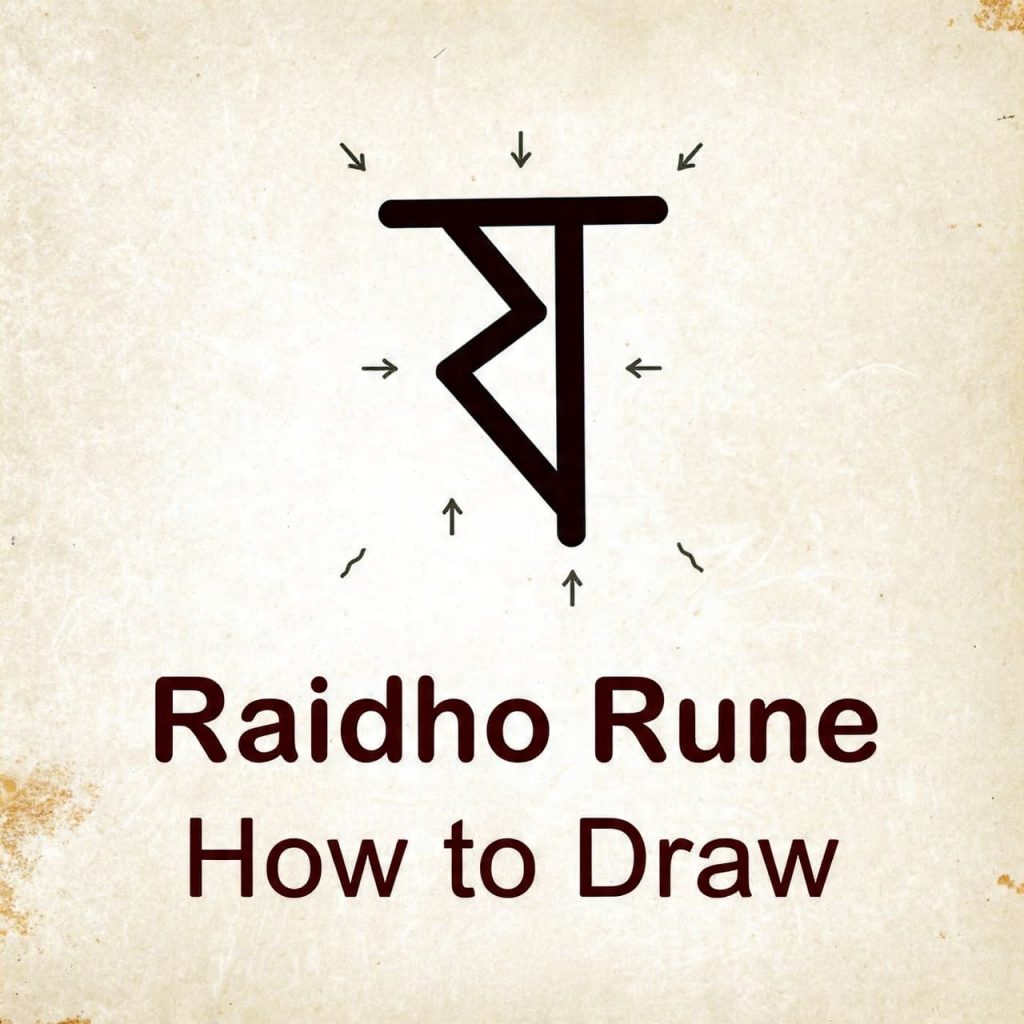
Learning how to draw the Raidho rune often seems simpler than it actually is. At first glance, the shape looks minimal, yet small mistakes in proportion or orientation can change what is being drawn. Beginners frequently feel uncertain not because the rune is complex, but because precision matters more than decoration. Without clear guidance, it is easy to draw something that resembles Raidho without actually being it.

💜 Need a clear answer right now?
CONSULT THE YES OR NO TAROT Free · No registration · Instant resultDrawing the Raidho rune is not an artistic exercise. It is a structural one. The goal is accuracy, not expression. When approached with clarity-first principles—such as the methodical learning strategies discussed at astroideal—drawing Raidho becomes a straightforward process focused on form, proportion, and orientation rather than symbolism or intuition.
Why Accuracy Matters When Drawing Raidho
Runes are not abstract symbols. They are defined characters with fixed forms. Drawing Raidho accurately preserves its identity. Small deviations, such as reversing the angle or placing the branch incorrectly, can unintentionally turn it into a different form or a meaningless mark.
Accuracy matters because Raidho’s meaning depends on structure, not interpretation. You are not expressing an idea; you are reproducing a specific sign.
This emphasis on precision is consistently reinforced by qualified professionals, who teach rune drawing as a matter of correct form rather than personal style.
Understanding the Basic Structure Before Drawing
Before putting pen to paper, it helps to understand what makes Raidho recognizable.
Raidho consists of:
- One straight vertical line
- One angled or curved branch extending from the right side of that line
The vertical line is the anchor. It must be straight and dominant.
The branch represents movement and must attach cleanly to the vertical line.
There are no extra lines, no symmetry, and no decorative elements.
Understanding this structure first prevents most common errors.
Step-by-Step Overview of Drawing Raidho
Drawing Raidho follows a clear sequence. Skipping steps often leads to proportion errors.
- Draw a straight vertical line.
- Identify the midpoint of that line.
- From slightly above the midpoint, draw a branch extending to the right and downward.
- Ensure the branch connects cleanly to the vertical line.
The order matters. Drawing the vertical line first establishes stability and proportion.
This process-based approach mirrors the clarity-driven structure used in focused love tarot readings, where sequence matters more than interpretation.
Drawing the Vertical Line Correctly
The vertical line is the foundation of the Raidho rune. It should be:
- Straight
- Slightly longer than the branch
- Drawn first
A tilted or curved vertical line weakens the structure. This line represents stability, so it must visually communicate that.
Beginners sometimes shorten the vertical line too much, making the branch appear dominant. This distorts the rune’s balance.
Placing the Branch Accurately
The branch is the most common source of error. It must:
- Extend from the right side of the vertical line
- Begin slightly above the midpoint
- Angle downward
If the branch begins too high, the rune looks top-heavy.
If it begins too low, the rune loses its sense of movement.
The branch should never extend to the left. Leftward extension changes the rune’s identity.
Learners who want confirmation of correct placement often seek neutral guidance from reliable readers to avoid subtle but significant errors.
Straight Versus Curved Branch
Historically, the Raidho branch could be straight or slightly curved, depending on carving medium. Stone and wood often produced straighter lines, while ink allowed gentle curves.
Both are acceptable as long as orientation and connection are correct. The choice between straight and curved is practical, not symbolic.
Excessive curvature, however, turns the rune into decoration rather than structure.
Maintaining Proportion
Proportion is more important than size. Raidho can be drawn large or small, but relationships between elements must remain consistent.
As a guideline:
- The vertical line should be the longest element
- The branch should be shorter and clearly secondary
- The angle should suggest movement without overpowering the base
Beginners often benefit from practicing on graph paper to maintain proportion.
Orientation: The Most Critical Rule
Orientation is non-negotiable. Raidho must face right when drawn upright.
Rotating the rune, mirroring it, or flipping it upside down creates a different form. In many cases, it no longer represents Raidho at all.
Orientation errors are common when drawing quickly or stylizing. Slowing down prevents this.
This discipline aligns with the careful boundaries maintained in online tarot sessions, where clarity is preserved by respecting structure.
Common Mistakes Beginners Make
Several mistakes appear repeatedly:
- Drawing the branch on the left
- Starting the branch too low
- Making the branch horizontal instead of angled
- Adding extra strokes
- Tilting the vertical line
Each of these changes the rune’s identity. Recognizing these errors early saves time and confusion.
Drawing Raidho by Hand Versus Digitally
Whether drawing by hand or digitally, the same rules apply. Medium does not change structure.
Digitally, snapping tools can help maintain straight lines. By hand, using light guide lines can improve accuracy.
The goal in both cases is legibility, not artistry.
How Drawing Reinforces Understanding
Drawing Raidho is not just mechanical. It reinforces understanding by forcing attention to structure.
As you draw, you naturally notice:
- Where stability comes from
- How movement emerges from structure
- Why orientation matters
This embodied learning deepens comprehension more effectively than memorization alone.
This learning-by-doing approach is also emphasized in visual formats such as video readings, where seeing structure explained reinforces accuracy, and in audio-based explanations like phone readings, which focus on sequence and order.
Practicing Without Overdoing It
Practice is useful, but repetition without awareness can create bad habits. A few careful drawings are better than many rushed ones.
Each practice attempt should include a brief pause to check:
- Is the vertical line straight?
- Is the branch on the right?
- Is the proportion balanced?
Once these checks become automatic, further practice is unnecessary.
When Stylization Is Appropriate
Stylization should only come after mastery of the basic form. Even then, stylization must preserve:
- Orientation
- Proportion
- Number of lines
Changing thickness or texture is acceptable. Changing structure is not.
Beginners should avoid stylization entirely until the standard form feels natural.
Drawing Raidho in Context
When Raidho is drawn alongside other runes, consistency matters. Line weight, scale, and orientation should match.
Inconsistent drawing creates confusion and undermines clarity. Each rune should be immediately recognizable.
This principle of consistency parallels the disciplined approach used in structured systems like horoscope insights, where coherence matters more than embellishment.
Drawing Does Not Create Meaning
It is important to separate drawing from interpretation. Drawing Raidho correctly does not activate meaning or influence outcomes.
Drawing is about recognition and learning. Meaning arises from context, not from the act of drawing.
This prevents unrealistic expectations and keeps practice grounded.
Educational frameworks such as those discussed at astroideal emphasize this separation clearly: form supports understanding; it does not generate effect.
Teaching Yourself to Draw Raidho
Self-teaching is entirely possible if approached methodically:
- Start with clear reference
- Draw slowly
- Check orientation
- Correct immediately
Avoid guessing or “feeling it out.” Raidho is not intuitive in shape; it is learned.
Drawing Raidho Repeatedly in the Same Session
Repeated drawing in a single session is unnecessary once accuracy is achieved. Over-repetition often leads to distortion through fatigue.
It is better to draw Raidho once correctly than many times imperfectly.
Long-Term Familiarity With the Shape
Over time, the shape of Raidho becomes instantly recognizable. You will know when it is drawn correctly without checking references.
This recognition is the goal. When achieved, drawing becomes effortless.
What Drawing Raidho Is Not
Drawing Raidho is not:
- A ritual
- A meditation
- A form of activation
- An artistic performance
It is a structural exercise.
Understanding this keeps expectations realistic and learning efficient.
Frequently Asked Questions
Is there only one correct way to draw Raidho?
There is one correct structure with minor acceptable variation.
Can the branch be curved?
Yes, slightly, as long as orientation and placement are correct.
Does size matter?
No. Proportion matters, not size.
Can I rotate the rune for style?
No. Rotation changes identity.
Is drawing digitally acceptable?
Yes. Medium does not affect correctness.
How many times should I practice?
Until accuracy feels natural, then stop.
Call to Action
Learning how to draw the Raidho rune correctly builds clarity through precision. When structure is respected, recognition replaces doubt. If you want to get a clear yes or no answer about whether your Raidho drawing is accurate, or prefer a disciplined one question tarot approach to learning rune forms step by step, focusing on orientation, proportion, and sequence is the most reliable way to master this rune with confidence.
