

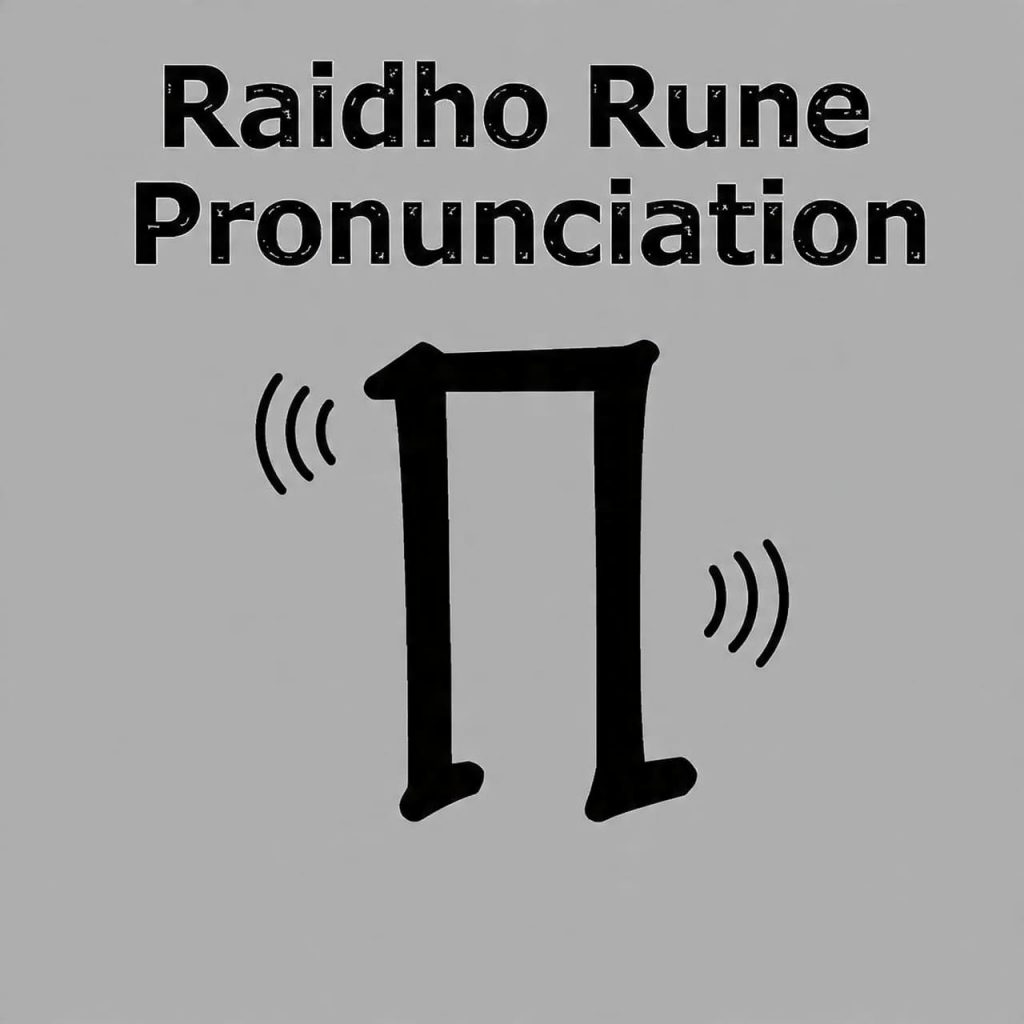
Pronouncing the Raidho rune correctly often causes more uncertainty than expected. Many learners assume pronunciation is symbolic or flexible, while others worry there is a single “correct” sound that must be mastered. This confusion usually comes from mixing historical linguistics with modern spiritual usage. Without separating these layers, pronunciation becomes unnecessarily stressful.

💜 Need a clear answer right now?
CONSULT THE YES OR NO TAROT Free · No registration · Instant resultRaidho rune pronunciation is not mystical, intuitive, or emotionally driven. It is linguistic. The rune originated as a sound-bearing character, and its pronunciation follows historical language patterns rather than modern spiritual preference. When approached with clarity-first learning principles—such as those discussed at astroideal—Raidho pronunciation becomes straightforward, practical, and easy to remember.
Why Pronunciation Matters for Runes
Runes were originally letters, not symbols. Each rune represented a sound used in spoken language. Pronunciation mattered because runes were carved, read, and understood within real communication systems.
For beginners, this is a critical reset. You are not learning how to “intonate energy.” You are learning how an early Germanic sound was formed and spoken.
This historical grounding is consistently emphasized by qualified professionals, who separate linguistic accuracy from modern interpretive practice.
The Historically Accepted Pronunciation of Raidho
The Raidho rune is generally pronounced as “RYE-thoh” or “RAI-thoh.”
The first sound resembles “rye” or “ride” without the final “d.”
The second sound is a soft “th,” similar to “this” rather than “think.”
The final vowel is open, similar to “oh.”
Phonetically, it is often rendered as:
/ˈrɑiθo/ or /ˈraiθo/
There may be slight variation depending on reconstructed dialect, but the structure remains consistent.
Understanding the “Th” Sound in Raidho
The “th” sound in Raidho is one of the most common points of confusion. It is not a hard “t” or “d.” It is a voiced dental fricative—the same sound used in the English word “this.”
This matters because substituting a hard consonant changes the sound family entirely. Raidho belongs to a linguistic system where consonant quality carried meaning.
Pronouncing it as “RAY-do” or “RYE-do” is inaccurate historically.
Learners who want to confirm phonetic distinctions sometimes consult neutral explanations from reliable readers, especially when encountering conflicting online sources.
Why There Are Multiple Spellings but One Core Sound
You may encounter spellings such as Raidho, Raido, Rad, or Reid. These variations reflect differences in transliteration, not pronunciation intent.
Early runic systems did not use standardized spelling the way modern languages do. What mattered was sound recognition.
Despite spelling differences, the core pronunciation remains consistent: a rolling or open “rai” followed by a soft “th” and an open vowel.
Understanding this prevents overthinking minor spelling variants.
Pronunciation Across Runic Systems
Raidho appears in the Elder Futhark. Later runic systems simplified or altered sound values, but Raidho’s pronunciation remained closely tied to its original phonetic role.
This consistency is important. It shows that pronunciation was stable enough to be recognized across regions.
Beginners often assume pronunciation changed dramatically over time. In reality, the changes were gradual and subtle.
Speaking Raidho Aloud Versus Reading It
There is a difference between recognizing pronunciation and speaking it aloud. Saying Raidho aloud does not “activate” anything. It simply reinforces correct sound recognition.
Speaking the rune can help learners remember it, just as saying a new word aloud helps with language learning.
This practical approach mirrors how pronunciation is handled in structured love tarot readings, where clarity of terms matters more than ritualization.
Common Mispronunciations to Avoid
Several mispronunciations appear frequently:
- “RAY-doh” (hard d instead of th)
- “RYE-doh” (missing dental fricative)
- “RAID-oh” (English word distortion)
- “RAH-ee-tho” (overcomplicated syllables)
These errors usually come from applying modern English spelling rules to ancient phonetics.
Remember: Raidho is not an English word.
Why Pronunciation Is Not Ritual
Some sources frame rune pronunciation as a chant or ritual. This is a modern reinterpretation, not a historical practice.
Historically, pronunciation was functional. Runes were spoken because they were language.
Treating pronunciation as ritual often leads to exaggerated sounds or invented emphasis that obscures accuracy.
Educational approaches like those discussed at astroideal emphasize linguistic clarity over ceremonial performance.
How Pronunciation Relates to Understanding
Correct pronunciation supports conceptual clarity, not spiritual effect. When you pronounce Raidho correctly, you reinforce its identity as a sound-based character.
This helps prevent confusion between runes with similar shapes or meanings.
Pronunciation anchors learning. It does not replace interpretation.
Should Beginners Worry About Perfect Accuracy?
No. Beginners should aim for approximate accuracy, not perfection.
Languages evolve, and reconstructed pronunciations are educated approximations. Minor variation is normal and expected.
What matters is preserving the core structure:
open “rai” + soft “th” + open vowel ending.
Overcorrecting creates anxiety without improving understanding.
Pronunciation and Modern Use
In modern rune study, pronunciation is primarily educational. It helps learners:
- Distinguish runes
- Remember meanings
- Maintain historical respect
It does not affect interpretation quality or outcome.
This practical framing aligns with the clarity-based structure used in online tarot sessions, where terminology accuracy supports understanding without becoming dogmatic.
Listening Versus Reading Pronunciation Guides
Listening to pronunciation examples can be helpful, but learners should be cautious. Not all audio sources are accurate.
Some recordings exaggerate vowels or replace sounds with easier modern equivalents.
When listening, focus on consonant quality—especially the “th”—rather than accent or tone.
Visual explanations through video readings sometimes demonstrate mouth placement, while audio formats similar to phone readings emphasize sound flow. These can support learning when used critically.
Pronunciation Does Not Change Meaning
Pronouncing Raidho slightly differently does not change its meaning. Meaning is contextual, not phonetic.
This is important because some learners fear they are “doing it wrong.” Pronunciation supports recognition, not correctness of interpretation.
Accuracy matters academically, not spiritually.
Avoiding Cultural Overreach
It is important not to claim ancient authority through pronunciation. Saying Raidho “correctly” does not confer authenticity or expertise.
Rune study benefits from humility and historical honesty. Pronunciation is one component, not a credential.
Ethical learning respects source material without turning it into hierarchy.
Pronunciation and Reversed Forms
Pronunciation does not change when discussing reversed or inverted Raidho. The sound remains the same.
Orientation affects interpretation, not phonetics.
This distinction helps keep learning organized and prevents unnecessary complication.
Pronunciation Practice Tips
Simple, effective practice includes:
- Saying the rune name once or twice aloud
- Associating sound with meaning
- Avoiding repetitive chanting
Short, intentional exposure builds familiarity without ritualization.
Context Without Prediction or Belief
Pronouncing Raidho does not predict anything or influence outcomes.
Light contextual awareness, such as general horoscope insights, may help learners notice broader linguistic or cultural patterns, but astrology does not inform rune pronunciation.
Pronunciation remains linguistic, not symbolic.
Long-Term Learning Perspective
As learners progress, pronunciation becomes automatic. It stops being a focus and becomes background knowledge.
This is a sign of healthy learning. When pronunciation no longer demands attention, understanding deepens naturally.
Raidho pronunciation is a foundation, not a destination.
Frequently Asked Questions
Is there only one correct pronunciation of Raidho?
There is one core structure, with minor acceptable variation.
Is the “th” sound important?
Yes. It distinguishes Raidho from other sounds.
Do I need to say Raidho aloud?
No. Speaking it can help learning but is not required.
Does pronunciation affect meaning?
No. Meaning is contextual.
Can beginners mispronounce it safely?
Yes. Accuracy improves with time.
Is chanting historically accurate?
No. Runes were spoken as language, not ritual.
Call to Action
Learning the pronunciation of Raidho helps anchor understanding in history rather than assumption. When sound is treated as language instead of performance, clarity replaces confusion. If you want to get a clear yes or no answer about whether you are pronouncing Raidho accurately, or prefer a disciplined one question tarot approach to learning runes step by step, focusing on linguistic structure rather than ritual interpretation is the most reliable way forward.
