

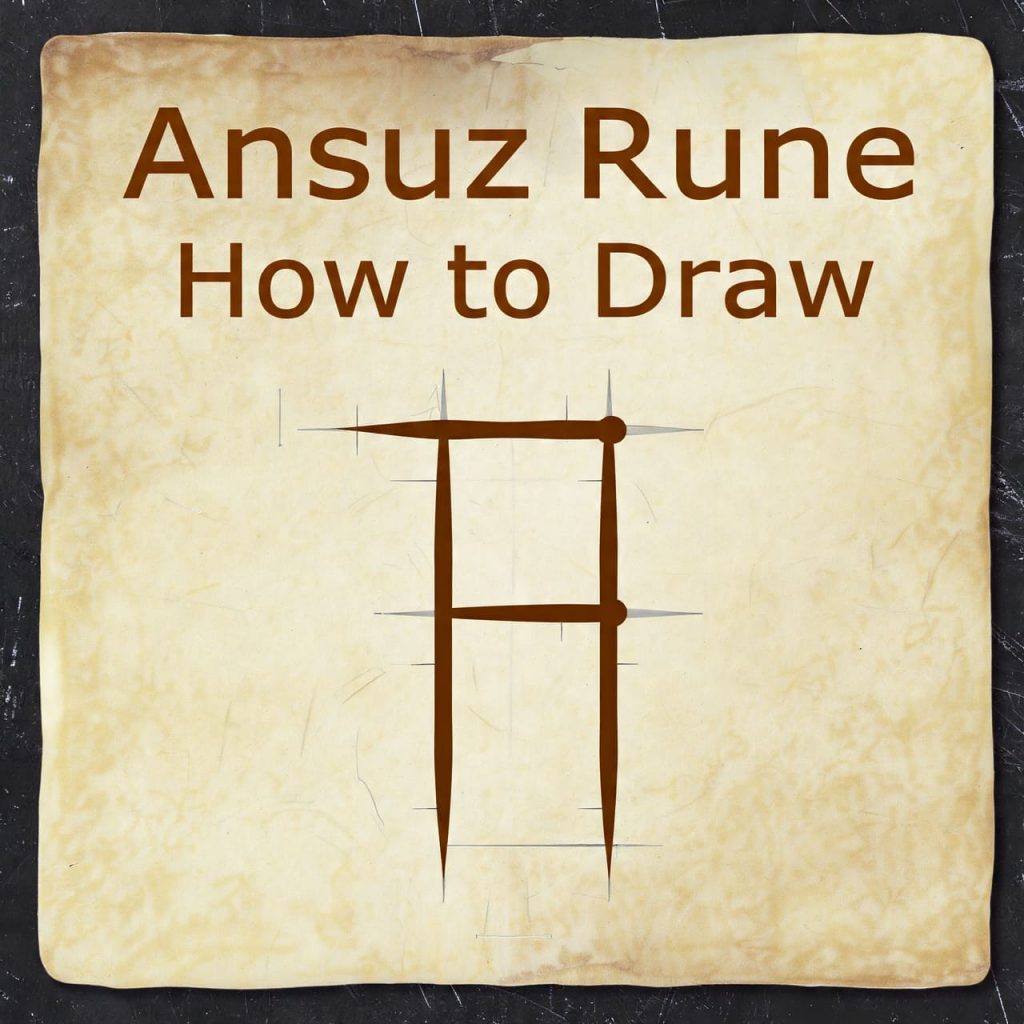
Learning how to draw the Ansuz rune often seems easier than it actually is. At first glance, the shape appears simple, even minimal. Yet many people hesitate once they begin, unsure about line direction, proportion, or orientation. This uncertainty is not trivial. With runes, accuracy matters, not because of superstition, but because structure defines identity. A rune drawn incorrectly is no longer the same symbol.

💜 Need a clear answer right now?
CONSULT THE YES OR NO TAROT Free · No registration · Instant resultThe challenge with Ansuz is that small deviations can subtly change its form. Beginners often assume variation is harmless, but runes are functional signs, not decorative motifs. Approaching the process calmly and methodically, using clarity-focused learning principles such as those discussed at astroideal, ensures the rune is drawn with confidence and consistency.
Why Drawing Ansuz Requires Precision
Ansuz is a rune of communication and transmission, and its structure reflects that role. Each line serves a purpose. When drawn correctly, the rune is immediately recognizable. When drawn loosely or stylized excessively, its identity becomes ambiguous.
Precision does not mean artistic perfection. It means respecting orientation, proportion, and direction. These elements distinguish Ansuz from other runes and from abstract symbols.
This emphasis on structural accuracy is often reinforced by qualified professionals, who treat runes as defined forms rather than flexible designs.
Understanding the Basic Structure of Ansuz
Before drawing Ansuz, it is important to understand its basic components. The rune consists of:
- One vertical main line
- Two shorter diagonal strokes extending from the right side of the vertical line
The vertical line is the anchor. The angled strokes represent outward movement, symbolizing transmission rather than containment. The rune is asymmetrical by design, and this asymmetry must be preserved.
Ansuz is never mirrored, rotated, or reversed when drawn upright. Orientation is not optional.
Step-by-Step: How to Draw the Ansuz Rune
Drawing Ansuz correctly can be broken down into simple, repeatable steps.
First, draw a straight vertical line from top to bottom. This line should be clean and unbroken. It serves as the spine of the rune and determines its orientation.
Second, add the upper diagonal stroke. This line begins at roughly the upper third of the vertical line and angles upward and outward to the right. It should be shorter than the main vertical line and drawn in one motion.
Third, add the lower diagonal stroke. This line begins below the first diagonal, again extending outward to the right, but angled slightly downward. It should mirror the upper diagonal in length and angle, creating balance without symmetry.
The spacing between the two diagonals matters. They should not touch or overlap. Each line must remain distinct.
Common Drawing Mistakes to Avoid
One frequent mistake is drawing the diagonal lines on the left side of the vertical line. This mirrors the rune and changes its identity.
Another mistake is angling both diagonal strokes in the same direction. Ansuz requires one upward and one downward diagonal to preserve its structural logic.
Over-curving the lines is also a common error. Runes are traditionally angular because they were carved, not written. Curves dilute clarity.
Beginners sometimes stylize the rune too early. Decoration should come only after the structure is fully understood.
Many learners cross-check their early drawings with neutral reference explanations from reliable readers to confirm that structure has been preserved before adding personal style.
Orientation: Upright Versus Incorrect Positioning
Ansuz must always be drawn upright unless intentionally studying reversed forms in a specific system. For beginners, reversed or rotated versions should be avoided entirely.
The vertical line must be vertical, not slanted. Even a slight tilt can make the rune resemble a different symbol.
Orientation matters because runes are read visually. A correctly drawn Ansuz is immediately legible; a tilted one introduces ambiguity.
Accuracy here builds long-term confidence.
Proportion and Balance in Drawing Ansuz
Proportion is more important than size. Ansuz can be drawn large or small, but the relationship between its lines must remain consistent.
The diagonal strokes should be noticeably shorter than the main vertical line. If they are too long, the rune becomes visually unstable. If too short, it loses its characteristic shape.
Balance does not mean symmetry. It means visual coherence.
Understanding this helps prevent overcorrection and unnecessary refinement.
Drawing Ansuz Repeatedly for Familiarity
Repetition is the most effective way to learn how to draw Ansuz. Drawing it once is not enough. Drawing it many times builds muscle memory.
Early repetition should be slow and deliberate. Speed comes naturally once the form is internalized.
This approach mirrors the discipline used in focused love tarot readings, where clarity improves through consistency rather than complexity.
Drawing Ansuz on Different Surfaces
Ansuz can be drawn on paper, carved into wood, traced in sand, or sketched digitally. The surface does not change the rune’s structure.
However, each surface highlights different challenges. Carving emphasizes straight lines and angles. Drawing on paper may tempt curves. Digital drawing can encourage over-stylization.
Practicing across mediums helps reinforce structural understanding rather than aesthetic preference.
Using Guides and References Responsibly
Visual guides can be helpful when learning to draw Ansuz, but they should be used sparingly. Overreliance on guides can prevent internalization of the form.
The goal is to be able to draw Ansuz from memory with confidence. References are stepping stones, not crutches.
Structured learning environments, similar to those used in online tarot sessions, emphasize gradual independence rather than constant correction.
When Stylization Is Appropriate
Stylization should only come after the correct form is mastered. Beginners often rush this step, leading to distorted symbols.
Acceptable stylization includes slight variation in line thickness or texture, as long as orientation and proportion remain intact.
Unacceptable stylization includes rotating the rune, curving the lines excessively, or merging strokes.
Respect for structure preserves meaning.
Drawing Ansuz for Learning Versus Display
Drawing Ansuz for study differs from drawing it for display. For learning, simplicity is best. Plain lines without embellishment help reinforce form.
For display, artistic choices may be added later, but only after mastery. Even then, clarity should never be sacrificed for decoration.
Understanding this distinction prevents confusion and frustration.
Modern Learning Tools and Drawing Ansuz
Modern learners often use videos or audio explanations to support learning. Visual demonstrations in video readings can help clarify stroke order and proportion, while verbal guidance similar to phone readings can reinforce orientation and structure without visual distraction.
These tools support learning but do not replace hands-on practice.
Contextual Awareness Without Overthinking
Some learners worry about timing, symbolism, or meaning while learning to draw Ansuz. This is unnecessary at the drawing stage.
Occasional reference to broader learning rhythms, such as general horoscope insights, can explain fluctuations in focus or patience, but they should not influence how the rune is drawn.
Drawing Ansuz is a mechanical skill before it is anything else.
What Drawing Ansuz Does Not Do
Drawing Ansuz correctly does not activate it, empower it, or produce outcomes. It builds accuracy and familiarity.
Expecting more than this creates unnecessary pressure. The value lies in precision, not effect.
Understanding this keeps practice grounded and effective.
Long-Term Confidence Through Drawing
Over time, drawing Ansuz becomes automatic. The hand knows the form without conscious effort.
This confidence frees attention for learning other runes or applications without revisiting basics.
Educational approaches like those discussed at astroideal emphasize this progression by focusing on mastery through repetition rather than performance.
Frequently Asked Questions
Is there only one correct way to draw Ansuz?
Yes, within strict structural limits.
Can Ansuz be mirrored?
No. Mirroring changes the rune.
Does size matter?
No. Proportion matters more than size.
Can beginners stylize Ansuz?
Not until the correct form is mastered.
Should I draw it daily?
Yes, briefly and consistently.
Does drawing accuracy affect meaning?
Accuracy preserves identity, not interpretation.
Call to Action
Learning how to draw the Ansuz rune correctly is about respecting structure, not achieving perfection. When form becomes familiar, confidence replaces hesitation. If you want to get a clear yes or no answer about whether you are drawing Ansuz accurately, or prefer a disciplined one question tarot approach to learning, focusing on orientation, proportion, and repetition is the most reliable way to master this rune.
