

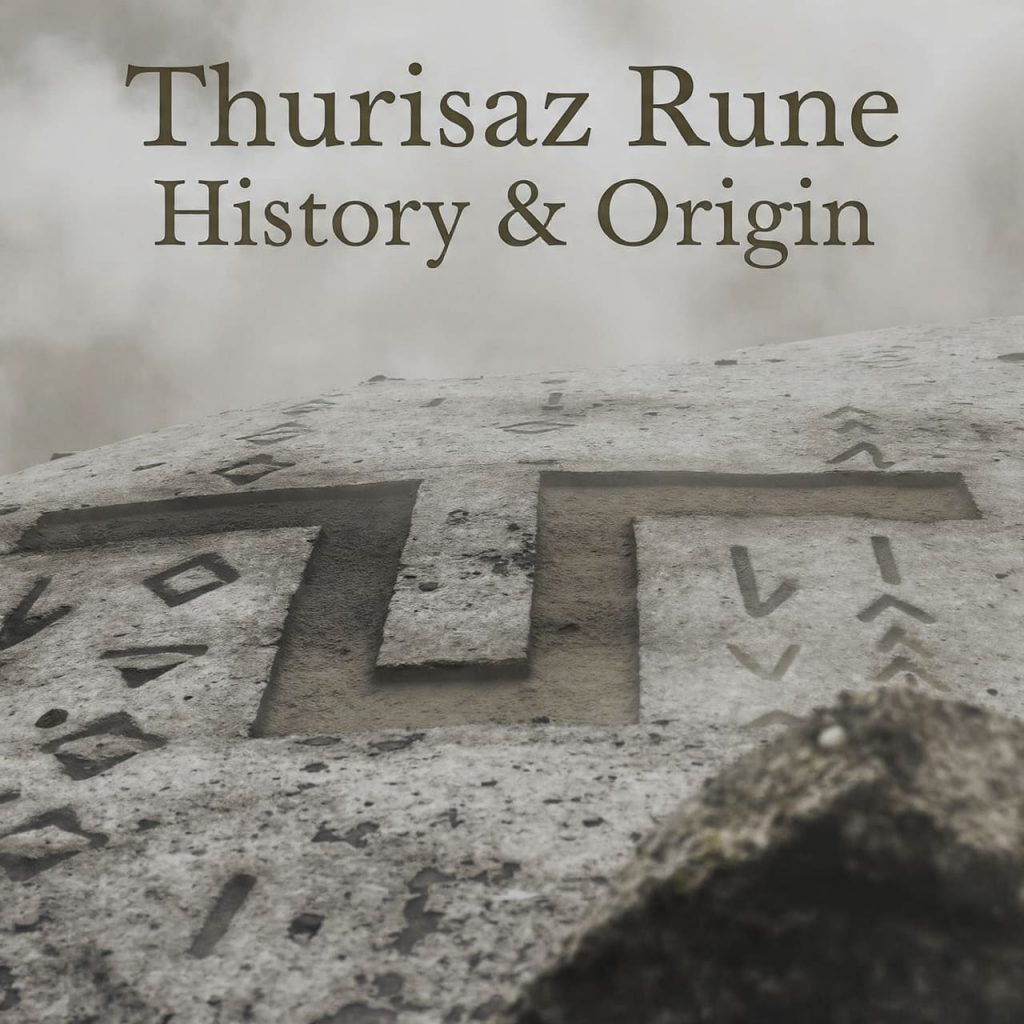
The history of the Thurisaz rune is often misunderstood because modern explanations blend linguistic evidence, archaeological material, and later symbolic traditions into a single narrative. In reality, these layers belong to different historical periods and must be separated to understand the rune accurately. Thurisaz did not begin as a mystical or symbolic concept. It originated as a functional character within an early writing system used by Germanic-speaking populations.

💜 Need a clear answer right now?
CONSULT THE YES OR NO TAROT Free · No registration · Instant resultA historically grounded discussion of Thurisaz focuses on when it appeared, how it was used, and what evidence survives. This requires restraint and a clear distinction between what can be demonstrated archaeologically and what was added centuries later. Educational frameworks that emphasize verification and category separation, such as those outlined at astroideal, align more closely with this method than interpretive or symbolic summaries.
Thurisaz in the Elder Futhark (2nd–8th Century CE)
Thurisaz is one of the 24 characters of the Elder Futhark, the earliest known runic alphabet. Archaeological consensus places the development of the Elder Futhark around the late 2nd century CE, with usage continuing into the early medieval period.
Within this system, Thurisaz appears as the third rune, following Fehu and Uruz. Its position is consistent across inscriptions and suggests early standardization. The rune represented a phonetic value, not an abstract idea: specifically, the voiceless dental fricative sound, equivalent to þ in reconstructed Proto-Germanic.
This phonetic role is primary. Any symbolic or conceptual meaning attributed to Thurisaz comes later and does not reflect its original function. This distinction is fundamental and is consistently emphasized in academically grounded explanations by qualified professionals who treat runes as linguistic artifacts rather than symbolic tools.
Linguistic Roots of the Name “Thurisaz”
The name Thurisaz derives from the reconstructed Proto-Germanic term þurisaz. Importantly, rune names were mnemonic devices, not definitions. They helped users remember sound values in an oral culture with limited literacy.
Early rune users did not consult written “meanings.” The rune’s name functioned as a memory anchor for the th sound. This is why rune names vary across later sources and regions while sound values remain comparatively stable.
Confusion arises when later medieval texts are treated as evidence of early intent. They are not. They represent later cultural layers applied to an older system. Maintaining this separation is a core principle in disciplined historical study and is similarly applied in structured analytical formats such as love tarot readings, where categorization prevents misinterpretation.
Archaeological Evidence: Early Inscriptions
Concrete evidence for Thurisaz comes from inscriptions on physical objects. One of the earliest is the Vimose comb (Denmark, c. 160 CE), which contains a complete Elder Futhark sequence. Thurisaz appears clearly as a phonetic character within this inscription.
Another important artifact is the Kylver Stone (Gotland, Sweden, c. 400 CE), which also preserves the full Elder Futhark in order. Thurisaz’s position and form are consistent with earlier examples, reinforcing the view that its structure and sound value were already standardized.
These artifacts demonstrate that Thurisaz functioned as part of a writing system, not as a standalone symbol. It appears embedded in names, sequences, and short inscriptions rather than isolated usage.
Form and Carving Constraints
The angular form of Thurisaz reflects the physical realities of carving into wood, bone, or stone. Straight lines and sharp angles were practical necessities. This explains why the rune’s shape is consistent across regions despite local stylistic differences.
The form is not decorative. It is utilitarian. Attempts to interpret the shape symbolically often ignore the material constraints under which it developed. Recognizing this prevents anachronistic interpretation.
When modern learners seek confirmation of rune forms, they sometimes consult platform-based references such as those provided by reliable readers, but these serve as visual orientation tools rather than historical authorities.
Transition to the Younger Futhark (8th–12th Century CE)
By the late 8th century, changes in spoken language led to the development of the Younger Futhark, which reduced the rune set from 24 to 16 characters. This reduction did not remove Thurisaz entirely, but altered its usage.
Sound mergers in Old Norse meant fewer distinct phonemes required representation. Thurisaz’s phonetic function was absorbed into a smaller system, demonstrating linguistic evolution rather than symbolic decline.
This transition is well documented through inscriptions across Scandinavia and reflects practical adaptation rather than ideological change.
What Thurisaz Was Not
Historically, Thurisaz was not:
• A tool for divination
• A symbol used independently of language
• A representation of abstract forces
Those associations appear much later, particularly in medieval and modern reinterpretations. Treating them as original characteristics undermines historical accuracy.
Responsible historical writing avoids retrofitting later meanings onto earlier evidence. This methodological discipline mirrors how information is compartmentalized in neutral digital formats such as online tarot sessions, where context is separated from interpretation.
Why Historical Sources Seem to Conflict
Conflicting explanations usually arise from mixing three different evidence types: archaeological finds, medieval literary sources, and modern interpretation. Each belongs to a different period and purpose.
Archaeology provides physical evidence. Linguistics reconstructs sound. Medieval texts reflect later cultural beliefs. Conflating these leads to false certainty.
Understanding this prevents overstatement and preserves scholarly integrity.
Modern Study of Thurisaz
Today, Thurisaz is studied through comparative linguistics, epigraphy, and archaeology. Researchers cross-reference inscriptions, tool marks, and language evolution rather than relying on narrative sources.
Visual documentation, including photographic catalogs and diagrams, is often supplemented by explanatory formats such as video readings or audio explanations similar to phone readings, which help learners distinguish structural features without adding interpretation.
Occasionally, broader cultural references like general horoscope insights are used to contextualize time periods, but they do not contribute to historical validation.
Limits of What Can Be Known
Not everything about Thurisaz can be recovered. There are no surviving manuals explaining intent. Responsible scholarship accepts these limits.
What can be known with confidence is:
• Its phonetic value
• Its position in the Elder Futhark
• Its presence in specific inscriptions
• Its evolution through language change
Everything beyond this belongs to later tradition, not origin.
The restrained approach encouraged at astroideal aligns with this evidence-first methodology by prioritizing clarity over speculation.
Frequently Asked Questions
Is Thurisaz one of the earliest runes?
Yes. It appears in the earliest complete Elder Futhark inscriptions.
Was it originally symbolic?
No. It functioned as a phonetic character.
Do we know who created it?
No individual authorship can be identified.
Why does its meaning vary today?
Later cultural traditions added symbolic layers.
Are inscriptions consistent across regions?
Yes, with minor stylistic variation.
Can its exact origin date be fixed?
Only within an approximate early Roman Iron Age range.
Call to Action
A clear understanding of Thurisaz begins with separating evidence from assumption. By focusing on archaeological artifacts, linguistic reconstruction, and historical context, you build a reliable foundation for further study. If your goal is to get a clear yes or no answer to what is historically supported, or to approach research through a disciplined one question tarot-style framework of inquiry, accuracy always starts with evidence.
