

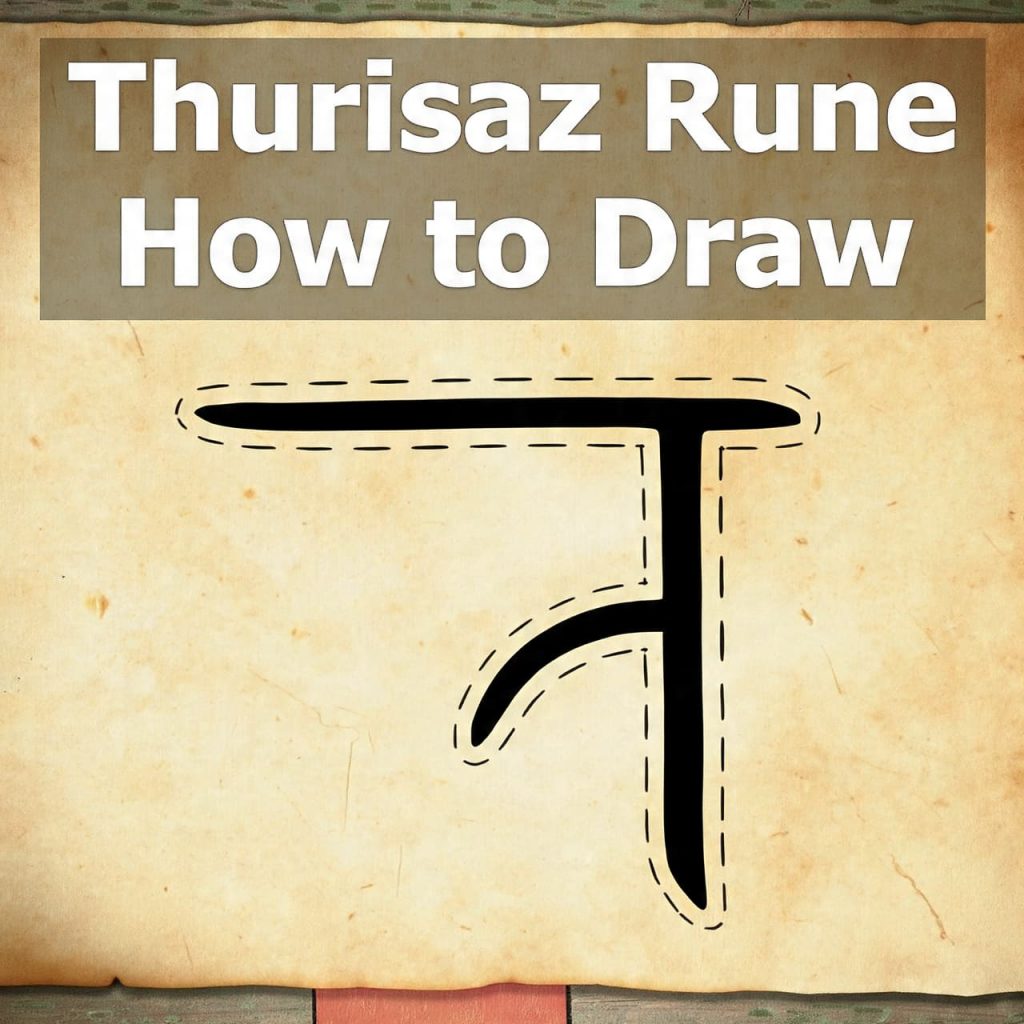
Learning how to draw the Thurisaz rune often appears simple at first glance, yet many beginners struggle to do it consistently. The difficulty is not artistic skill, but uncertainty about structure. Small variations in angle, proportion, or stroke order can leave learners unsure whether they are drawing the rune accurately or merely approximating its shape.

💜 Need a clear answer right now?
CONSULT THE YES OR NO TAROT Free · No registration · Instant resultThis uncertainty usually comes from a lack of clear, practical instruction. Thurisaz is a structurally precise rune, and drawing it correctly depends on understanding its form rather than copying it casually. A clarity-first learning approach, similar to the methodical frameworks explained at astroideal, helps eliminate guesswork by focusing on form, proportion, and consistency instead of interpretation.
Why Drawing Accuracy Matters With Thurisaz
Runes are not decorative symbols. Each rune has a defined structure that distinguishes it from others in the same system. With Thurisaz, small drawing errors can easily blur that distinction, especially for beginners who are still learning rune shapes.
Accuracy matters because drawing is a form of engagement. When the structure is unclear, attention shifts from learning to second-guessing. A clearly drawn Thurisaz reinforces recognition and builds confidence, while inconsistent drawings slow learning.
This emphasis on structural accuracy is often highlighted by qualified professionals, who teach runes as forms with fixed construction rather than flexible designs.
Understanding the Basic Structure of Thurisaz
Before drawing, it is essential to understand what the rune consists of. Thurisaz is built from two main components:
- A single vertical line
- A triangular or angled protrusion attached to that line
The rune is not symmetrical. One side remains straight and stable, while the other introduces an angular extension. This imbalance is intentional and should not be corrected or “smoothed out.”
Many beginners mistakenly curve lines or mirror the shape for visual balance. Doing so alters the rune’s identity. Thurisaz relies on contrast between straightness and angle.
The Correct Orientation of the Rune
Orientation is one of the most common sources of error. Thurisaz is traditionally drawn upright, with the vertical line serving as the main axis. The angled element extends from one side of this axis, not both.
Flipping or rotating the rune may make it look visually interesting, but it no longer represents Thurisaz accurately. Beginners should practice drawing it in its standard orientation until recognition becomes automatic.
This same discipline of maintaining correct orientation is reinforced in structured practices such as focused love tarot readings, where consistency is essential for clarity.
Step-by-Step: How to Draw Thurisaz
Drawing Thurisaz correctly is best learned through a controlled, step-by-step process rather than freehand copying.
First, draw a straight vertical line from top to bottom. This line should be firm and unbroken. It forms the spine of the rune and determines its overall stability.
Second, about halfway down the vertical line, add an angled stroke that points outward. This stroke should not curve. It forms a sharp, deliberate angle.
Third, connect this angled stroke back toward the vertical line, forming a triangular or thorn-like shape. The lines should meet cleanly without overlap.
Once complete, the rune should look deliberate and balanced, but not decorative. Extra flourishes weaken clarity.
Stroke Order and Why It Matters
While rune traditions vary, stroke order helps beginners maintain consistency. Drawing the vertical line first establishes proportion. Adding the angled shape afterward ensures the rune remains anchored.
If the angled shape is drawn first, beginners often misjudge placement or size, forcing corrections that distort the final form. Stroke order reduces hesitation and improves muscle memory.
Over time, this process becomes automatic, which is the goal of repeated practice.
Common Drawing Mistakes to Avoid
One frequent mistake is rounding the angles. Thurisaz relies on sharpness, not curves. Curved lines make the rune resemble other symbols and reduce clarity.
Another mistake is making the triangular section too large or too small. Proportion matters. The angled element should be noticeable but not dominate the vertical line.
Beginners also sometimes tilt the entire rune. This usually happens when drawing quickly or without reference. Slowing down corrects this naturally.
Learners who want confirmation that their form is correct sometimes consult reference-based guidance from reliable readers, not for interpretation, but for structural verification.
Practicing Drawing Without Overcomplication
Effective practice focuses on repetition, not variation. Beginners benefit from drawing the same rune multiple times on plain paper, keeping size and orientation consistent.
Avoid experimenting with materials or styles early on. Pens, pencils, or markers all work as long as the lines are clear. The goal is recognition, not aesthetics.
Some learners prefer guided environments such as online tarot sessions, where rune forms are demonstrated visually. Others find video readings useful for observing stroke order, while phone readings allow learners to focus on verbal instruction without visual distraction. These formats serve as reference points rather than teaching replacements.
Maintaining Focus While Drawing
Drawing runes requires attention, not interpretation. Beginners sometimes drift into thinking about meaning while drawing, which introduces distraction and inconsistency.
It is more effective to treat drawing as a technical exercise. Focus on straightness, angles, and proportion. Meaning can be addressed separately.
Occasionally, broad contextual tools like general horoscope insights may help learners notice patterns in focus or consistency, but they should never influence how the rune is drawn.
Recognizing a Correctly Drawn Thurisaz
A correctly drawn Thurisaz is immediately recognizable. The vertical line is straight. The angled section is sharp and deliberate. The rune does not look decorative or symmetrical.
If you can draw it consistently without checking a reference, you have reached functional accuracy. Perfection is unnecessary; consistency is the benchmark.
Building Confidence Over Time
Confidence develops through repetition and restraint. Drawing Thurisaz correctly once is less important than drawing it correctly many times.
Avoid comparing your drawings to stylized images online. Focus instead on whether your version maintains structure. Over time, your hand will naturally produce the correct form without conscious adjustment.
Educational frameworks like those discussed at astroideal emphasize this gradual mastery by prioritizing clarity and consistency over speed or creativity.
Frequently Asked Questions
Do I need artistic skill to draw Thurisaz?
No. Accuracy depends on structure, not artistic ability.
Can I stylize the rune once I learn it?
Stylization should only come after consistent accuracy is achieved.
Does size matter when drawing?
No, as long as proportions remain consistent.
Is there a correct stroke direction?
Starting with the vertical line is recommended for consistency.
Can I draw Thurisaz quickly?
Speed improves naturally after accuracy is established.
Is it normal to redraw it many times?
Yes. Repetition is part of learning.
Call to Action
Drawing Thurisaz correctly begins with slowing down and respecting its structure. Focus on one clear form, practice it consistently, and avoid unnecessary variation. Whether you are aiming to get a clear yes or no answer during focused study or prefer a disciplined one question tarot framework, precision in form is what builds long-term confidence and clarity.
