

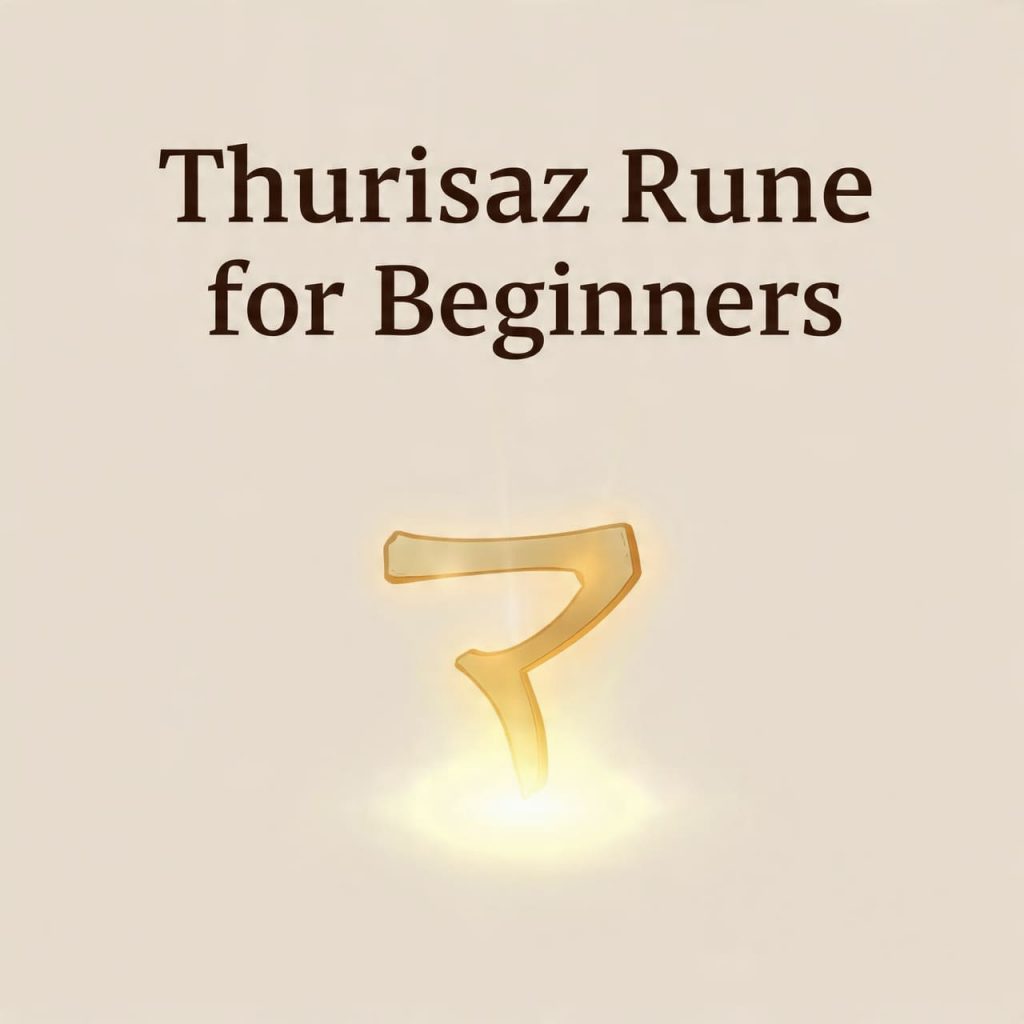
Beginning rune study can feel frustrating because many explanations either oversimplify or overwhelm. Thurisaz often causes the most hesitation for beginners because it does not describe action, reward, or progress. Instead, it points to a condition that interrupts momentum. When you first encounter it, the rune can feel difficult to place, especially if you are expecting clear direction rather than restraint.

💜 Need a clear answer right now?
CONSULT THE YES OR NO TAROT Free · No registration · Instant resultThis confusion is common among beginners because Thurisaz does not function as an answer in the usual sense. It functions as a condition. Learning to recognize that distinction is the first step toward understanding it correctly, using the same clarity-first learning principles emphasized in structured educational approaches like those explained at astroideal.
What Thurisaz Traditionally Represents
Historically, Thurisaz is associated with the concept of a threshold. In early Germanic rune systems, it symbolized forces that prevent careless movement forward. This was not interpreted as punishment or danger, but as necessary resistance.
For beginners, this means Thurisaz does not describe events. It describes interruption.
When Thurisaz appears, something is not meant to proceed automatically. The rune marks a moment where awareness must come before action. That is its entire function. There is no hidden layer beyond this core idea, and beginners benefit from learning it exactly as it is, without added symbolism.
Clear foundational explanations like this are often reinforced by qualified professionals because beginners tend to over-interpret when left without structure.
Why Thurisaz Feels Difficult at First
Most runes describe motion, outcome, or development. Thurisaz does none of these. It interrupts the sequence instead of continuing it. Beginners often struggle because they want to “do something” with the rune, but Thurisaz does not ask for action.
The difficulty comes from expectation, not complexity.
Thurisaz simply indicates that something requires conscious recognition before proceeding. That recognition may involve a boundary, a consequence, or a necessary pause. Beginners often mislabel this as negativity because it does not provide encouragement or reassurance.
Understanding this difference prevents unnecessary confusion and keeps learning grounded.
How to Interpret Thurisaz Without Overthinking
For beginners, interpreting Thurisaz requires discipline rather than intuition. The correct approach is to ask only one thing: What is being prevented from moving forward automatically?
Nothing more is required.
You are not meant to search for symbolism, emotions, or explanations. Thurisaz does not elaborate. It stops. That stopping point is the meaning.
This same principle is used in structured formats such as focused love tarot readings, where clarity depends on limiting interpretation rather than expanding it. The rune is understood by recognizing its function, not by attaching stories to it.
If you find yourself trying to justify or explain the rune, you are already moving away from its purpose.
Using One Clear Question as a Beginner
Thurisaz works best when paired with a single, direct question. Beginners often fail here by asking broad or layered questions. The rune does not respond well to complexity.
A clear question is factual, immediate, and limited. It does not ask why, how, or what will happen. It asks whether something can proceed as it currently stands.
When Thurisaz appears in response, the interpretation is consistent: something must be acknowledged before movement continues.
Beginners who struggle with question clarity often benefit from guidance by reliable readers, not for interpretation, but for maintaining clean question structure.
Practical Examples for Beginners
To make this concrete, consider how Thurisaz functions across situations without predicting outcomes.
If the question assumes movement, Thurisaz indicates interruption.
If the question assumes readiness, Thurisaz indicates a missing recognition.
If the question assumes permission, Thurisaz indicates a boundary.
The rune does not specify what the boundary is. That is intentional. The learning comes from recognizing that a boundary exists, not from naming it.
This is why Thurisaz is often misunderstood by beginners who expect explanation rather than condition.
Staying Grounded While Learning
Learning runes should not feel urgent. Thurisaz in particular teaches restraint through experience. Beginners who rush interpretation tend to misread it.
A calm learning environment helps. Some beginners choose private study, while others prefer structured formats like online tarot sessions, where explanations remain contained. Others prefer video readings for visual clarity or phone readings to eliminate visual distraction altogether.
The method matters less than the pace. Thurisaz rewards patience by design.
Context Without Prediction
Beginners often ask whether external context helps with Thurisaz. Limited context can be useful only to recognize patterns, not to assign meaning.
Occasional reference to broader cycles, such as brief horoscope insights, can help beginners notice repetition in when Thurisaz appears. However, it should never be used to explain the rune itself.
Context supports awareness. It does not replace interpretation.
Building Confidence With Thurisaz
Confidence with Thurisaz develops when beginners stop expecting answers and start recognizing conditions. The rune becomes clear once you stop asking what it means and start noticing what it interrupts.
This shift removes frustration and replaces it with recognition. Thurisaz does not confuse. Expectations do.
The learning philosophy promoted at astroideal reinforces this approach by prioritizing clarity, restraint, and ethical interpretation over speculation.
Frequently Asked Questions
Is Thurisaz a negative rune?
No. It indicates resistance, not negativity.
Does Thurisaz block progress permanently?
No. It indicates interruption, not denial.
Should beginners interpret Thurisaz symbolically?
No. Functional interpretation is more accurate at the beginner level.
Why does Thurisaz feel unclear?
Because it withholds explanation by design.
Can beginners work with Thurisaz alone?
Yes, if they maintain clear questions and restrained interpretation.
Does Thurisaz require intuition?
No. It requires observation.
Call to Action
Understanding Thurisaz begins when you stop seeking explanation and focus on recognition. If you want clarity without overanalysis, start by narrowing your focus to one honest question. Whether you are ready to get a clear yes or no answer or prefer a disciplined one question tarot approach, choosing simplicity is the most effective way to learn this rune correctly.
