

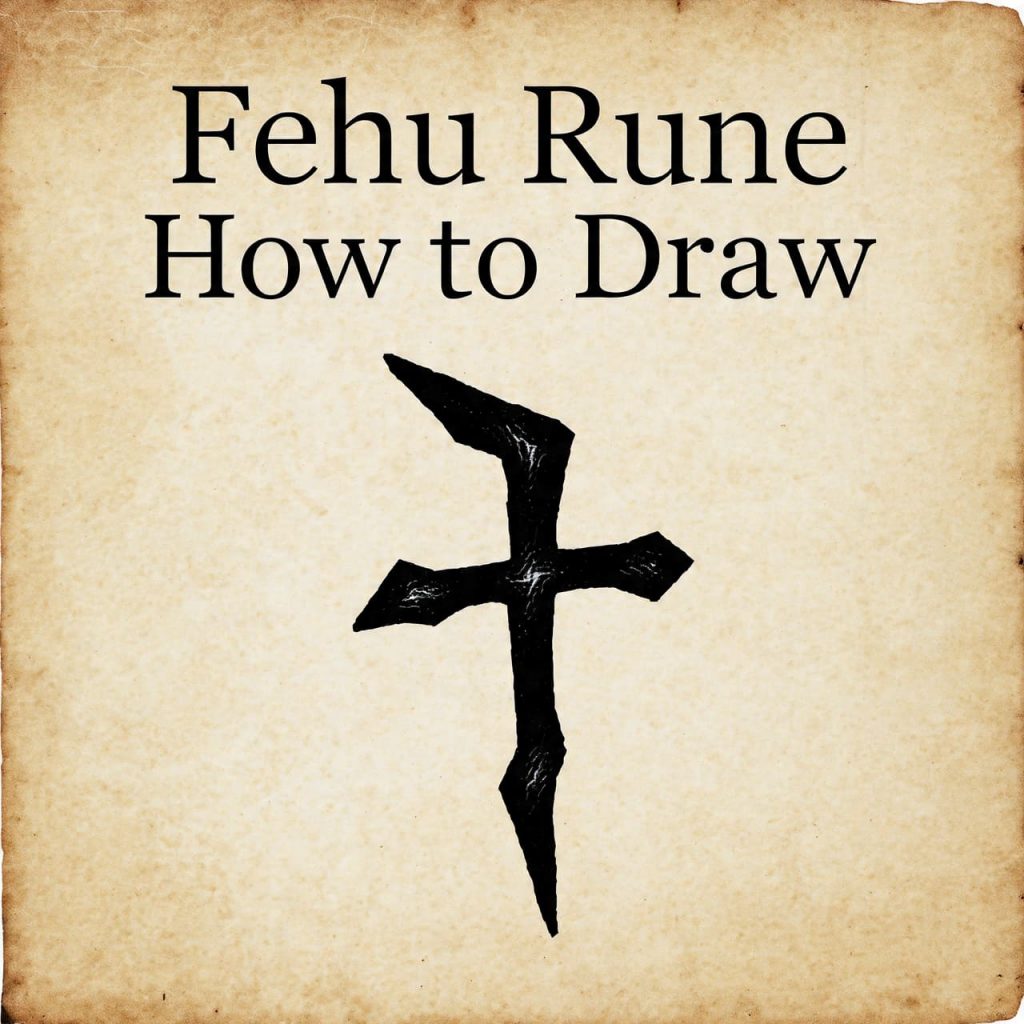
Fehu rune how to draw is a common question because the symbol looks simple but feels easy to get wrong. Small variations in line placement, angle, or proportion can make people unsure whether they are drawing Fehu accurately or unintentionally changing it into something else.

💜 Need a clear answer right now?
CONSULT THE YES OR NO TAROT Free · No registration · Instant resultThis uncertainty usually appears when someone wants to draw the rune intentionally rather than casually. The concern is not artistic ability, but correctness. Drawing a rune carries meaning through form, and when the form feels uncertain, confidence drops.
Approaches discussed in astroideal often frame this kind of uncertainty as a clarity issue rather than a skill issue. Instead of aiming for perfection, the goal is understanding which elements are essential and which are flexible. Some people also consult qualified professionals when accuracy matters, particularly when learning historically rooted symbols.
Why a Yes or No Tarot Helps Here
Questions about how to draw Fehu often persist because people hesitate to commit to a version. They redraw it repeatedly, compare sources, and doubt whether their version is “right.”
A yes-or-no tarot format helps by answering one practical question: is this way of drawing Fehu correct and acceptable, or not? It does not teach drawing techniques. It ends uncertainty.
Clarity matters because repetition builds familiarity. Without settling on a form, practice never becomes confident. Some people use structured formats such as love tarot readings not for emotional insight, but because the yes-or-no structure limits hesitation and encourages commitment.
The Essential Structure of the Fehu Rune
To draw Fehu correctly, it is important to understand its essential structure. Fehu is not decorative. It is built from a small number of intentional strokes.
The rune consists of:
- One vertical line
- Two diagonal lines branching upward from the vertical line
These branches always angle upward, not downward. This upward orientation is a defining feature and should not be altered.
If these three elements are present and oriented correctly, the rune remains recognizably Fehu.
Where People Commonly Go Wrong
Most mistakes in drawing Fehu come from overthinking rather than lack of skill. Common errors include:
- Making the branches horizontal instead of angled
- Placing branches on both sides of the vertical line
- Drawing curves instead of straight lines
- Adding extra strokes for symmetry
Fehu is intentionally asymmetrical. Trying to “balance” it usually results in a different symbol.
Understanding this prevents unnecessary correction and frustration.
Step-by-Step Explanation of How to Draw Fehu
Drawing Fehu is straightforward when broken into clear steps.
First, draw a straight vertical line from top to bottom. This line forms the spine of the rune and should be the longest stroke.
Second, draw the upper diagonal branch starting from the upper half of the vertical line, angling upward and outward.
Third, draw the lower diagonal branch starting slightly below the first branch, also angling upward and outward, parallel to the first.
The two branches should not meet or cross. They should clearly originate from the vertical line.
This structure is sufficient. No additional lines are needed.
Proportion and Spacing
Proportion matters more than size. The branches should be shorter than the vertical line and spaced so they do not touch.
There is flexibility in angle and length, but extreme variations can distort recognition. Keeping the branches roughly parallel and upward-facing preserves clarity.
Drawing slowly helps maintain proportion, especially when practicing for the first time.
Direction and Orientation
Fehu is traditionally drawn upright. While size and style may vary, orientation should remain consistent.
Rotating the rune or mirroring it can change its recognition. For learning purposes, keeping the rune upright avoids confusion.
This is especially important for beginners who are still developing visual familiarity.
Encouraging One Clear Drawing Question
Drawing uncertainty often persists because the question is unclear. People ask whether their version is “perfect” or “authentic,” which invites doubt.
A clearer question focuses on correctness:
- “Is this drawing recognizably and structurally Fehu, yes or no?”
- “Does this version preserve the essential elements?”
- “Is this form acceptable for consistent use?”
Some people consult reliable readers or knowledgeable guides to confirm that their drawing meets essential criteria rather than chasing stylistic perfection.
Why Simplicity Is Important When Drawing Fehu
Fehu was historically carved, not illustrated. It needed to be drawn quickly and clearly using simple tools.
This historical context explains its straight lines and minimal structure. Adding decoration contradicts the rune’s original function.
Keeping the drawing simple respects both clarity and tradition.
Practicing Drawing Fehu Confidently
Confidence comes from repetition, not variation. Practicing the same form repeatedly builds muscle memory and visual consistency.
It is more effective to draw Fehu ten times the same way than to experiment with ten different styles.
This approach reduces doubt and strengthens recognition.
Common Beginner Concerns
Beginners often worry about line thickness, artistic style, or aesthetic appeal. These concerns are secondary.
Fehu does not require artistic flourish. It requires structural accuracy.
Accepting this allows beginners to focus on learning rather than judging their drawing.
Why Overthinking the Drawing Process Happens
Overthinking often comes from treating the rune as symbolic art rather than a functional sign. This leads to unnecessary complexity.
The yes-or-no framework helps by setting a clear standard: either the essential structure is present or it is not.
For some learners, video readings or visual explanations help ground this understanding and reduce hesitation.
Accepting a Consistent Drawing Style
Once you settle on a clear, correct form, acceptance matters. Constantly revising the drawing undermines confidence.
Consistency allows the symbol to become familiar and reliable.
Some people prefer phone readings or spoken confirmation because hearing reassurance helps them commit to a form without revisiting doubt.
Drawing Fehu in Modern Contexts
In modern use, Fehu may be drawn on paper, digitally, or mentally. Regardless of medium, the same structural principles apply.
Keeping the form consistent across contexts reinforces recognition and understanding.
This practical mindset keeps drawing grounded rather than symbolic or performative.
Maintaining Accuracy Over Time
Accuracy improves naturally when the drawing becomes habitual. Over time, the need to reference examples fades.
Decision approaches discussed in astroideal often emphasize choosing a correct form once and committing to it, rather than continually seeking confirmation. Some learners also use horoscope insights reflectively to notice how confidence grows with repetition.
Frequently Asked Questions
Is there only one correct way to draw Fehu?
There is one essential structure, with minor stylistic flexibility.
Do the angles have to be exact?
No, but they should clearly angle upward.
Can the branches be on both sides?
No. Both branches should be on the same side.
Does size matter?
No. Proportion matters more than size.
Can Fehu be drawn quickly?
Yes. It was designed for quick, clear marking.
Is guidance necessary?
It can help at first, but practice builds confidence.
How do I know my drawing is correct?
When it is instantly recognizable and consistent.
Call to Action
If uncertainty about Fehu rune how to draw is slowing your progress, it may be time to get a clear yes or no answer about whether your form is correct and commit to it. A focused one question tarot approach can help you stop second-guessing and draw the rune with confidence and consistency.
