

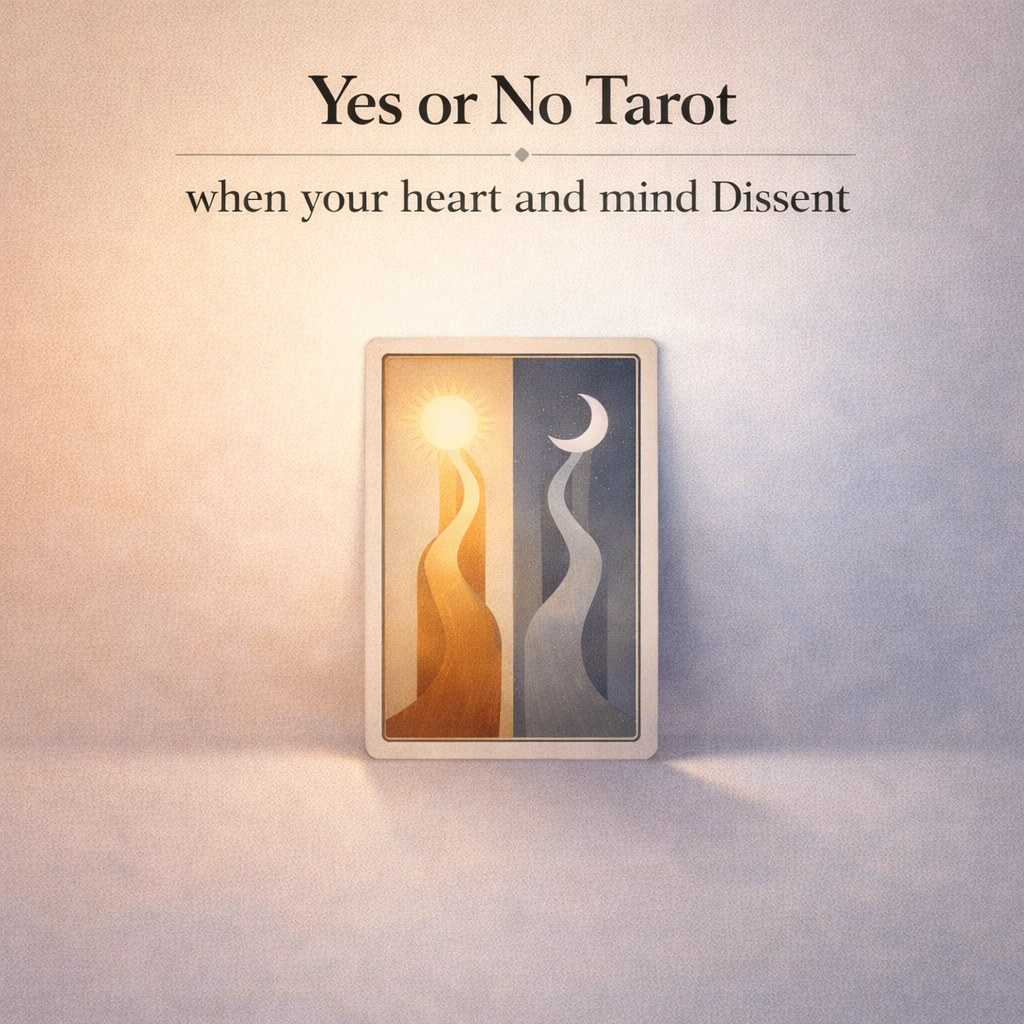
Según los expertos de Astroideal, When your heart and mind disagree, decision-making becomes strained. One part of you feels pulled in a certain direction, while another part urges caution or restraint. You may understand the situation logically, yet feel emotionally unsettled, or feel emotionally certain while mentally unconvinced. This internal split creates hesitation that does not resolve on its own.

💜 Need a clear answer right now?
CONSULT THE YES OR NO TAROT Free · No registration · Instant resultThe difficulty here is not confusion about the facts. It is internal conflict. As long as feeling and reasoning pull in opposite directions, the decision remains open and mentally exhausting. Using strategies explained in yes or no can help narrow this conflict into a single, clear decision point, allowing movement without forcing emotional or intellectual agreement first.
Why a Yes or No Tarot Helps Here
When the heart and mind disagree, overanalysis often increases the divide. Logical arguments multiply while emotions remain unchanged. A yes-or-no tarot approach helps because it does not ask either side to win.
Clarity matters here because internal debate consumes energy without producing resolution. A binary structure removes the need to reconcile emotions and logic immediately. Instead of asking which side is right, the focus shifts to whether the answer to one specific decision is yes or no right now.
Many people who seek guidance from qualified professionals describe this structure as stabilizing during internal conflict because it interrupts endless internal negotiation. The value lies in containment. One clear question creates an endpoint that neither emotion nor logic provides on its own.
This approach does not invalidate feelings or reasoning. It allows a decision even while disagreement remains.
Encouraging One Clear Question
Internal conflict often leads to complex questions that try to satisfy both heart and mind at once. These questions usually increase frustration rather than clarity.
A clear question focuses on one action or choice only. It avoids emotional justification and logical explanation. The wording should allow a direct yes-or-no answer without interpretation.
A practical way to form the question is to identify the decision you are delaying and remove references to feelings, reasoning, or outcomes. If the question attempts to balance emotion and logic within the wording, it is too broad.
Although many people are familiar with emotionally expressive formats such as love tarot readings, this situation requires restraint. One precise question reduces internal noise and allows clarity to emerge without debate.
Precision reduces internal tension.
Approaching the Decision Without Forcing Agreement
When heart and mind disagree, there is often pressure to resolve the conflict before deciding. This pressure can keep you stuck indefinitely.
A calm approach accepts that agreement is not required for clarity. Emotional neutrality allows the decision to be made without demanding alignment between feeling and thought.
Honesty is essential. Ask only what you are prepared to decide. If part of you plans to reopen the decision until heart and mind align, clarity will not hold. This is why reliable readers often emphasize readiness. Readiness means accepting a clear answer even while internal conflict remains.
The goal is not harmony. It is forward movement.
Reducing Internal Noise Before Asking
Disagreement between heart and mind becomes louder when internal dialogue is constant. Rehearsing arguments or emotional reactions keeps both sides active.
Before forming your question, reduce this internal noise. Pause analysis and emotional replay briefly. This is not suppression; it is creating space for clarity.
Many people who engage in online tarot sessions notice that stepping out of internal debate helps them focus on the decision itself. The same principle applies independently. Fewer competing thoughts make the answer easier to accept.
Reducing noise strengthens decisiveness.
Respecting the Answer Despite Internal Resistance
Once a yes-or-no answer is reached, stopping is essential. Internal conflict often tempts you to question the answer until both sides agree.
Respecting the decision boundary allows clarity to settle. Even if the heart resists or the mind questions the answer, allowing it to stand prevents the conflict from restarting.
Structured formats such as video readings naturally reinforce this boundary by offering a clear start and end. When deciding privately, you create the same effect by committing not to revisit the question immediately.
Closure weakens internal division.
Managing Emotional and Logical Aftereffects
After making a decision, heart and mind may continue reacting differently. This does not mean the decision was flawed. Internal alignment often follows action, not the other way around.
Managing this phase involves patience rather than analysis. Allow emotions and reasoning to adjust without reopening the decision. Focus on completing the next practical step related to the choice.
Some people prefer decisive formats such as phone readings because they reinforce finality and reduce internal back-and-forth. Regardless of approach, letting the decision stand gives both sides time to settle.
Stability grows through consistency.
Allowing Alignment to Develop Naturally
Alignment between heart and mind rarely happens under pressure. It develops as emotional intensity decreases and perspective returns.
Avoid seeking immediate confirmation. Revisiting the decision too quickly can restore conflict. Distance allows internal alignment to form gradually.
Tools like horoscope insights are sometimes explored later, but they should not be used to reassess the original decision. The purpose of choosing is resolution, not continued internal debate.
Alignment follows clarity, not the other way around.
Frequently Asked Questions
Is this approach useful when emotions and logic strongly conflict?
Yes. A yes-or-no structure allows decisions even when internal agreement is absent.
Do heart and mind need to align before deciding?
No. Alignment often happens after action, not before it.
What if one side strongly resists the answer?
Resistance is common. Allowing the answer to stand reduces prolonged internal conflict.
Can this reduce internal debate?
Yes. Ending the decision loop weakens ongoing mental and emotional negotiation.
Should I ask multiple questions to satisfy both sides?
No. Multiple questions usually deepen conflict rather than resolve it.
Does this ignore emotional or logical input?
No. It temporarily limits their influence to allow a clear decision.
Call to Action: Choose Clarity Even When You Feel Divided
When your heart and mind disagree, waiting for alignment can keep you stuck indefinitely. You do not need internal harmony to move forward. You need a clear decision point that allows progress.
By using strategies explained in yes or no, you can focus on one question tarot and get a clear yes or no answer that cuts through internal conflict. Even if you sometimes explore tools like horoscope insights, the strength of a yes or no tarot reading lies in its structure. Choose clarity now, let the decision stand, and allow alignment to follow in its own time.
Heart vs. Mind Conflicts and Their Tarot Archetypes
| Conflict Type | Heart Card | Mind Card | Resolution Path |
|---|---|---|---|
| Love vs. logic in relationships | The Lovers | The Emperor | Identify non-negotiables first |
| Desire vs. practicality in career | Ace of Wands | Four of Pentacles | Calculate minimum viable risk |
| Intuition vs. fear | The High Priestess | Nine of Swords | Distinguish fear from wisdom |
| Excitement vs. caution | The Fool | The Hermit | Pause before leaping |
| Loyalty vs. self-protection | Six of Cups | Seven of Swords | Name what must be protected |
Tarot Spreads for Heart-Mind Conflicts
| Spread | Cards | Focus | Output |
|---|---|---|---|
| Heart vs. Mind Draw | 2 | One card per perspective | Visualizes the tension |
| Integration Spread | 4 | Heart / Mind / Fear / Wisdom | Root cause of conflict |
| Values Alignment Spread | 5 | What each choice costs and gives | True priority ranking |
| The Soul Path Spread | 6 | Deeper self vs. conditioned self | Authentic direction |
| One Question Resolution | 1 | What do I most need to honor right now | Immediate clarity anchor |
Limitations of this interpretation
No tarot reading is universal or deterministic. Cards reflect symbolic energy at the moment of the reading, not fixed outcomes. Personal circumstances, timing, and free will all play significant roles in how situations unfold.
Use this guide as a starting point for reflection, not as a substitute for professional advice in medical, legal, or financial matters.
Preguntas frecuentes
¿Can tarot help when my heart and mind disagree?
Yes. A two-card spread — one card for your emotional truth, one for your rational assessment — makes the internal conflict visible and often reveals which voice is speaking from fear versus wisdom.
¿What tarot cards represent the conflict between heart and mind?
The Lovers versus The Emperor, The High Priestess versus The Hermit, and Ace of Wands versus Four of Pentacles are classic pairings that illustrate emotional desire in tension with rational caution.
¿How do I know if tarot is showing my heart or my mind?
Cups suit cards and Major Arcana tied to intuition (Moon, High Priestess, Star) tend to reflect heart energy. Swords and earth-element cards often mirror analytical or fear-based mental activity.
¿What does the Two of Swords mean for heart-mind conflict?
The Two of Swords depicts the deliberate blindfold — choosing not to look at a truth because it forces a decision. In heart-mind conflicts it signals that you already know the answer but are avoiding it.
¿Which matters more in decisions: heart or mind?
Tarot does not assign supremacy to either. It asks instead whether your heart’s desire is rooted in genuine values or fear of loss, and whether your mind’s objection is based on wisdom or conditioned caution.
¿What is the Integration Spread for heart-mind conflict?
A four-card spread asking: What does my heart genuinely want? What does my mind genuinely fear? What is the deeper wisdom beneath both? What is my clearest next step? This resolves most internal deadlocks.
¿What should I do when every tarot card pulls me in opposite directions?
Opposite cards are not a contradiction — they are a full picture. The tension between them is real and worth sitting with rather than resolving prematurely. Journal both perspectives before deciding.
¿Can tarot tell me which choice is right when I am torn?
Tarot reveals which choice is more aligned with your authentic values, not simply which will feel better short-term. Cards like The Star, The World, and Strength signal deep alignment; The Tower signals forced clarity ahead.
¿How long should I wait after a heart-mind tarot reading before acting?
Forty-eight to seventy-two hours minimum. Sleep on the reading, note what still resonates, and observe whether your anxiety increases or decreases as you consider each path. Act from the steadier ground.
¿What is the best single question to ask tarot when heart and mind conflict?
‘What do I most need to honor right now?’ grounds the reading in present truth rather than future prediction, making it more useful than ‘What will happen if I choose X?’
¿Can a tarot reader help more than a self-reading in this situation?
A skilled reader brings no emotional stake in your decision, which can reveal projections a self-reading misses. For deeply conflicted questions, an external perspective from an experienced reader adds genuine value.
Related articles
Need clarity today? Connect with our expert tarot readers at Astroideal.
