

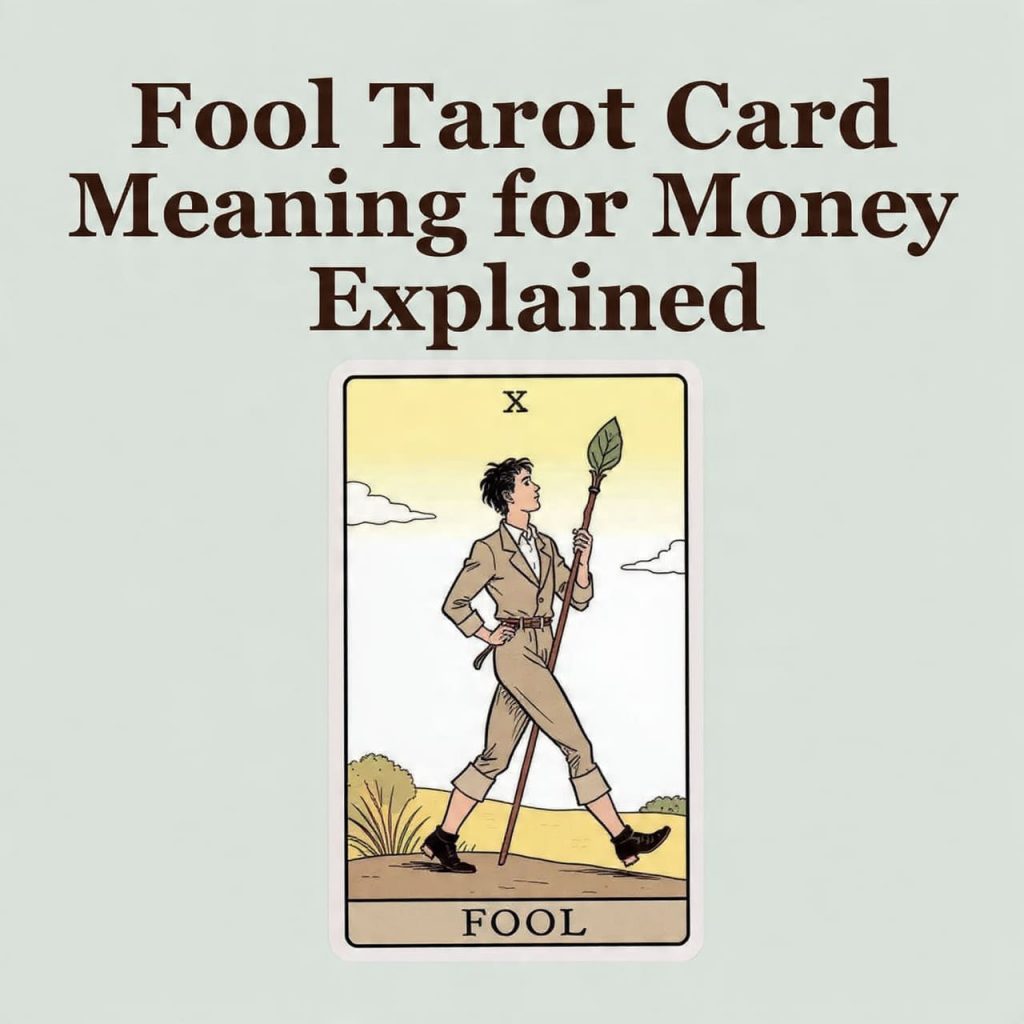
According to Astroideal experts, Money readings often revolve around stability, security, and long-term planning, which is why the Fool tarot card can feel confusing or even unsettling when it appears in a financial context. Associated with beginnings, openness, and leaps of faith, the Fool does not immediately align with traditional ideas of financial caution. Yet many practitioners believe the Fool carries an important spiritual message about money: growth often begins before certainty exists. Rather than signaling recklessness, the Fool invites awareness around trust, potential, and the mindset shaping financial choices. Interpreting this card responsibly benefits from symbolic layering and contextual strategies such as those outlined in cards meanings.

💜 Need a clear answer right now?
CONSULT THE YES OR NO TAROT Free · No registration · Instant resultThis article explains the Fool tarot card meaning for money in a balanced, informative way. It explores core symbolism, upright and reversed interpretations, emotional and spiritual lessons, timing considerations, and ethical reading practices, focusing on clarity rather than guarantees or shortcuts.
Core Symbolism of the Fool Tarot Card in Money
Beginnings and Financial Potential
The Fool is traditionally numbered zero, symbolizing unlimited potential rather than defined outcomes. In money readings, many practitioners interpret this as a financial beginning—new ideas, opportunities, or perspectives that have not yet taken form.
This does not guarantee profit, but it highlights openness and possibility.
Readers trained by qualified professionals often emphasize that the Fool represents capacity rather than outcome.
Trust and Risk Awareness
The Fool walks forward with trust, but not blindness. Spiritually, this suggests a relationship with money that balances optimism with awareness. Financial growth may require stepping outside comfort zones, but not ignoring reality.
The Fool invites conscious risk, not reckless behavior.
Detachment From Fear-Based Control
Another key theme of the Fool is detachment from fear. In money matters, this may reflect releasing anxiety-driven control or rigid beliefs that limit growth.
This detachment supports flexibility rather than irresponsibility.
Is the Fool a Positive Sign for Money?
Redefining Positivity in Financial Tarot
Whether the Fool is “positive” for money depends on context. Many practitioners view it as constructive because it supports learning, adaptability, and new beginnings.
However, positivity under the Fool does not mean immediate financial gain. It suggests experience that leads to growth.
Opportunity Before Structure
The Fool often appears before structure exists. In financially focused love tarot readings, practitioners sometimes note that emotional and financial openness often mirror each other—new beginnings require trust but also boundaries.
The Fool highlights the moment before commitment solidifies.
Growth Through Exploration
Spiritually, the Fool supports exploration. Money lessons under this card are often learned through experience rather than theory.
Upright Fool Tarot Card Meaning for Money
Upright Meaning: New Financial Path
When upright, the Fool is commonly interpreted as the start of a new financial path. This may involve a new job, business idea, investment approach, or relationship with money.
The path is not fully defined, but potential exists.
Openness to Learning
Upright Fool energy emphasizes learning. Financial decisions may involve trial and error, but growth occurs through openness rather than fear of mistakes.
Many practitioners believe this card appears when curiosity outweighs anxiety.
Indicators of Upright Fool Energy in Money
Readers frequently associate upright Fool energy with:
- New income ideas or ventures
- Willingness to learn financial skills
- Reduced fear around starting over
The Fool and Financial Risk
Calculated Risk Versus Naivety
Spiritually, the Fool distinguishes calculated risk from naivety. Risk taken with awareness can lead to growth, while blind risk often reflects avoidance of responsibility.
Practitioners stress the importance of context when interpreting this card.
Releasing Scarcity Mindset
The Fool often appears when scarcity thinking limits opportunity. Spiritually, it invites trust in one’s ability to adapt and recover.
This does not eliminate planning, but it reduces paralysis.
Staying Grounded While Exploring
While the Fool encourages openness, grounding remains essential. Awareness of resources, limits, and consequences supports healthy exploration.
Reversed Fool Tarot Card Meaning in Money
Fear of Starting or Financial Hesitation
Reversed, the Fool often reflects fear—fear of starting, fear of failing, or fear of repeating past mistakes. Financial opportunities may be avoided due to self-doubt.
This hesitation can stall progress.
Recklessness or Poor Judgment
Another reversed interpretation involves recklessness. Financial choices may be made without sufficient information or preparation.
Consulting reliable readers can help clarify whether reversed Fool energy reflects fear or impulsivity.
Reversal as a Call for Awareness
Rather than predicting loss, reversed Fool energy often invites awareness. Slowing down, gathering information, and grounding intentions can restore balance.
Spiritual Lessons of the Fool in Money
Money as a Learning Journey
Spiritually, the Fool frames money as a learning journey rather than a fixed measure of success. Mistakes become teachers rather than failures.
This perspective reduces shame and encourages growth.
Trusting Adaptability
The Fool emphasizes adaptability. Financial confidence comes from knowing one can adjust rather than control every outcome.
This trust supports resilience.
Detachment From Outcome Obsession
Many practitioners believe the Fool invites detachment from outcome obsession. Focusing solely on results can limit creativity and opportunity.
Timing and the Fool in Money Readings
Timing as “At the Beginning”
The Fool is often interpreted as “at the beginning.” In money readings, this suggests that a financial story is just starting rather than concluding.
Clarity develops over time.
This aligns with reflective approaches often emphasized in online tarot sessions, where patience and awareness are prioritized over prediction.
Slow Definition, Fast Learning
While outcomes may take time, learning under the Fool often happens quickly. Experiences provide immediate feedback.
Indicators Timing Is Supportive
Rather than dates, readers often observe:
- Curiosity replacing fear
- Willingness to explore options
- Openness to feedback
The Fool and Career-Related Finances
Career Shifts and Income Exploration
In career-related money readings, the Fool often reflects exploration. This may involve changing fields, starting a side project, or redefining financial goals.
Security may temporarily feel uncertain, but learning expands.
Entry-Level or Beginner Energy
The Fool often indicates beginner energy. Starting at a lower financial level may be part of gaining long-term experience.
Humility supports growth here.
Avoiding Unrealistic Expectations
Practitioners caution against expecting immediate success. The Fool values experience over instant reward.
Practical Reading Formats for Money Insight
Common Tarot Formats Used
Different formats influence how Fool-related money messages are processed. The table below outlines commonly used options.
| Format | Depth of Insight | Interaction Style | Best For |
|---|---|---|---|
| Video | High | Visual and conversational | Exploring new financial paths |
| Phone | Medium to high | Voice-focused | Privacy and reassurance |
| Written | Moderate | Reflective | Reviewing risks and ideas |
Many seekers find video readings helpful when interpreting open-ended cards like the Fool, as visual explanation clarifies potential and boundaries.
Ethical Interpretation of Money Readings
Practitioners emphasize that the Fool should not be used to encourage gambling or avoidance of responsibility. Ethical readings focus on awareness, preparation, and choice.
Pricing and Duration Expectations
While costs vary, general expectations for money-focused readings are outlined below.
| Session Length | Typical Cost Range | Focus |
|---|---|---|
| 20–30 minutes | Lower range | Immediate direction |
| 45–60 minutes | Mid range | Exploring options and risks |
| Extended sessions | Higher range | Long-term financial learning |
Emotional Patterns Around Money and the Fool
Reducing Fear of Mistakes
The Fool often appears when fear of mistakes blocks financial action. Spiritually, it reframes mistakes as part of growth.
This reduces paralysis.
Confidence Through Experience
Financial confidence under the Fool develops through experience rather than certainty. Each step builds awareness.
Letting Go of Comparison
The Fool discourages comparison with others’ financial paths. Each journey begins at a different point.
Integrating Broader Perspective in Financial Growth
Financial Cycles and Beginnings
The Fool often reflects the beginning of a financial cycle. Some practitioners integrate this understanding with broader perspectives, sometimes considering themes alongside horoscope insights to contextualize new starts without deterministic claims.
Structured Interpretation for Clarity
Applying structured strategies such as symbolic layering and situational context discussed in cards meanings helps ensure the Fool is interpreted as conscious exploration rather than recklessness.
Accessibility, Boundaries, and Financial Awareness
Emotional Readiness for Fool Readings
Fool-related money readings are most effective when individuals are open to learning. Practitioners suggest approaching them with curiosity rather than urgency.
Maintaining Healthy Financial Boundaries
Even under the Fool, boundaries matter. Setting basic safeguards supports exploration without harm.
Accessible Support Options
For those seeking discretion and grounding, phone readings are often considered accessible and supportive when discussing uncertain financial beginnings.
Frequently Asked Questions
Is the Fool a good card for money?
Many practitioners believe it reflects potential and learning rather than guaranteed gain.
Does the Fool mean financial risk?
It can indicate risk, but usually emphasizes awareness rather than recklessness.
Can the Fool suggest starting over financially?
Yes, it often reflects new beginnings or fresh perspectives.
What does reversed Fool mean for money?
It may indicate fear of starting or impulsive decisions needing correction.
How long does Fool energy last in money readings?
Its influence continues until experience clarifies direction.
What format works best for Fool money readings?
Interactive or reflective formats often help explore options safely.
Conclusion
The Fool tarot card meaning for money centers on beginnings, openness, and the willingness to learn through experience. Rather than promising immediate financial success, many practitioners believe it reflects potential that unfolds through curiosity, adaptability, and conscious risk-taking. When interpreted thoughtfully and ethically, the Fool reframes money not as something to control through fear, but as a journey shaped by awareness, resilience, and trust in one’s capacity to grow.
Card meanings across different life areas
| Life Area | Upright Meaning | Reversed Meaning | Advice |
|---|---|---|---|
| Love | Transformation and renewal | Resistance to necessary change | Embrace evolution in relationships |
| Career | New opportunities emerging | Fear of taking the next step | Trust your professional instincts |
| Health | Positive lifestyle changes | Neglecting important signals | Listen to your body |
| Finances | Financial restructuring ahead | Holding onto outdated strategies | Adapt your financial approach |
| Spirituality | Deep inner awakening | Spiritual stagnation | Explore new practices |
Common card combinations and their interpretations
| Combination | Interpretation | Area Most Affected | Energy Level |
|---|---|---|---|
| With The Empress | Creative renewal and abundance | Relationships and creativity | Positive |
| With The Tower | Dramatic but necessary transformation | All areas | Intense |
| With The Star | Hope after difficult times | Emotional healing | Uplifting |
| With The Hermit | Deep introspection needed | Personal growth | Contemplative |
| With The Sun | Breakthrough and clarity | Career and purpose | Very Positive |
Limitaciones de esta interpretación
Ninguna interpretación de tarot es universal ni determinista. El significado varía según el contexto personal, cultural y emocional de cada consultante.
Usa esta guía como punto de partida para tu propia reflexión, no como verdad absoluta. El tarot orienta, no decide por ti.
Preguntas frecuentes
¿What does this tarot card mean in a general reading?
This card represents transformation, transition, and important life lessons. Its specific meaning depends on position, surrounding cards, and your question.
¿Is this card positive or negative?
No tarot card is purely positive or negative. Each carries guidance that can help you navigate your current situation with greater awareness.
¿What does it mean when this card appears reversed?
A reversed position often indicates blocked energy, internalized lessons, or a need to look at the situation from a different perspective.
¿How does this card affect love readings?
In love contexts, this card often signals a period of change or growth in relationships, inviting you to embrace evolution rather than resist it.
¿What should I do if this card appears in my reading?
Reflect on the areas of your life that need transformation. The card is an invitation to grow, not a cause for alarm.
¿Can this card predict specific events?
Tarot cards suggest energies and tendencies rather than specific events. Use the guidance to make more informed decisions.
¿How does this card interact with other Major Arcana?
Combined with other Major Arcana, this card amplifies themes of transformation. The specific combination provides nuanced guidance.
¿Does this card have different meanings in different decks?
Core symbolism remains consistent across decks, but artistic interpretation may add subtle nuances. A skilled reader adapts accordingly.
¿What zodiac sign is associated with this card?
Tarot cards have traditional astrological associations, but the card’s message in your reading transcends zodiac boundaries.
¿How often does this card appear in readings?
Frequency varies by individual. If it appears repeatedly, it likely highlights an important ongoing theme in your life that needs attention.
¿Should I be worried if this card appears?
There is no reason to worry. Even challenging cards offer valuable guidance. They show areas where growth and positive change are possible.
Artículos relacionados
¿Quieres una lectura de tarot personalizada? Consulta con nuestros tarotistas expertos en Astroideal.
