

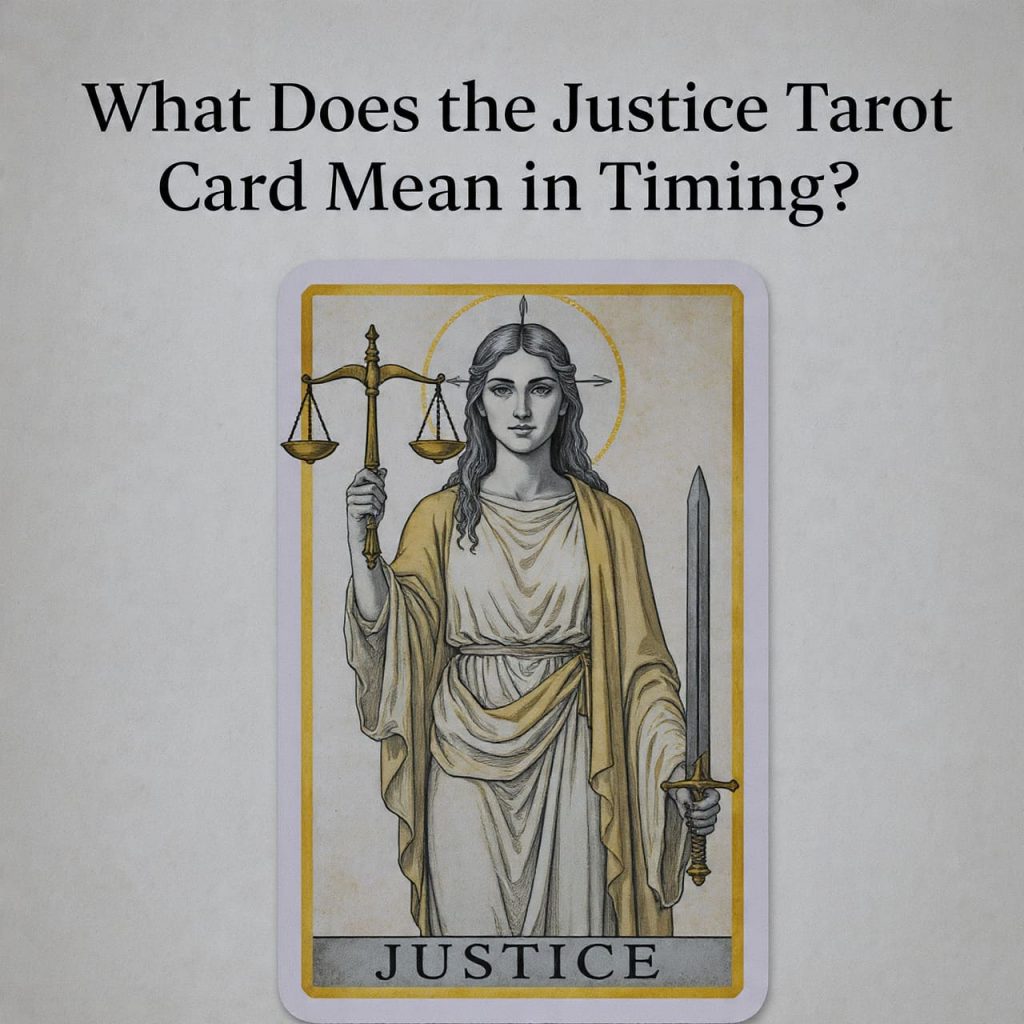
When people ask about timing in tarot, they are often searching for certainty: when will something happen, how long will it take, or is this delayed. The Justice tarot card introduces a very different framework for answering those questions. Rather than pointing to speed or delay, many practitioners believe Justice speaks to correct timing, where events unfold when conditions are fair, balanced, and aligned. In timing-focused readings, Justice reframes the question from “how soon” to “how properly.” Understanding this card in timing contexts benefits from layered symbolic interpretation and contextual reasoning, approaches commonly discussed in structured frameworks such as those outlined in cards meanings.

💜 Need a clear answer right now?
CONSULT THE YES OR NO TAROT Free · No registration · Instant resultThis article explores what the Justice tarot card means in timing, examining how practitioners interpret its symbolism, upright and reversed meanings, ethical considerations, and practical reading formats. The goal is clarity rather than prediction, offering a grounded explanation of how Justice approaches time, cause and effect, and readiness.
Core Symbolism of the Justice Tarot Card and Time
Cause and Effect as a Timing Principle
Justice is deeply associated with cause and effect. In timing readings, many believe this symbolism suggests that events occur as a result of prior actions, not random chance. Timing under Justice is therefore conditional rather than fixed.
This means outcomes unfold once all contributing factors have been accounted for, including choices, responsibilities, and consequences.
Readers trained by qualified professionals often emphasize that Justice reflects earned timing rather than accelerated movement.
Balance Over Speed
The scales held by Justice symbolize equilibrium. In timing interpretations, this often means that nothing happens too early or too late, but precisely when balance is restored.
Practitioners suggest that Justice rarely indicates haste. Instead, it points to a moment when all sides of a situation are properly weighed.
Truth and Transparency in Timing
Justice is also associated with truth and clarity. In timing contexts, this may suggest that events occur once relevant information is known or acknowledged.
This transparency-based timing is especially common in legal, contractual, or emotionally complex situations.
Justice as a Timing Card: What It Generally Indicates
Timing Based on Fairness, Not Desire
Unlike cards associated with momentum or opportunity, Justice does not respond to urgency. Many believe it reflects timing that aligns with fairness rather than personal desire.
In practical terms, this means delays are not punishments but part of ensuring balance and accuracy.
Structured and Measured Timeframes
Justice is often associated with structured timeframes. Practitioners sometimes interpret it as indicating weeks or months rather than days, especially when decisions or agreements are involved.
In emotionally driven contexts like love tarot readings, Justice often signals that timing depends on honest communication rather than emotional intensity.
Accountability and Readiness
Justice suggests that timing aligns with accountability. Events move forward once responsibilities are accepted and clarity is achieved.
This may involve internal accountability, external agreements, or both.
Upright Justice Tarot Card Meaning in Timing
Upright Justice as “Right Timing”
When upright, Justice is commonly interpreted as right timing. Many practitioners believe it indicates that events will occur when all conditions are fair, clear, and justified.
This can feel slow, but it is often described as precise.
Timing Linked to Decisions and Outcomes
Justice often appears when timing depends on decisions, especially formal or consequential ones. This may involve contracts, conversations, or personal commitments.
Rather than indicating movement itself, the card highlights the moment when movement becomes appropriate.
Signs Timing Is Approaching Under Justice
Practitioners often look for indicators such as:
- Clear communication replacing ambiguity
- Agreements or decisions being finalized
- Emotional neutrality replacing urgency
Reversed Justice and Timing Delays
Delays Due to Imbalance
Reversed, Justice is often associated with imbalance or unresolved issues. In timing readings, this may indicate delays caused by missing information, unfair dynamics, or avoidance.
These delays are not permanent but signal the need for correction.
Avoidance of Responsibility
Another common reversed interpretation is avoidance. Timing may be delayed because accountability has not yet been accepted by one or more parties.
Consulting reliable readers can help clarify whether delays are external, internal, or both.
Reversal as a Call for Realignment
Rather than signaling failure, reversed Justice often invites reassessment. Addressing imbalance can restore forward movement.
Justice, Timing, and Free Will
Timing as a Result of Choice
Justice reinforces the idea that timing is influenced by choice. Outcomes are not predetermined but shaped by actions and decisions.
This makes Justice particularly relevant in situations involving ethics, fairness, or mutual agreement.
Acceptance Versus Resistance
Timing under Justice often improves once resistance is released. Accepting reality as it is can accelerate clarity, even if outcomes remain measured.
This perspective aligns with reflective approaches often emphasized in online tarot sessions, where awareness precedes action.
When Waiting Is the Right Action
Justice can indicate that waiting is not passive but purposeful. Timing unfolds once fairness is restored, not when pressure is applied.
Justice and Timing in Relationships
Emotional Timing and Readiness
In relationship timing questions, Justice often reflects emotional readiness rather than romantic urgency. Reconciliation, commitment, or closure occurs when honesty and balance are present.
This may involve accountability on both sides.
Legal or Formal Relationship Timelines
Justice may also point to formal processes affecting timing, such as agreements, boundaries, or external obligations.
These processes shape when progress becomes possible.
Balanced Outcomes Over Quick Ones
Many practitioners believe Justice favors balanced outcomes over fast ones. Timing reflects sustainability rather than intensity.
Justice and Timing in Career and Decisions
Professional Timing and Merit
In career-related timing questions, Justice is often interpreted as merit-based timing. Promotions, approvals, or outcomes occur once qualifications and fairness align.
This can involve evaluations, reviews, or formal decisions.
Processes and Procedures
Justice frequently appears when timing is governed by systems or procedures rather than personal influence. Understanding the process often clarifies the timeline.
Patience as Strategic Advantage
Patience under Justice is strategic, not passive. Observing rules and processes can ultimately lead to more stable outcomes.
Practical Reading Formats for Timing Questions
Common Tarot Formats for Timing
Different formats influence how timing information is interpreted. The table below outlines commonly used options.
| Format | Timing Clarity | Interaction Style | Best For |
|---|---|---|---|
| Video | High | Visual and conversational | Complex timing dynamics |
| Phone | Medium to high | Voice-focused | Privacy and follow-up questions |
| Written | Moderate | Reflective | Process-based timing |
Many seekers find video readings helpful for timing questions involving Justice, as nuanced explanation often matters more than dates.
Ethical Considerations in Timing Readings
Practitioners emphasize avoiding rigid date predictions with Justice. The card supports conditional timing, not fixed deadlines.
Pricing and Duration Expectations
While costs vary, general expectations are outlined below.
| Session Length | Typical Cost Range | Focus |
|---|---|---|
| 20–30 minutes | Lower range | Immediate timing clarity |
| 45–60 minutes | Mid range | Conditional timing analysis |
| Extended sessions | Higher range | Complex decision timelines |
Justice, Astrology, and Cyclical Timing
Justice and Cycles of Balance
Justice is often associated with cycles of balance and correction. Timing reflects when equilibrium is restored rather than when desire peaks.
Integrating Broader Context
Some practitioners integrate tarot timing insights with broader cyclical perspectives, sometimes considering themes alongside horoscope insights to add context without deterministic claims.
Structured Interpretation for Timing Accuracy
Applying structured strategies such as contextual layering and situational analysis discussed in cards meanings helps ensure Justice’s timing message is interpreted as conditional and ethical rather than predictive.
Accessibility, Boundaries, and Timing Clarity
Emotional Readiness for Timing Readings
Timing questions can increase anxiety. Practitioners suggest approaching Justice readings with openness rather than urgency.
Maintaining Healthy Boundaries
Justice emphasizes autonomy. Limiting repeated timing checks helps maintain clarity and emotional balance.
Accessible Reading Options
For those who prefer discretion and focus, phone readings are often considered accessible and supportive for timing discussions.
Frequently Asked Questions
Does Justice give exact timing?
Most practitioners believe it does not. It reflects conditional timing based on fairness and readiness.
Is Justice a slow timing card?
It is measured rather than slow. Timing unfolds when balance is restored.
Can Justice indicate delays?
Yes, especially if accountability or clarity is missing.
Is Justice accurate for legal or formal timing?
Many believe it is particularly relevant for structured or contractual timelines.
How long does Justice energy last?
Its influence continues until balance and fairness are achieved.
What format works best for Justice timing readings?
Interactive formats often help clarify conditions and context.
Conclusion
The Justice tarot card meaning in timing centers on fairness, accountability, and alignment rather than speed or urgency. Many practitioners believe it reflects right timing rather than fast timing, where events unfold once balance is restored and truth is acknowledged.
When interpreted thoughtfully and ethically, Justice offers a grounded framework for understanding time as a result of choices and conditions, making it a valuable guide for timing questions rooted in responsibility and clarity.
