

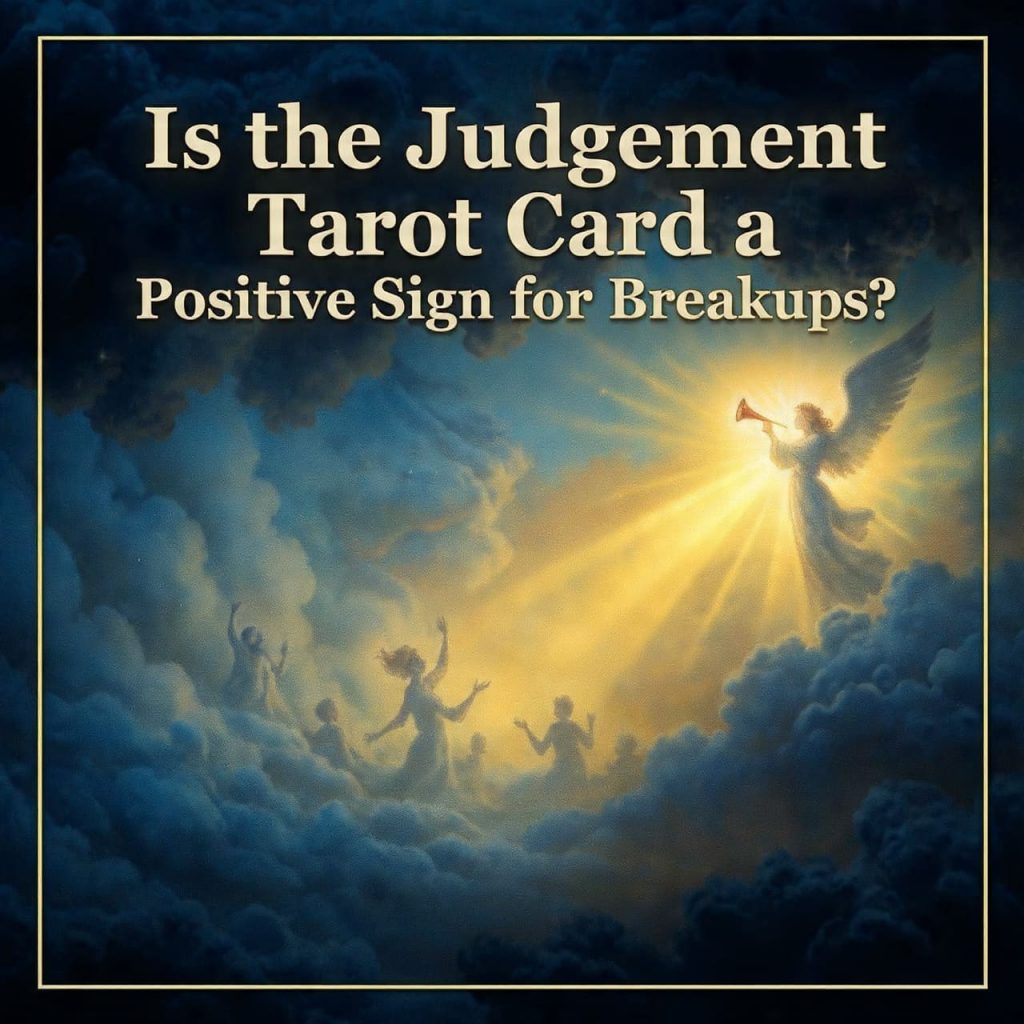
The Judgement tarot card often provokes strong reactions when it appears in readings about breakups. Some interpret it as a hopeful sign of renewal, while others associate it with final decisions and emotional reckoning. Many believe the card represents a moment of truth rather than a simple “good” or “bad” outcome. To understand whether Judgement is a positive sign after a breakup, it is essential to explore its symbolism, traditional interpretations, and the broader context in which it appears. Interpreting this card thoughtfully, using layered methods such as those discussed in cards meanings, allows readers to move beyond surface-level assumptions and toward a more balanced understanding.

💜 Need a clear answer right now?
CONSULT THE YES OR NO TAROT Free · No registration · Instant resultThis article examines the Judgement tarot card specifically in relation to breakups, focusing on clarity, accountability, and emotional transformation. Rather than offering guarantees, it presents widely accepted perspectives used by experienced practitioners and encourages realistic, grounded interpretation.
Core Meaning of the Judgement Tarot Card
Symbolism and Imagery Explained
The Judgement card typically depicts figures rising in response to a call, often symbolized by a trumpet. Many believe this imagery reflects awakening, realization, and accountability. In breakup readings, these symbols are frequently associated with moments of self-awareness rather than immediate reconciliation or separation.
The rising figures suggest a transition from one state of being to another. Practitioners suggest that this transition is internal before it becomes external, emphasizing insight over action.
Upright Judgement in General Readings
When upright, Judgement is commonly interpreted as clarity, resolution, and conscious decision-making. It often appears when a situation has reached a point where avoidance is no longer possible. In relationships, this may mean acknowledging truths that were previously ignored.
Readers trained by qualified professionals often stress that upright Judgement encourages responsibility and honest reflection, which can be constructive regardless of whether a relationship continues.
Judgement Versus Finality
A frequent misconception is that Judgement signals an absolute ending. Many practitioners clarify that, unlike Death, Judgement is not primarily about closure but about evaluation. It asks what has been learned and how those lessons will inform future choices.
Judgement Tarot Card in Breakup Contexts
Emotional Reckoning After Separation
After a breakup, Judgement is often read as an emotional reckoning. Many believe it indicates a period when both individuals reassess their actions, motivations, and patterns. This reassessment can feel intense but is not inherently negative.
Rather than pointing to blame, the card highlights understanding. Practitioners suggest this awareness can be healing, even if reconciliation is not pursued.
Is It a Positive Sign?
Whether Judgement is “positive” depends on perspective. From an emotional growth standpoint, many view it as beneficial because it promotes accountability and conscious choice. However, positivity does not always mean comfort.
In the context of love tarot readings, Judgement is often described as constructive rather than reassuring, offering insight instead of emotional certainty.
When Judgement Appears With Breakup Questions
Judgement frequently appears when the querent is ready to confront the reality of the relationship. This may involve accepting the breakup, understanding why it occurred, or recognizing personal growth that emerged from it.
Upright and Reversed Judgement in Breakups
Upright Judgement as Growth and Clarity
Upright Judgement is commonly associated with breakthroughs in understanding. Many believe it signals that emotional confusion is lifting, allowing for clearer perception of what the breakup represents.
This clarity may lead to forgiveness, closure, or informed decisions about future contact. The card does not dictate the outcome but frames the process.
Reversed Judgement and Resistance
Reversed Judgement is often interpreted as avoidance or self-doubt. In breakup readings, it may suggest difficulty accepting the separation or reluctance to examine personal responsibility.
Practitioners caution against reading reversals as negative predictions. Instead, they are seen as indicators of where inner work is needed.
Balanced Interpretations From Experienced Readers
Consulting reliable readers can help maintain balance, especially when emotions are heightened. Experienced practitioners emphasize that Judgement invites reflection, not self-criticism.
Breakups, Closure, and Renewal
Closure as an Internal Process
Judgement often reframes closure as an internal process rather than an external event. Many believe true closure comes from understanding, not from conversations or apologies alone.
This perspective can be empowering, particularly when communication with an ex-partner is limited or unavailable.
Renewal Without Reconciliation
One of the most misunderstood aspects of Judgement is its association with renewal. Renewal does not necessarily mean restarting the same relationship. Practitioners suggest it often refers to renewed self-awareness or healthier relationship patterns.
Common themes associated with renewal include:
- Clearer personal boundaries
- Greater emotional accountability
- Increased self-respect
Acceptance as a Positive Outcome
Acceptance is frequently highlighted as a positive outcome of Judgement. While acceptance may feel less dramatic than reconciliation, many believe it offers lasting emotional stability.
Timing, Decisions, and Accountability
Judgement and Timing in Breakups
Timing questions often arise after breakups. Judgement is not typically associated with quick resolutions. Instead, it reflects readiness for decisive moments once sufficient understanding has been reached.
Practitioners suggest that the card points to internal timing rather than external schedules.
Decision-Making After Separation
Judgement emphasizes conscious decision-making. Whether deciding to move on, reconnect, or set boundaries, the card supports choices made from awareness rather than impulse.
This approach aligns with interpretive styles commonly used in online tarot sessions, where reflection is prioritized over prediction.
Accountability Without Guilt
A key aspect of Judgement is accountability without excessive guilt. Many readers stress that the card encourages learning from mistakes rather than dwelling on them.
Practical Reading Formats for Breakup Guidance
Common Formats Used
Breakup-related tarot readings are offered in various formats, each with distinct advantages. The table below outlines common options.
| Format | Depth of Insight | Interaction Level | Best Use Case |
|---|---|---|---|
| Video | High | Visual and conversational | Emotional clarity |
| Phone | Medium to high | Voice-based | Privacy and immediacy |
| Written | Moderate | Reflective | Ongoing self-review |
Many clients find video readings useful when processing emotionally complex cards like Judgement, as visual cues can support understanding.
Interpreting Responsibly After Breakups
Responsible interpretation avoids framing Judgement as a verdict. Practitioners suggest focusing on personal insight rather than external validation.
Pricing and Duration Considerations
The table below provides general expectations, though costs and session lengths vary widely.
| Session Length | Typical Cost Range | Focus |
|---|---|---|
| 20–30 minutes | Lower range | Immediate clarity |
| 45–60 minutes | Mid range | In-depth reflection |
| Extended sessions | Higher range | Pattern analysis |
Astrology, Life Reviews, and Perspective
Judgement as a Life Review Card
Many associate Judgement with life reviews, moments when individuals reassess their path. After a breakup, this can involve examining relationship patterns across time.
Integrating Tarot With Astrology
Some practitioners integrate tarot insights with astrological cycles to add context. This approach may include referencing broader emotional trends found in horoscope insights, though interpretations remain non-deterministic.
Using Structured Interpretive Strategies
Applying structured strategies, such as contextual layering and symbolic analysis described in cards meanings, helps maintain depth and avoid oversimplified conclusions about breakups.
Emotional Support and Accessibility
Emotional Readiness for Readings
Judgement often appears when emotional readiness has developed. Practitioners recommend approaching readings with openness rather than seeking validation.
Maintaining Healthy Boundaries
Setting boundaries around how often readings are sought can prevent emotional dependency. Judgement supports autonomy and self-trust.
Accessible Reading Options
For those seeking discretion, phone readings are often considered accessible and supportive, allowing space for honest reflection without visual pressure.
Frequently Asked Questions
Is the Judgement card good or bad after a breakup?
It is generally considered constructive rather than good or bad. The card emphasizes understanding and conscious choice.
Does Judgement mean reconciliation is coming?
Not necessarily. Many believe it reflects clarity and evaluation, which may or may not lead to renewed connection.
How long does Judgement energy last after a breakup?
Its influence is often tied to personal reflection rather than fixed timelines. It lasts as long as insight is unfolding.
Can Judgement indicate closure?
Yes, many practitioners associate it with internal closure achieved through understanding and acceptance.
Is Judgement accurate for emotional questions?
Its value lies in promoting awareness rather than predicting outcomes. Accuracy depends on context and interpretation.
What format works best for breakup readings?
This varies by individual. Some prefer written reflection, while others benefit from interactive sessions.
Conclusion
The Judgement tarot card is often misunderstood in breakup readings. Rather than signaling a strictly positive or negative outcome, it represents clarity, accountability, and conscious decision-making.
Many believe its true value lies in helping individuals understand what a breakup reveals about themselves and their emotional patterns.
When interpreted thoughtfully and ethically, Judgement can be a constructive guide through post-breakup reflection, supporting growth and informed choices without offering unrealistic promises.
